49 works in this view — arrow keys or swipe to move between them.
Dance in Art · 1977
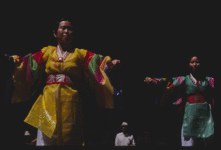
Civic Center Plaza Ethnic Dance Festival, Chicago, Illinois
Unknown artist
- Source:
- Library of Congress
- Rights:
- Public domain — free to use, share and adapt.
- Recorded as:
- Public Domain
This photograph documents the visible presence of classical Indian dance traditions in American public cultural space during the 1970s, a period when these forms were expanding their audience and institutional recognition in North America. For dance historians, it provides evidence of how classical Indian dance traditions were being presented, costumed, and performed for diverse audiences in mid-sized American cities, and captures the professionalization and visibility of South Asian performance traditions in the post-immigration-reform cultural landscape. For practitioners, it shows trained classical dancers bringing these forms to outdoor public festivals, establishing them as participatory elements of American multicultural celebration.
What you are looking at
A photograph captures a moment from a public ethnic dance festival at Civic Center Plaza in Chicago. The image shows multiple dancers in traditional or culturally-specific dress performing simultaneously on what appears to be an outdoor stage or plaza floor. In the foreground, a dancer in a vibrant yellow dress with red and gold decorative elements—likely South Asian in origin—strikes a dynamic pose with arms extended in a stylized frame, chest lifted, and legs in a strong stance. The dress's cut and the arm positions suggest classical Indian dance vocabulary. To the right, another performer in turquoise or teal clothing is visible mid-movement. The lighting is theatrical, suggesting evening performance, and the dark background emphasizes the brilliance of the costumes. The composition suggests multiple performance groups taking turns or performing in sequence, creating a vivid tableau of cultural celebration and dance traditions on display.
The dancing
The primary dancer in yellow demonstrates a strong, grounded frame with lifted torso, extended arms held in a stylized position, and an assertive upward gaze. The weight appears centered and stable, the chest open and expanded. This is formal, trained movement—not improvised or social. The dancer's body is fully engaged and facing a specific direction, suggesting a composed choreography rather than participatory or processional dance. A second figure in turquoise is similarly engaged and positioned, implying coordinated group performance. Both dancers maintain the lifted carriage and precise arm vocabulary characteristic of classical Indian dance techniques.
The dance depicted
The image most likely documents classical Indian dance—most probably Bharatanatyam or a related classical form such as Kathak or Kuchipudi—being performed as part of a public cultural festival celebrating ethnic diversity. The lifted frame, extended arm positions, the formal costume (particularly the structured yellow dress with traditional patterning), and the composed, frontal orientation all align with classical Indian dance training and presentation. The setting and context—an urban American plaza in 1977 during a dedicated ethnic festival—suggests this was part of the mid-to-late 1970s growth of classical Indian dance performance in North America, when these traditions were being actively presented to mainstream American audiences through community celebrations and cultural institutions. The dancers appear to be trained performers rather than cultural practitioners demonstrating folk or social forms.
How it was made
This is a photograph, most likely color slide film or professional color print stock typical of festival documentation in the 1970s. The depth of color saturation, the theatrical quality of the lighting (which appears to be deliberately positioned rather than natural), and the framing all suggest professional or semi-professional documentation of a public event. The photograph captures a split-second of live performance in what appears to be evening conditions, freezing the dancers in mid-gesture. The technical quality and composition suggest this image was made by a documenter with some knowledge of performance photography—the framing isolates the dancers effectively and the exposure captures both costume detail and the dancers' expressions.
About this work
This photograph documents a moment from Chicago's Civic Center Plaza Ethnic Dance Festival in July 1977, capturing classical Indian dancers—most likely performing Bharatanatyam—during what was a significant public celebration of cultural diversity in an American urban center. The image shows formally trained dancers in vibrant traditional costumes mid-performance, their bodies displaying the lifted carriage, extended arm vocabulary, and composed precision of classical Indian dance forms. It is a snapshot of a particular historical moment: the 1970s emergence of classical Indian dance as an established and publicly visible performance tradition in mainstream American cultural institutions. The festival context tells us this was not a private or traditional religious performance, but rather a deliberate act of cultural presentation and intercultural celebration in a major American city.
How to look at it
Attend to the dancer's body position and the precision of the arm and hand placement—this is not improvisation but trained, classical vocabulary. The lifted chest and forward gaze are not accidental but part of the formal presentation of classical Indian dance. Notice the costume construction: the structured bodice, the arranged fabric, the decorative elements—these are not adaptations of sari-wearing but formal costume for performance. The lighting and framing suggest this is a documented, valued performance moment, not a casual demonstration. The presence of multiple dancers in full costume, appearing to perform in turn or ensemble, tells us this was a major festival event requiring significant coordination and resources.
The period
The 1970s were a pivotal decade for classical Indian dance in North America. The Immigration and Nationality Act of 1965 had opened pathways for Indian artists to establish themselves in the United States, and by the mid-1970s, classical forms like Bharatanatyam—long marginalized in India itself during the independence and postcolonial period—were experiencing a significant revival both in India and among diaspora communities abroad. American cities with significant South Asian populations began hosting festival performances and establishing dance schools. Civic celebrations of 'ethnic' culture (a framing that would become more complex and contested in subsequent decades) positioned these traditions as markers of cultural heritage and diversity worth presenting to mainstream American audiences. The photograph captures this moment of institutional and public recognition.
Where it lives
The photograph comes from the Library of Congress collections (source: loc), likely from a documentation project of American cultural events or urban festivals. It was catalogued with minimal descriptive information, reflecting archival practices that often prioritized cataloguing efficiency over detailed contextual recording for non-Western performance traditions.
Dance in this work
Questions about this work
What dance form is being performed?
The costume, body carriage, arm positions, and formal presentation strongly suggest a classical Indian dance form, most likely Bharatanatyam. The lifted frame, extended arm vocabulary, and precise body positioning are characteristic of this tradition. Without additional documentation, the specific form cannot be stated with absolute certainty, but the visual evidence points clearly to classical rather than folk or social forms.
Why were ethnic dance festivals important in 1970s American cities?
The 1970s saw growing recognition of cultural diversity in American cities, and ethnic festivals became major public celebrations. For South Asian communities, these festivals provided platforms to present classical dance traditions to mainstream audiences and to transmit cultural knowledge to younger generations growing up in America. They also marked the arrival and establishment of South Asian diaspora communities in American urban centers.
How do I identify the specific classical Indian dance form?
While the image is consistent with Bharatanatyam in its formal presentation, costume structure, and body vocabulary, definitive identification would require additional documentation such as the festival program or the dancers' own records. Other classical forms like Kathak or Kuchipudi share some visual vocabulary, particularly in costume and formal presentation.
More dance artwork





