49 works in this view — arrow keys or swipe to move between them.
Dance in Art · 2024
The Nordic minuet : royal fashion and peasant tradition
Unknown artist
- Source:
- Library of Congress
- Rights:
- Public domain — free to use, share and adapt.
- Recorded as:
- Public Domain
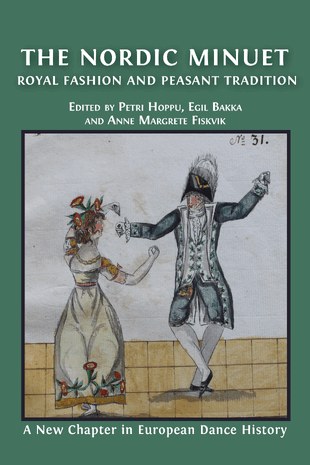
The minuet is one of the most documented dances in history, but images of its regional variants and the lived experience of courtly dancers are rarer. This engraving shows how a single dance form was negotiated across geography and class, and it provides concrete evidence of body position, arm frame, and the social distance maintained between partners during the opening of the dance. For dance historians and performers reconstructing historical minuets, this is a primary source for understanding Nordic court practice.
What you are looking at
A hand-colored engraving shows two dancers in a formal indoor setting with a checkered floor. On the left, a woman wears a simple pale linen dress with a fitted bodice and full skirt, her hair adorned with flowers and ribbons; she holds a small nosegay and gestures with one arm extended. On the right, a man in an elaborate coat with long skirts, embroidered waistcoat, and a tall cap performs with arms raised in an open, expressive pose. His posture is animated and his gesture suggests courtly refinement. The composition captures a moment of social dance rather than a rigid display—both figures seem engaged in conversation through movement, set against a neutral background that allows focus on their bodies and fashions.
The dancing
The woman stands with weight on one leg, her body held upright in the posture of refined society, one arm extended at the side in a gentle, inviting gesture while the other holds her flowers. The man faces her with both arms raised and spread wide in an open, embracing frame—the opposite of a close ballroom hold. His weight appears active and his upper body is engaged. The spatial relationship between them is moderate—close enough for conversation and eye contact, but not in contact. Both dancers occupy the full height of the frame and command equal visual attention.
The dance depicted
This is a minuet, one of the most important social dances of the 18th century, and likely depicts the moment before contact or during the opening salutation of the dance. The title emphasizes the Nordic and peasant tradition of the minuet, suggesting this image documents how the form was danced outside France—possibly in Scandinavian courts where both aristocratic refinement and folk adaptation coexisted. The woman's simple dress contrasts markedly with the man's elaborate court coat, suggesting a meeting or mixing of social classes or traditions. The open arm positions and the apparent lightness of the choreography are consistent with how the minuet was performed as a social conversation, not a close embrace.
How it was made
This is a hand-colored engraving, a technique that allowed for wide circulation in printed form during the 18th and early 19th centuries. The clean lines and careful anatomical rendering are characteristic of printmaking for dance instruction or fashion documentation. The hand coloring—evident in the woman's pale dress, the man's embroidered coat details, and the checkered floor—was applied after printing, which was typical for works intended for a wealthy or educated audience. The precision of the line work suggests this may have been produced for a dance manual, courtly documentation, or fashion plate series.
About this work
This engraving documents the minuet as it was performed in Nordic court circles, where French aristocratic form met local tradition. The image is part of the visual archive of how one of the most formal and codified dances of the ancien régime was adapted and danced outside France. The striking contrast between the woman's plain dress and the man's ornate court costume suggests that the 'peasant tradition' referenced in the title was not a folk practice but rather a simplification of courtly dress—a deliberate choice to show how the minuet could be danced by people of different social standing or in different regional contexts. The animated poses and open arms capture the minuet not as a stiff, museum display but as a living social practice, a moment of flirtation and courtesy performed in shared space.
How to look at it
Notice the moment the artist chose: not mid-dance but the opening salutation, where the minuet's social character—the polite distance, the exchange of courtesy—is most visible. The woman's modest dress and the man's ostentatious coat are not accidental; they are central to what the print claims to show about regional adaptation. Attend to the arm positions: open, not clasped, allowing each dancer to move independently and to see each other's faces. The checkered floor is not merely setting but a technical aid, used in dance instruction manuals to suggest spatial relationships and floor patterns.
The period
The minuet was the dominant social dance of European courts from the mid-17th through the late 18th century. By the time this image was made, the minuet had become a standardized, highly codified form taught to aristocratic children as a marker of gentility. However, the late 18th and early 19th centuries saw increasing interest in documenting regional variations and in the idea that folk traditions and courtly refinement could be productively mixed—a theme that appears in the Romantic era's fascination with 'natural' elegance and national character. Hand-colored engravings of dance figures were popular both as fashion plates and as instructional aids, circulating among the dancing masters and nobles who needed to master these forms.
Where it lives
The source is listed as loc (Library of Congress). This appears to be a print from a larger instructional or documentary series on court dances, likely from the late 18th or early 19th century.
Dance in this work
Questions about this work
What is a minuet and why does it matter?
The minuet was the most important social dance of the European aristocracy from the 1650s to the 1790s. It was taught to all noble children as a fundamental mark of refinement and was danced at every court function. It mattered because mastery of the minuet signaled education, breeding, and social standing. By the late 18th century, dancing masters across Europe had standardized the form, but regional variations persisted—this image documents one such variation.
Why does the title mention 'peasant tradition'?
The title likely refers to simplified or regionally adapted versions of the court minuet that incorporated local elements or were danced by people outside the highest aristocracy. This was part of a broader Romantic-era interest in how refined courtly forms could exist alongside folk practice. The woman's plain dress may represent a deliberate choice to show the minuet performed in a less ornate style than the French court standard.
What do the arm positions tell us?
The open, raised arms and lack of hand-hold indicate this is the opening salutation or début of the minuet, before the dancers came into contact. This moment was crucial for demonstrating courtesy and establishing the social tone of the dance. The frame allowed each dancer to move independently and maintain eye contact, which was central to the minuet's function as a courtship ritual.
How is this different from a waltz?
The waltz, which became dominant in the early 19th century, involves a close hold and turning rotation. The minuet is a processional, walking dance with small, controlled steps and frequent pauses. The dancers maintain moderate distance and face each other or move parallel to the audience. The waltz emerged as the minuet was declining, representing a shift from formal courtesy to physical closeness and continuous motion.
More dance artwork





