49 works in this view — arrow keys or swipe to move between them.
Dance in Art
Urban Social Dance, Jamaica Fieldwork
Unknown artist
- Source:
- Library of Congress
- Rights:
- Public domain — free to use, share and adapt.
- Recorded as:
- Public Domain
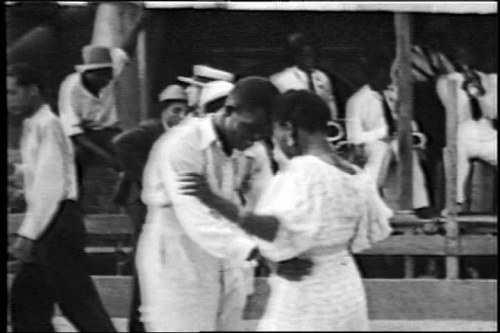
This is primary documentation of Jamaican vernacular social dance practice, a crucial corrective to theatrical and competitive models that dominate dance archives. It shows that couple-dancing in Jamaica in this period was neither exotic spectacle nor formalized technique, but an intimate, community-embedded social practice. For historians of Caribbean dance and diaspora-afro-popular tradition, this photograph is evidence of continuity and adaptation in social courtship and celebration dance.
What you are looking at
A black-and-white photograph captures an outdoor social dance scene, likely from mid-20th-century Jamaica. Two couples occupy the center frame in close embrace, their bodies pressed together in an intimate hold. The dancers wear light-colored clothing—white shirts and dresses—appropriate to a tropical climate. Surrounding them stand numerous onlookers in similar dress, creating a dense social gathering. The setting appears to be outdoors in daylight, with vertical wooden posts or poles visible in the background, suggesting a community space, market area, or informal public venue. The photograph is grainy and high-contrast, typical of documentary fieldwork photography of the era.
The dancing
The central couple stand in a closed ballroom-style frame with bodies in close contact and arms positioned in an embrace. A second couple visible to their left mirrors this hold. The dancers' posture suggests a steady, grounded movement rather than high-energy motion—weight appears centered and stable. The density of spectators and the informal outdoor setting suggest this is participatory social dancing rather than performance. The intimacy of the holds and the gathering of onlookers indicate courtship or celebration dancing was a communal activity.
The dance depicted
This appears to be a rural Jamaican social dance, most likely a form of couple dancing within the diaspora-afro-popular or specialty-club-latin tradition. The close embrace, the outdoor community setting, and the era suggest this could be a Jamaican variant of social couple dances such as dancehall's precursors or a form of quadrille-based social dancing that persisted in rural Jamaica. The photograph documents lived social practice rather than performance, showing how dancing functioned as courtship and community gathering in mid-20th-century Jamaica.
How it was made
This is a black-and-white photograph, likely taken as part of ethnographic or anthropological fieldwork documentation. The grainy quality, high contrast, and composition suggest professional documentary photography from approximately the 1950s–1970s. The medium's capacity to capture candid social activity in natural light made it ideal for capturing vernacular dance practices that formal theater documentation would miss. Such photographs were typically produced for academic archives rather than mass publication, limiting their circulation to specialist audiences.
About this work
This photograph documents a moment of social dance in rural Jamaica, showing couples in close embrace surrounded by community members. It is a rare visual record of how couple dancing functioned as participatory social practice in Caribbean life, distinct from both staged performance and competitive ballroom dancing. The image belongs in a gallery about dance because it captures the lived social and courtship contexts in which most human beings actually dance—not on stages, but in community spaces where dance marks celebration, connection, and cultural continuity.
How to look at it
Note the formality of the dancers' embrace despite the informal outdoor setting—this suggests a codified social dance form, not improvisation. Attend to the onlookers' proximity and engagement: they are not distant spectators but participants in the social moment, suggesting this is not performance but communal participation. The photograph freezes a steady moment in the dance cycle rather than a dramatic peak, suggesting the sustained close connection of the dance was itself the point, not spectacle or virtuosity.
The period
This photograph was made during the mid-to-late 20th century, a period when ethnographic and anthropological fieldwork photography became a standard practice for documenting vernacular culture. In Jamaica specifically, this was a period of post-independence cultural documentation and growing academic interest in Creole and folk traditions. The photograph predates or is contemporary with the international rise of dancehall and reggae, yet shows how couple dancing and community gathering through dance remained central to rural Jamaican social life.
Where it lives
This photograph is held by the Library of Congress and is identified as part of Jamaica fieldwork documentation. It belongs within ethnographic and anthropological photography archives rather than fine art collections, though it has significant value as both historical document and visual art.
Dance in this work
Questions about this work
What dance is this?
The photograph documents social couple dancing in rural Jamaica, likely from the mid-20th century. The specific style name is not recorded, but the close embrace, community setting, and era suggest a form within the Caribbean social dance tradition, possibly related to quadrille adaptations or early dancehall-era social forms. Without additional documentation or oral history, the precise local name remains uncertain.
Why were people dancing outside in such close groups?
This appears to be a community gathering or celebration where social dancing was participatory entertainment. The density of onlookers and the formal coupling suggests a courtship or festival context where dancing marked social bonding and romantic connection. In rural Caribbean communities, such gatherings often took place in public outdoor spaces because they were communal events, not private entertainment.
Is this professional dance or folk dance?
This is neither—it is vernacular social dance, a living practice embedded in everyday social and courtship life. It is not choreographed performance or theatrical presentation, nor is it formally taught tradition like ballet or classical forms. It represents how ordinary people in a particular time and place danced together in their own communities.
More dance artwork





