49 works in this view — arrow keys or swipe to move between them.
Dance in Art · 1912
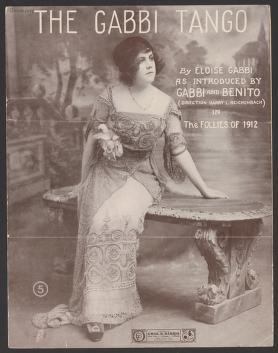
The Gabbi tango
Unknown artist
- Source:
- Library of Congress
- Rights:
- Public domain — free to use, share and adapt.
- Recorded as:
- Public Domain
This image is valuable evidence of how tango was packaged and sold to audiences in the crucial moment of its international emergence (1912). It shows the visual codes of tango performance—the fashionable dress, the sophisticated bearing—that made the dance both desirable and transgressive to Western audiences, and it illustrates the commercial and promotional infrastructure of theatrical dance in the early twentieth century.
What you are looking at
A woman in an elegant white lace dress sits at a small decorative table, her body turned to face the viewer in a composed three-quarter pose. The dress is fitted at the bodice and hips, with elaborate lace detailing throughout and a full skirt that extends to her ankles, typical of 1912 fashion. She wears long gloves and has her hair styled in the Gibson Girl manner of the era. Behind her stands a large decorative urn or vase on a pedestal. The lighting is soft and theatrical, creating a pale, ethereal quality characteristic of early photographic or rotogravure printing. The setting appears to be an interior room, though the background remains muted and undefined, focusing attention on the elegantly dressed figure.
The dancing
The dancer is seated rather than standing, with her torso upright and her gaze directed toward the viewer with a poised, dignified expression. Her arms are positioned gracefully, with one hand resting near her lap and the other positioned to suggest ease and elegance. The pose suggests a moment of repose rather than active dancing—this is a portrait of a performer in her theatrical costume rather than a representation of movement in progress. The entire composition emphasizes stillness, decorum, and the presentation of fashionable elegance.
The dance depicted
This appears to be a theatrical photograph or promotional print rather than a depiction of active dance. 'The Gabbi Tango' is listed as the title, suggesting this is a performer known as Gabbi who was famous for tango dancing in 1912. However, no actual dancing is shown; instead, this is a posed studio portrait of the performer in costume. The tango was at the height of its international popularity in 1912, and such portrait prints were common marketing materials for famous dancers. The elegant, sensuous dress and poised bearing suggest the glamour associated with tango performance in the early twentieth century, though the seated pose does not show the characteristic embrace, frame, or movement of tango itself.
How it was made
This is a photographic print, most likely a rotogravure or similar photomechanical reproduction process that would allow mass production for theatrical promotion and sale to the public. The soft tonal gradations and the mode of printing are consistent with early twentieth-century theatrical publicity photography. The technique allowed for rapid, affordable distribution of images of celebrated performers to fans and theater audiences, making this a document of how dance celebrities were marketed and consumed in the early 1900s. The Library of Congress cataloging suggests this is part of their theatrical ephemera collections.
About this work
This is a 1912 theatrical portrait of a performer associated with tango dancing, presented as a photographic promotional print rather than an action image. It documents both the fashion and the cultural status of tango in the early twentieth century, when the dance was scandalizing and fascinating European and North American audiences in equal measure. The image testifies to the star system and commercial apparatus of theatrical dance during this period—performers like Gabbi were marketed through glamorous costume photographs sold to the public much as film stars would be a decade later.
How to look at it
Attend to the costume and styling as evidence of early twentieth-century tango fashion: the elaborate lace, the fitted silhouette, the gloves, and the Gibson Girl hair all signal theatrical sophistication and a vision of tango as elegant rather than scandalous. Note that the performer is seated and static—this is a portrait, not an action image. The soft photographic technique and pale tones create an aesthetic of glamour and distance that emphasizes the celebrity and mystique of the performer rather than the embodied technique of the dance.
The artist
The artist is not recorded. This is a mass-produced theatrical photograph, likely made by a commercial studio photographer in Europe (possibly Paris or Buenos Aires, the two centers of tango performance at this time). Such images were standard products of the theatrical industry, created and distributed by theaters and by the performers themselves.
The period
Tango emerged from the working-class dance halls of Buenos Aires in the 1880s and 1890s and began its explosive international spread around 1912, the exact date of this print. By 1912, tango was the sensation of Paris, London, and New York, though it was often condemned as immoral and sexually transgressive. Simultaneously, the theatrical world was becoming increasingly visual and star-driven; celebrated performers like the dancer Vaslav Nijinsky were making their names partly through photographic publicity. This portrait belongs to that moment when photomechanical reproduction allowed mass distribution of images of dance celebrities.
Where it lives
This is part of the Library of Congress collections, cataloged as theatrical ephemera from the early twentieth century. It is a mass-produced promotional print, likely sold at theaters or through fan networks.
Dance in this work
Questions about this work
Is Gabbi shown actually dancing?
No. This is a posed portrait photograph, not an action image. Gabbi is seated in an elegant costume, presented as a glamorous theatrical celebrity rather than captured in the act of dancing. Such static promotional portraits were standard ways of marketing star performers in the early twentieth century.
What does this tell us about tango in 1912?
This image shows tango as an international sensation associated with sophisticated fashion and theatrical glamour. The elaborate dress and elegant bearing signal that tango was being repackaged for upper-class and bourgeois audiences in Europe and North America, even though the dance originated in working-class Argentine dance halls. The existence of such mass-produced promotional prints testifies to tango's commercial power at the moment of its emergence as a global phenomenon.
Why doesn't the record have more information?
This is a mass-produced commercial print. The Library of Congress and similar institutions hold thousands of such objects, many with minimal documentation. Unless the performer Gabbi was internationally famous enough to be recorded in theatrical histories, much of her biographical information may be lost.
More dance artwork





