49 works in this view — arrow keys or swipe to move between them.
Dance in Art · 1920
Demons
Unknown artist
- Source:
- Library of Congress
- Rights:
- Public domain — free to use, share and adapt.
- Recorded as:
- Public Domain
This sketch is a rare window into early 20th-century theatrical dance practice at the moment of creation. It shows how a designer or choreographer thought about movement in space—the relationship between individual bodies and a collective composition. The expressionistic style and supernatural subject matter connect it to the modernist dance ferment of the 1920s, when artists were actively reimagining what dance could represent and how it could be drawn.
What you are looking at
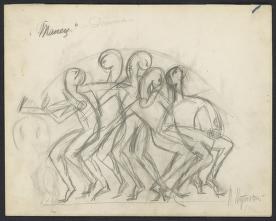
A sketch in graphite of five figures in rapid, gestural motion, arranged in a loose diagonal composition across the page. The figures are drawn with elongated, sinewy limbs and appear to be moving in unison or in related trajectories, their bodies twisting and tilting at sharp angles. The linework is economical and loose, suggesting movement rather than defining it precisely; the artist has used minimal cross-hatching and no background detail. The title "Demons" inscribed at upper left in cursive suggests these are not human dancers but supernatural or theatrical creatures. The sketch has the character of a study or working drawing—the kind a theatre designer or painter would make to explore a compositional idea or to capture an impression of movement before refining it.
The dancing
Five figures with exaggerated proportions: long, spindly legs and torsos that arch, bend, and writhe. Their arms are either raised or extended, framing bodies that lean away from vertical. The limbs interweave; some figures appear to be reaching or gesturing toward one another, while others seem to turn inward on themselves. There is no formal partnering or ballroom frame visible. Instead, the dominant quality is of isolated yet synchronized movement—each figure occupies its own space while participating in a collective action. The weight appears to shift and sway rather than to settle; very little appears grounded.
The dance depicted
The work most likely depicts a theatrical or fantastical dance—a group choreography for stage performance rather than a social or folk form. The exaggerated anatomy, the supernatural framing (the title 'Demons'), and the stylized movement all point toward early 20th-century modernist theatre, possibly a ballet or experimental dance production. The lack of recognizable hold or step vocabulary, combined with the emphasis on torsional and gestural movement, suggests a contemporary or expressionist idiom rather than classical ballet, though the theatrical context is unmistakable. Without further documentation or identification of the source, the specific production and choreographer remain uncertain.
How it was made
Graphite sketch on paper, executed with fluid, economical line work. The artist employed light cross-hatching in places to suggest volume and shadow, particularly around the torsos and limbs. The sketch is unfinished in the academic sense—there is no background, no careful rendering of anatomy, and no fine detail. This is the working language of a theatre designer or choreographer's notebook: quick, exploratory, and focused on capturing the essential gesture and composition rather than the illusion of three-dimensional form. The technique implies this was made during or immediately after observing or imagining a choreographic sequence.
About this work
This is a sketch from the early 20th century, likely by a designer or artist associated with a theatre or ballet company, documenting a group dance composition titled 'Demons.' The five figures are rendered in an economical modernist idiom that prioritizes movement and emotion over anatomical precision. The work sits at the intersection of theatre design, choreographic notation, and drawing practice—a moment of creative capture before rehearsal, performance, or revision. It belongs in a dance archive not as a finished artwork intended for exhibition, but as evidence of how choreographic ideas were conceived and communicated in the studio and on the page.
How to look at it
Note the diagonal flow of the composition: no figure is vertical or at rest. Observe how the limbs of one figure almost touch or echo those of its neighbors, creating a sense of rhythmic unity without physical contact. Pay attention to the economy of line—the artist conveys weight, direction, and energy through minimal means. The sketch asks you to read movement as much as form: your eye follows the implied trajectory of each body, completing the gesture that the line suggests. This is the grammar of early modernist dance drawing, which valued suggestion and synthesis over anatomical completeness.
The period
The early 1920s were a period of intense formal and thematic innovation in European theatre and dance. Expressionist and modernist movements were challenging classical ballet conventions, drawing on primitivism, folklore, and psychological drama. Choreographers like Mary Wigman and German Expressionist dancers were exploring contorted, emotionally charged bodies; simultaneously, the Ballets Russes were commissioning avant-garde designers to reimagine theatrical spectacle. A sketch of 'Demons' from 1920 sits squarely in this ferment. The modernist line style and the emphasis on expressive rather than virtuosic movement reflect the era's preoccupation with the body as a vehicle for emotional or supernatural truth rather than formal perfection.
Where it lives
The work is held in the Library of Congress and catalogued as a sketch with the title 'Demons' and a date of 1920. No artist name is recorded, and no medium designation appears in the catalogue.
Dance in this work
Questions about this work
Is this a finished drawing or a sketch?
It is a working sketch—the kind a choreographer or theatre designer would make to explore composition and movement. The loose linework, absence of background, and lack of anatomical refinement are all characteristic of sketch practice rather than a finished artwork for exhibition or reproduction.
What dance style is this?
The style is not a recognizable ballroom, folk, or classical ballet form. Instead, it appears to be a modernist theatrical or expressionist dance—likely a composition for a stage production rather than a social or traditional dance.
Why are the figures drawn so distorted?
The exaggeration emphasizes movement and emotion. Early 20th-century modernist artists deliberately departed from naturalism to convey psychological or supernatural states. The title 'Demons' signals that these are not ordinary humans but theatrical characters, and the distorted anatomy reinforces that otherworldly quality.
Could this be a study for a larger painting or print?
Possibly, but there is no evidence in the record of a finished work. It is more likely a sketch made to work out choreographic or compositional ideas, the sort of thing a designer would discard or keep in a studio archive rather than formally complete.
More dance artwork





