49 works in this view — arrow keys or swipe to move between them.
Dance in Art · 1971
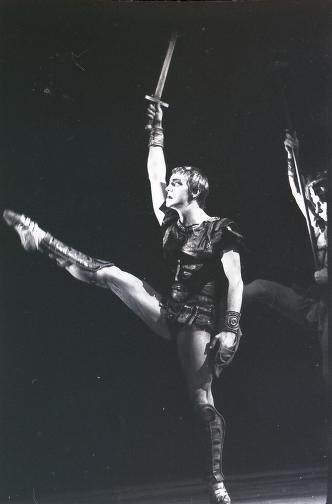
Maris Liepa's Main Role.
Unknown artist
- Source:
- Library of Congress
- Rights:
- Public domain — free to use, share and adapt.
- Recorded as:
- Public Domain
Maris Liepa was a leading Soviet ballet dancer of the mid-20th century, and this photograph documents him in a role for which he was celebrated. The image provides rare visual evidence of how classical male technique and dramatic presence were executed and valued in Soviet ballet during this period, and captures a specific aesthetic of male ballet heroism.
What you are looking at
A male dancer in a dramatic leap dominates the frame, captured mid-air against a dark background. He wears a dark sleeveless tunic or tank top and dark tights or leg coverings, with what appears to be a decorative belt or harness at the waist. His right arm is raised high, holding aloft a sword or blade that catches the light. His left leg is extended upward in a high, controlled extension while his body arches with considerable athleticism. The pose suggests a moment of triumph or combat—the raised sword and elevated leg creating a dynamic silhouette. A second figure is partially visible on the right edge of the frame, suggesting this is part of a staged performance. The lighting is stark and theatrical, with the dancer's body emerging sharply from darkness.
The dancing
A single male dancer occupies the center, executing a controlled leap with exceptional height and extension. His right arm is fully extended upward, gripping a blade; his left leg extends high in a grand battement or développé. The torso is slightly arched, the supporting leg beneath him though the angle suggests significant airtime. The musculature and line of the body suggest trained classical technique, with clean extension and control. A second dancer appears at frame right, out of focus, indicating ensemble or partnered choreography.
The dance depicted
This is ballet, almost certainly from a classical or neoclassical male solo. The raised sword, the dramatic leap, and the costume suggest a warrior or hero role—possibly from a classical narrative ballet such as Don Quixote, La Bayadère, or another work featuring a male demi-caractère or premier danseur role. The title 'Maris Liepa's Main Role' indicates this documents a specific celebrated dancer in a signature role. The technical demand—the height, the extension, the control while wielding a prop—indicates this is a principal dancer's showcase. Without identification of the specific ballet, the style remains unconfirmed, but the classical technique and theatrical context are clear.
How it was made
This is a black-and-white photograph, likely professional stage or publicity documentation. The dramatic lighting and sharp focus on the dancer's body suggest it was taken during performance or a formal photo shoot in a theater setting. The high contrast and grain are consistent with mid-20th-century photographic practice. Photography allowed this moment of peak extension to be captured and preserved in a way no other medium could, making it an invaluable record of how this role was danced at this moment in time.
About this work
A black-and-white photograph of a male ballet dancer in mid-leap, sword raised, captured during what the record identifies as 'Maris Liepa's Main Role.' The image documents a moment of classical ballet technique at its most virtuosic, freezing in time a pose that demonstrates the strength, extension, and dramatic presence required of a principal male dancer in Soviet-era ballet. This is both a theater document and a portrait of a specific dancer in a moment of performance mastery.
How to look at it
Observe the extreme extension of the left leg and the height of the leap—this is the peak moment the photographer chose, when the dancer appears most weightless despite the sword's weight. Notice how the raised blade becomes part of the composition, creating a vertical line that emphasizes the lift and aspiration of the pose. The dark costume against dark background makes the body's line the sole focus; this was a deliberate choice in theatrical photography of the era, isolating the dancer's form for maximum clarity.
The artist
The photographer is not recorded in the catalogue. The image originates from the Library of Congress and is labeled as having unknown era and creator details. It appears to be professional stage photography, possibly from a Soviet ballet company's documentation archive.
The period
This photograph dates to 1971, a period when Soviet ballet was at an international peak of prestige and technical excellence. Maris Liepa danced with the Bolshoi Ballet and was known for his dramatic intensity, clean technique, and commanding stage presence. Male roles in classical ballet of this era emphasized both virtuosic technique and theatrical characterization—this leap with sword exemplifies that dual demand. The photograph reflects Cold War-era ballet culture, when Soviet dancers were celebrated internationally and their performances were meticulously documented.
Where it lives
The image is held by the Library of Congress and catalogued in LODance. It is labeled as having unknown era of origin and unknown creator, though it is dated 1971-01-01 in the record. It represents the Library of Congress's holdings of performance photography from the Soviet ballet tradition.
Dance in this work
Questions about this work
Who was Maris Liepa?
Maris Liepa (1936–1989) was a Soviet ballet dancer with the Bolshoi Ballet, celebrated for his dramatic presence, clean technique, and commanding performances in classical and contemporary roles. He was a leading male dancer of his generation and performed internationally during the height of Soviet ballet's prestige. He was known for roles in classical ballets and for his work with choreographer Yuri Grigorovich.
What role is this from?
The record identifies this only as 'Maris Liepa's Main Role,' without specifying which ballet. Based on the costume (warrior-like tunic) and the raised sword, it is likely from a classical narrative ballet such as Don Quixote, La Bayadère, or a similar work, but the specific ballet cannot be confirmed from the image alone.
Why document ballet photography in the 1970s?
Theater photography in this era served multiple purposes: creating records of performances for posterity, producing publicity and promotional images, and documenting the technical achievements of celebrated dancers. For Soviet institutions, this was also part of official cultural documentation. The dramatic lighting and isolated composition of this image suggest it was a studio or stage shot intended for publication.
More dance artwork





