49 works in this view — arrow keys or swipe to move between them.
Dance in Art · 1962
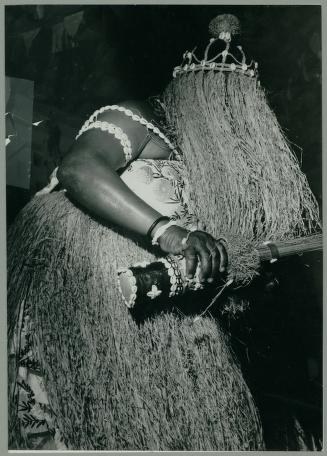
Candomblé in Bahia (Brazil) Omolú Daughter.
Unknown artist
- Source:
- Library of Congress
- Rights:
- Public domain — free to use, share and adapt.
- Recorded as:
- Public Domain
This photograph provides rare documentary evidence of African diasporic religious movement in Brazil during a period when such practice was criminalized or erased from official record. It demonstrates that to understand African diasporic dance is to understand religious ecstasy, costume, and possession—not stage movement divorced from spiritual context. The image asks viewers to recognize sacred trance and adornment as forms of dance equally worthy of study as theatrical forms.
What you are looking at
A black-and-white photograph captures a moment of intense spiritual ritual and embodied movement. A figure dominates the frame, their torso bare except for a thick collar or circular adornment around the neck and a wide band around the upper arm or shoulder. The body is wrapped or surrounded by voluminous dried grasses, raffia, or similar natural fiber material that rises dramatically upward, creating a sculptural silhouette. The head is crowned with or emerges from these fibers. The figure's arm extends forward with hand visible and clearly articulated. The texture and scale of the fibrous material suggest costume-making as a sacred practice. The photograph is tightly framed and dramatically lit, with strong contrast between the bare skin and the pale, shredded material. The setting and props indicate ritual rather than theatrical spectacle—this is documentary evidence of lived spiritual practice.
The dancing
A single figure is central, with visible musculature and dark skin contrasting sharply against the pale fibers. The body is upright and engaged; the extended arm and visible hand position suggest active gesture or blessing rather than passive display. The weight appears grounded. The costume—the fiber mass and metal adornments—transforms the figure into something beyond human scale, appropriate to possession or deity representation. The photographer has chosen an angle that emphasizes the figure's agency and presence rather than treating the costume as mere object.
The dance depicted
This is almost certainly documentation of Candomblé ritual in Bahia, Brazil, as stated in the title. The title's reference to 'Omolú Daughter' (Omolú being a major orixá, or divine force, in Candomblé) indicates this depicts either a devotee possessed by or embodying that orixá, or a ritual specialist in the ecstatic trance states central to Candomblé practice. The fibers and regalia are characteristic of orixá manifestation. While Candomblé involves rhythmic movement, song, and trance-induced motion, this photograph captures a moment of presence and adornment rather than active dance—yet the distinction between static ritual pose and dance in African diasporic religious practice is fluid. The body's readiness and the gestural language suggest imminent or ongoing movement.
How it was made
This is a black-and-white photograph, likely taken in situ during an actual religious ceremony rather than posed in a studio. The dramatic lighting and tight framing suggest documentary or ethnographic photography practice of the early 1960s, though the aesthetic suggests artistic intention as well as archival purpose. The photograph's strong contrast and compositional focus elevate it beyond simple documentation. The medium—camera as witness—allowed capture of a sacred moment that would otherwise remain invisible to outsiders, though the ethics of that capture are not transparent from the image alone.
About this work
This photograph documents a moment in Candomblé, the Afro-Brazilian religious tradition that synthesizes Yoruba veneration of orixás with Catholicism and indigenous Brazilian practice. Taken in Bahia in 1962, it records the embodied, costumed presence of a devotee in ritual. Candomblé, outlawed or suppressed throughout much of Brazilian history, centered sacred trance, collective music and movement, and the material culture of possession. This image is evidence of spiritual practice as dance practice—the body adorned, activated, and situated within a community of ritual specialists and celebrants. The photograph belongs in a dance archive because Candomblé does not separate sacred movement from sacred dress, music, or trance; all are unified in the orixá's manifestation.
How to look at it
Attend to the figure's composure and presence within the costume rather than the spectacular quality of the fibers. Note the hand gesture—extended, articulate, intentional—which suggests agency and spiritual authority. Observe how the body carries the costume as part of itself rather than wearing it as a separate object. The photograph freezes a moment of readiness or manifestation, not dynamic movement, yet the figure's alertness and the ritual context make stillness itself a form of embodied practice. The tight framing forces focus on the individual body; the absence of visible community or musicians makes the solitary figure's inner state—not choreographed action—the subject.
The period
In 1962, Candomblé was experiencing both increased repression and growing visibility in Brazil. The religion, which had been practiced covertly and mixed with Catholic saints' veneration as a survival strategy, was gaining academic and artistic attention. The photograph dates to the early era of serious ethnographic documentation of Afro-Brazilian religious practice, before the cultural reclamation and legal recognition that would gradually follow. Simultaneously, Brazilian modernism was beginning to celebrate rather than suppress African-derived cultural forms. In global dance history, this moment precedes the widespread recognition of non-Western movement systems in academic discourse.
Where it lives
The photograph is held in the Library of Congress. Its source and original photographer are not recorded in the available catalogue information. It belongs to documentary and ethnographic photography collections, likely gathered as visual evidence of cultural practice rather than as fine art.
Dance in this work
Questions about this work
What is Omolú in Candomblé?
Omolú (also Obaluaiyê) is an orixá associated with disease, healing, and the earth. In Candomblé ritual, devotees may be possessed by or embody orixás, taking on their characteristics, movements, and power. An 'Omolú Daughter' would be a female devotee particularly associated with this orixá—either through initiation lineage or through possession during ceremony.
Is this dance?
In the Western concert tradition, no—the photograph captures a moment of stillness and adornment. In Candomblé practice, yes: sacred movement includes possession trance, rhythmic embodiment, and the ecstatic states that precede and follow visible motion. The photograph documents the spiritual technology of which dance is a part, even if no active movement is visible in this frame.
Why photograph sacred ritual?
By the 1960s, Candomblé was increasingly studied by anthropologists and documented by photographers. These images served multiple purposes: anthropological record, artistic documentation, and—later—cultural preservation and reclamation. The ethics of documenting secret or sacred practice without full consent remain contested; this photograph is evidence of that history.
What are the fibers?
The material is likely raffia, straw, dried palm fibers, or similar natural materials used in Candomblé regalia to represent the orixá's presence and to transform the devotee's appearance. Such costumes are sacred objects, prepared through ritual, not merely decorative.
More dance artwork





