49 works in this view — arrow keys or swipe to move between them.
Dance in Art · 1980
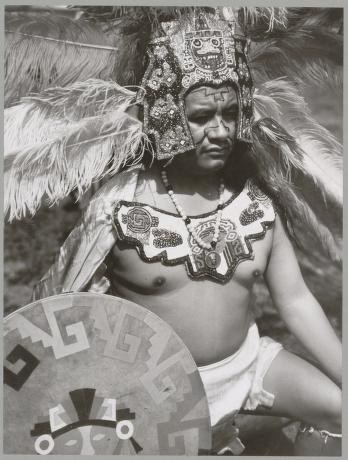
Oaxacan Feather Dancer.
Unknown artist
- Source:
- Library of Congress
- Rights:
- Public domain — free to use, share and adapt.
- Recorded as:
- Public Domain
The feathered headdress and geometric regalia are iconic markers of Oaxacan indigenous identity and ceremonial performance, representing continuity of pre-Columbian visual traditions into contemporary practice. For dancers and choreographers, the image documents a historically significant costume vocabulary that has influenced Mexican dance and performance aesthetics. For historians, it is evidence of how indigenous dance traditions were photographed and preserved as cultural artifacts during a period of increasing interest in ethnographic documentation.
What you are looking at
A male dancer stands facing the camera in a frontal pose, his body bare-chested and painted or costumed in geometric patterns rendered in black and white. He wears a white loincloth or brief at the hip. Most striking is his headdress: an elaborate feathered crown of immense proportions, rising high above his head with layered white feathers arranged in a radiating fan or wings effect. The feathers appear natural and have been carefully arranged to create architectural volume. He also wears an ornate pectoral or chest piece with intricate geometric designs—possibly embroidered or appliquéd cloth—that covers his torso below the shoulders. In his left hand (viewer's right) he holds what appears to be a decorated shield or circular object with geometric patterning. The photograph is in black and white, shot against a plain background with even lighting that emphasizes the sculptural quality of the costume and the geometry of the body paint and regalia.
The dancing
A single male dancer is captured in a vertical, frontal stance with feet planted and weight evenly distributed. His posture is upright and composed, arms positioned to display the costume elements—the left arm slightly raised to present the shield-like object. The body is spare and athletic, with defined musculature visible on the chest and shoulders. The gaze is direct and forward, giving the image a formal, presentational quality rather than a narrative or kinetic moment. The entire composition emphasizes verticality and symmetry, framing the dancer as a static sculptural form rather than mid-movement.
The dance depicted
This is a feathered dancer costume from the Isthmus of Tehuantepec region of Oaxaca, Mexico, associated with indigenous Zapotec or Mixe ceremonial and celebratory dances. The spectacular feathered headdress is characteristic of traditional Oaxacan festival wear and appears in ceremonial contexts and sometimes in social dances performed during community celebrations. The geometric body paint, the shield, and the pectoral ornament all conform to the visual language of Mesoamerican indigenous dance dress. The photograph documents the costume in presentation stance rather than capturing active movement, making it difficult to determine the specific kinetic vocabulary, but the regalia itself signals sacred or ceremonial purpose. Without additional context, the specific dance form cannot be narrowly identified, though the costume vocabulary places it within global-americas-indigenous traditions.
How it was made
This is a black and white photograph, likely dating to the 1980 date in the catalogue record based on photographic stock and printing characteristics. The image appears to be a professional documentation photograph, possibly from an ethnographic or cultural survey. The even studio lighting, neutral background, and frontal pose all suggest this was shot for the purpose of recording and preserving costume and regalia detail—a common practice in mid-to-late 20th-century anthropological and cultural documentation photography. The clarity and detail visible in the geometric patterns and feather arrangement indicate a well-executed studio or field photograph using quality equipment.
About this work
This photograph documents a male dancer in full ceremonial or festival regalia from Oaxaca, Mexico, specifically featuring the iconic feathered headdress associated with Oaxacan indigenous celebratory dance traditions. The image is a studio record of costume in presentation stance, emphasizing the sculptural and ornamental elements of the dress rather than capturing movement or narrative. It belongs in a dance history collection as evidence of the visual culture and material practices of Mesoamerican indigenous dance traditions, and as documentation of how these performances were visually recorded in the late 20th century.
How to look at it
Attend first to the feathered headdress: observe how the feathers radiate outward and upward, creating a massive architectural structure that transforms the dancer's silhouette. Notice the geometric body paint on the torso—the patterns appear to represent specific iconographic designs rather than abstract decoration. Look at the pectoral ornament: it reads as worked cloth, possibly embroidered, with a distinct visual language of its own. The shield or circular object in the dancer's hand suggests this costume is associated with dance forms that incorporate held objects and props. The formal, presentational pose reflects documentation photography practice; imagine this costume in motion to grasp its full visual impact.
The period
By 1980, indigenous dance traditions in Mexico had become subjects of both academic ethnographic study and nationalist cultural preservation efforts. The photograph likely reflects a documentary impulse to record traditional dress and regalia before perceived loss or change. Oaxacan dance and costume traditions had become more visible to international audiences through cultural tourism and academic interest in Mesoamerican performance. The formal studio presentation of the costume—rather than a photograph of the dance in action—reflects mid-20th-century ethnographic photography conventions, which prioritized clear, detailed documentation of material culture over kinetic documentation.
Where it lives
The work is held by the Library of Congress and sourced from their collections. It is catalogued as a photograph, likely part of a larger documentation project or collection on Oaxacan or Mexican indigenous culture.
Dance in this work
Questions about this work
What is the feathered headdress made of?
The headdress appears to be constructed from natural feathers, likely from large birds indigenous to Mexico such as eagles, quetzals, or macaws. The feathers are arranged in a radiating fan or wing-like structure and attached to a foundation (likely of basketry, cloth, or wood) that sits on the dancer's head. The scale and intricacy suggest considerable skill in construction and considerable value to the wearer.
Is this a male or female dance?
The figure is male, and Oaxacan feathered headdress dances are typically performed by men. However, Oaxaca has rich traditions of both male and female dance performance, and women perform other important ceremonial and social dances.
When and where would this costume be worn?
Feathered headdress costumes are worn during important community celebrations, festivals, and ceremonial occasions in Oaxaca, particularly in the Isthmus of Tehuantepec region. These can include Guelaguetza (a major cultural festival), regional celebrations, and other festive gatherings. The costume signals the wearer's participation in community ritual and celebration.
What do the geometric patterns represent?
The geometric patterns appear to be traditional iconographic designs with roots in Mesoamerican visual language, though without additional documentation it is difficult to specify their exact meaning. Such patterns often relate to cosmological, spiritual, or social significance within the community.
More dance artwork





