49 works in this view — arrow keys or swipe to move between them.
Dance in Art · 1894
Imperial Japanese dance
Unknown artist
- Source:
- Library of Congress
- Rights:
- Public domain — free to use, share and adapt.
- Recorded as:
- Public Domain
This photograph documents the aesthetics and staging conventions of how Japanese classical dance was presented to Western audiences in the 1890s—a period when such performances were novel and influential. It shows the deliberate, sustained gestural language characteristic of Nihon buyo or kabuki, which differs fundamentally from Western ballet in its emphasis on controlled, sculptural arm positions and facial composure. For dance historians and theatre historians, the image is evidence of cultural translation and the emergence of 'world dance' as a theatrical category in the late 19th century.
What you are looking at
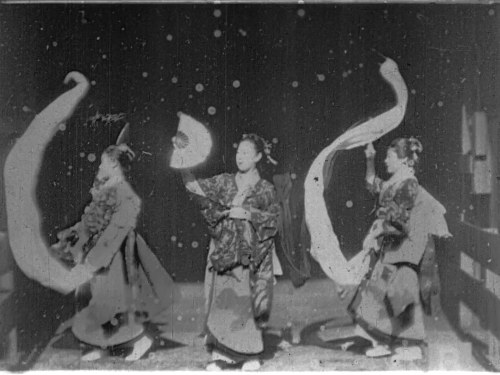
Three female dancers occupy a darkened stage set against a starry or speckled backdrop suggesting night or a celestial scene. Each wears a flowing, draped costume in a light fabric that catches the light dramatically. The two outer figures hold their arms raised in curved, elegant gestures—the left dancer's right arm and the right dancer's left arm each bent into graceful arcs above shoulder height. The central figure stands more upright with arms at her sides or in a neutral position. All three wear what appears to be traditional Japanese dress, possibly modified for performance: the garments have the characteristic silhouette and draping of kimono or theatrical adaptation thereof. The poses suggest a moment of controlled, formal positioning rather than rapid movement—the kind of tableau vivant or formal ceremonial arrangement typical of late 19th-century staged Japanese dance for Western audiences. The lighting is theatrical, creating strong contrasts between the illuminated figures and the dark background.
The dancing
The three dancers are arranged in a shallow line across the frame, with the outer two figures mirroring each other in pose and arm carriage. Each outer dancer curves one arm upward in a smooth, sustained arc, the elbow slightly bent and the line flowing from shoulder through fingertips. This symmetrical framing suggests formal training and choreographic intention rather than spontaneous movement. The bodies stand relatively upright and still, the weight evenly distributed, with no visible indication of rapid footwork or weight transfer. The central figure maintains a more reserved posture, anchoring the composition.
The dance depicted
This appears to be a staged performance of Japanese classical or theatrical dance, most likely kabuki or a related court/theatrical tradition adapted for late 19th-century theatrical presentation. The formal symmetry, the emphasis on arm position and sustained gesture over footwork, and the ceremonial quality of the tableau are consistent with kabuki or Nihon buyo (Japanese classical dance). The pose—particularly the curved arm lines—resembles the sustained gestural vocabulary of Japanese dance traditions, where the arm and hand describe narrative or emotional content through deliberate, sculptural positioning. The theatrical staging and the fact that this was recorded for Western consumption in 1894 suggests this may have been part of the wave of Japanese performance touring Europe and America in the late 19th century, or a Western theatrical company's interpretation of Japanese aesthetics.
How it was made
This is a photograph, almost certainly a black-and-white gelatin or albumen print given the date (1894) and the visible grain and tonal range. The photographer has used theatrical lighting to create strong modeling on the figures and to make the costumes read clearly against the dark background. The speckled or stippled effect in the background is either a photographic effect (paint or textured backdrop) or an artifact of the printing process. Photography allowed this documentation of staged performance with far greater detail and immediacy than earlier engraving or lithography, making it a valuable record of how Japanese dance was presented in Western theatres at this date. The image quality and composition suggest professional theatrical documentation rather than casual snapshot.
About this work
This is a photograph of a staged performance of Japanese dance dated 1894, showing three dancers in a formal, symmetrical arrangement against a theatrical backdrop. The image records a moment of high theatrical artifice—the dancers suspended in posed gestures rather than captured mid-movement—which was characteristic of both traditional Japanese dance training and late 19th-century Western theatrical aesthetics. The work is valuable as evidence of how Japanese performance was translated for Western stages during the period when Japanese art and culture were becoming fashionable in Europe and America. The photograph preserves the visual language of a specific moment in global theatrical history, when 'Japanese dance' was a marketable genre distinct from ballet or Western concert dance, and when photography was the primary means of documenting such ephemeral performances.
How to look at it
Notice the symmetrical framing and the emphasis on the curved arm lines—these are fundamental to how Japanese classical dance communicates meaning and emotion. The photograph captures a moment of deliberate stillness or transition, not the peak of a rapid movement; in traditions like kabuki, such sustained poses (often called 'mie' in kabuki terminology) are choreographic climaxes that demand close attention. The facial composure and the stillness of the torso are as important as the arm gesture. Observe how the photographer used lighting to make the costumes and gestures read clearly; this is theatrical photography, not documentary realism, and every element of the composition—the backdrop, the pose, the lighting—has been arranged to create a specific visual effect.
The period
Japan opened to the West in 1868, and by the 1890s Japanese performance traditions were circulating in European and American theatres as exotic novelties. The late 19th century saw intense Western interest in Japanese art, design, and performance—the Japonisme movement in visual art had established Japan as a source of sophisticated aesthetic refinement. At the same time, photography had become the standard medium for documenting theatrical performance, replacing earlier hand-drawn documentation. In the context of dance history, this image arrives at a moment when ballet had established itself as the dominant concert dance form in the West, making any non-Western dance tradition appear as exotic 'other.' Japanese dance troupes touring the West typically presented highly formalized, museum-like performances of classical forms—distilled versions of complex, centuries-old traditions—designed to appeal to Western audiences' taste for both technical virtuosity and 'authentic' cultural spectacle.
Where it lives
The image is held in the Library of Congress (loc), suggesting it was part of American theatrical or cultural documentation in the 1890s. No further provenance information is recorded.
Dance in this work
Questions about this work
Is this kabuki?
The image shows characteristics consistent with kabuki or Nihon buyo (Japanese classical dance), including the formal pose, the emphasis on arm gesture, and the theatrical costume and makeup. However, without additional documentation, we cannot confirm the specific dance tradition or whether this was a 'pure' kabuki performance or a Western adaptation or interpretation. The theatrical setting and the date (1894) suggest this may have been performed for a Western audience rather than in Japan.
Why are the dancers posed so still?
In Japanese classical dance traditions, sustained, sculptural poses are not mere breaks in the action—they are choreographic statements. The pose shown here, with the curved arm lines, likely communicates narrative or emotional content. The photographer has also caught a moment of formal arrangement or transition, not the peak of rapid movement, which is typical of how stage photographs were composed in this era.
How was this photograph taken?
This is a black-and-white photograph, likely a gelatin or albumen print typical of professional theatrical photography in the 1890s. The photographer used theatrical lighting to create strong contrast and to make the costumes and gestures read clearly. The speckled background is probably a painted or textured backdrop, possibly to evoke night or a celestial setting.
More dance artwork





