49 works in this view — arrow keys or swipe to move between them.
Dance in Art · 1911
That crazy dance
Unknown artist
- Source:
- Library of Congress
- Rights:
- Public domain — free to use, share and adapt.
- Recorded as:
- Public Domain
Early-20th-century theatrical posters are primary sources for understanding how dance was represented, consumed, and understood by the general public. This image captures the aesthetics, star system, and narrative frameworks that shaped musical theater production in a major American city, showing how fairy-tale narratives and balletic elegance were commodified and promoted.
What you are looking at
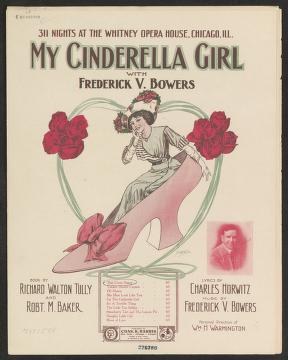
This is a theatrical poster advertising a musical comedy called *My Cinderella Girl*, performed at the Whitney Opera House in Chicago. The composition centers on a stylized female figure in a pink ball gown and matching heeled slipper, posed against oversized red roses. The woman's pose is elegant and spiraling—her body curves sinuously, one arm raised, her weight shifted in a manner suggesting graceful movement or a curtsy. The overall aesthetic is Art Nouveau, with flowing organic lines and a decorative treatment of form. The figure appears suspended in a moment of theatrical poise rather than caught mid-step; this is the language of stage promotion, not documentary. At bottom, a theatrical playbill lists the venue, production dates (30 nights), and credits the book and lyrics to Richard Walton Daley and Robert M. Baker, with music by Charles Hoagey and Frederick V. Dowers. A sepia-toned photograph of a woman—likely the star performer—appears in the lower right corner. The poster's composition celebrates glamour and spectacle rather than precise choreographic documentation.
The dancing
The central figure displays a sophisticated theatrical posture—spine curved, chin lifted, one arm extended in a balletic gesture suggesting cultivated grace. The pose reads as a stylized representation of theatrical bearing rather than a snapshot of actual dancing. Her body demonstrates an understanding of balletic deportment: lifted chest, elongated line through the torso, and the positioning suggests familiarity with theatrical conventions of elegance. The single figure dominates, posed in isolation rather than in interaction with a partner, which emphasizes star status over choreographic content.
The dance depicted
The image alone does not specify a particular dance style; rather, it presents the generalized theatrical elegance associated with early-20th-century musical comedy and operetta. The title invokes the Cinderella fairy tale—a narrative framework deeply embedded in romantic ballet tradition—but the theatrical poster format prioritizes star appeal and spectacle over choreographic specificity. The figure's pose suggests balletic training and classical theatrical deportment, but no technique, hold, or movement pattern can be identified with certainty. This is promotional imagery, designed to sell the show to a general audience rather than to document actual choreography.
How it was made
This is a color lithograph or chromolithograph, a commercial printing method that allowed mass production of theatrical posters for distribution and display. The technique's bold chromatic separation—particularly evident in the saturated reds, pinks, and sepia tones—was characteristic of theatrical advertising of the period. Lithography allowed fine linear detail in the decorative elements while maintaining bold graphic impact. The survival of this object in an archive suggests it served as both a marketing tool and a historical record of theatrical commerce in early-20th-century Chicago.
About this work
This is a commercial theatrical poster for a musical comedy produced in Chicago in 1911, featuring a stylized image of a woman in ball gown and heeled slipper posed against Art Nouveau florals. The work belongs in a dance history collection because it documents the promotion and visual culture of early musical theater—the theatrical conventions, costume aesthetics, and deportment codes that shaped how dance was presented to the public. Posters like this reveal how theatrical dance was packaged, who performed it, and what visual language was deployed to attract audiences. The image also offers evidence of how balletic training and classical theatrical elegance were marketed as markers of refinement and spectacle in popular musical entertainment.
How to look at it
Attend to the figure's posture and the conventions it embodies: the lifted spine, the arm gesture, the curve of the body all communicate 'theatrical elegance' to a contemporary viewer. Notice how the oversized flowers frame the figure, making the human form decorative and central. The heeled slipper is a detail worth noting—it references both Cinderella narrative and fashionable femininity of the period. The sepia photograph of the star performer in the corner grounds the idealized theatrical image in actual human presence, suggesting the connection between poster fantasy and live performance.
The artist
The poster credits the book and lyrics to Richard Walton Daley and Robert M. Baker, with music by Charles Hoagey and Frederick V. Dowers. The visual design is not attributed in the visible text. The production was mounted at the Whitney Opera House in Chicago for a 30-night run. No information about the choreography or choreographer appears on the poster—typical for commercial theater of the period, which often credited composers and librettists but not dance creators.
The period
In 1911, musical comedy and operetta were thriving entertainment forms in American cities. The theatrical world was marked by the star system, in which a single performer's name and image drove ticket sales. Balletic training and classical theatrical deportment were markers of theatrical legitimacy and refinement, even in commercial entertainment. The Art Nouveau aesthetic visible in the poster's design was still fashionable, though modernism was beginning to challenge it. Chicago had active theatrical life and multiple venues; a 30-night run suggests a successful local production, likely drawing on both trained performers and popular appeal.
Where it lives
This poster is held by the Library of Congress, which records it as a theatrical advertisement for a Chicago production. It represents the category of commercial theatrical ephemera—objects produced for short-term use and circulation but which survive as historical records of performance culture.
Dance in this work
Questions about this work
What was the Whitney Opera House and how significant was it in Chicago?
The Whitney Opera House was one of several theatrical venues in early-20th-century Chicago, a city with vibrant theatrical culture. A 30-night run there suggests a successful popular production, though specific details about the venue's status are not indicated in the poster text.
Can I tell what kind of dancing was actually in this show?
Not from the poster alone. The credits name the composer, librettist, and lyricist but no choreographer or dance captain, which was common practice in theatrical promotion of the period. Choreography was often uncredited or created collaboratively by performers and directors rather than attributed to a named creator.
What do the Art Nouveau aesthetics tell us about dance representation?
The flowing organic lines, the emphasis on graceful curved forms, and the integration of the figure with floral elements reflect early-20th-century aesthetics that prized elegance, refinement, and natural beauty. This visual language shaped how theatrical dance was understood—as an art of cultivated grace rather than athletic spectacle.
Why is there a photograph of a woman in the corner?
This was standard practice on theatrical posters: the photograph identified the star performer, making her name and face recognizable to the public. The idealized lithographic image above was supplemented by photographic documentation of the actual performer, linking fantasy to embodied presence.
More dance artwork





