49 works in this view — arrow keys or swipe to move between them.
Dance in Art · 1914
Tango mad
Unknown artist
- Source:
- Library of Congress
- Rights:
- Public domain — free to use, share and adapt.
- Recorded as:
- Public Domain
The tango reached Argentina's ballrooms in the 1890s and had migrated to European salons and stages by 1910; this poster documents its almost simultaneous adoption as mainstream American theatrical entertainment. It reveals how quickly new dances could be commercialized and how they functioned as markers of modernity and cosmopolitan sophistication in popular culture. Understanding this poster clarifies how social dance and theatrical entertainment intersected in the early 20th century, and why the tango became culturally central to that moment.
What you are looking at
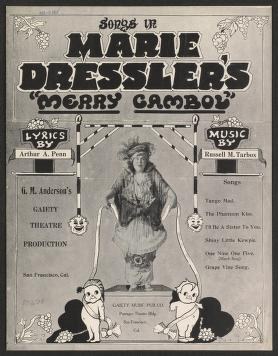
A vaudeville or music hall poster from the early 20th century advertising "Tango Mad," a production featuring Marie Dressler. The composition is symmetrical and theatrical, with ornate decorative borders in the Art Nouveau style framing the central image. Marie Dressler is pictured in the center wearing an elegant dark dress with a feathered hat, her pose suggesting both sophistication and theatrical flair. Below her are two caricatured figures—likely comedic supporting characters—drawn in a broader, more exaggerated style. The poster credits production details on either side: the Garrett Theatre in San Francisco appears on the left, with other credits on the right. Musical notation and instrument illustrations (horns) accent the composition, emphasizing the entertainment value. The color scheme uses earth tones and blacks typical of period lithography, with ornamental flourishes at top and bottom.
The dancing
Dressler occupies the vertical center in an upright, composed stance—poised rather than actively dancing. Her posture is formal and dignified, with her body weight centered and her gaze directed outward toward the viewer. Her arms hang naturally at her sides in a restrained gesture that suggests the stage presence of a celebrated performer rather than active dance movement. The two supporting figures below are rendered in caricature style, with more exaggerated limbs and postures suggesting comedy or slapstick action, creating visual contrast with Dressler's composed central figure.
The dance depicted
The poster advertises a tango-themed theatrical production, a genre that was enormously popular in North America in the 1910s following the international tango craze that swept from Argentina beginning around 1910. The imagery does not depict tango choreography itself but rather stages the star performer in theatrical dress. The tango in this period was understood both as a social dance and as a spectacular stage entertainment, often framed for audiences as exotic, slightly scandalous, and absolutely modern. The supporting caricatures suggest the production incorporated comedy alongside dance spectacle—a typical vaudeville mixture.
How it was made
This is a color lithographic poster, a printing technique that allowed for bold graphic design, decorative lettering, and wide distribution to theaters and public spaces. Lithography was ideal for theatrical promotion, enabling production of multiple copies for mass circulation while maintaining vivid color and fine detail. The ornate typographic style and decorative frame are typical of Belle Époque and early Art Deco poster design, suggesting this was a professional production from a major theater or touring company. The printing technology and composition indicate this was designed for public display in urban entertainment districts.
About this work
This is a theatrical advertising poster for a tango-themed stage production starring the established performer Marie Dressler, dating to around 1914 when the tango craze was at its height in North America. The work is both a document of commercial dance entertainment and a record of how the tango was packaged and sold to American audiences in the early 20th century. It demonstrates that the tango, while rooted in social dance, was absorbed into vaudeville and music hall entertainment as a spectacle and marker of modernity and urban sophistication.
The poster belongs in a dance history collection as evidence of the tango's rapid migration from Argentine social dance to mass-market theatrical entertainment. It shows how dance became a vehicle for celebrity and how theatrical producers marketed dance to audiences through star power, exoticism, and the association with contemporary musical styles. The work also illustrates the visual language theaters used to advertise entertainment in the early cinema era.
How to look at it
The poster does not depict active tango dancing but rather the theatrical presentation of a star performer associated with tango. Notice how Dressler is positioned centrally in formal dress rather than in dance action—the work markets the performer and the concept of tango rather than demonstrating tango technique. The ornamental frame and decorative typography emphasize the theatrical event as a spectacle to be experienced as a whole. The caricatured supporting figures below suggest that the production balanced sophisticated star power with popular comedy, a standard vaudeville formula. The poster's composition is designed to catch the eye from a distance, using bold lettering, symmetry, and the central star image as the primary attractions.
The artist
The artist is not recorded. The poster shows the sophisticated graphic design and lithographic skill typical of professional theatrical poster makers working in major American cities in the 1910s, but without a signature or other identifying marks, individual authorship cannot be established.
The period
The tango craze emerged in Buenos Aires in the 1890s in working-class dance halls and gradually moved upward socially and geographically. By 1912–1915, it had become an international phenomenon, spreading from Paris and London to New York, San Francisco, and across North America. The dance was simultaneously celebrated as modern and cosmopolitan and condemned as scandalous and sexually suggestive—a tension that made it commercially irresistible to theatrical producers. The theatrical tango of this era was distinct from social tango; it was stylized for spectacle, often incorporated comedy, and was performed by trained entertainers rather than social dancers. This poster reflects the height of that theatrical moment, when tango was still novel enough to guarantee box office appeal but familiar enough to require no explanation.
Where it lives
The poster is held by the Library of Congress and was digitized as part of their theatrical and entertainment materials collection. It represents a type of ephemeral printed material—designed for temporary public display—that was often discarded; its survival and preservation makes it a valuable document of early 20th-century theatrical promotion.
Dance in this work
Questions about this work
Was Marie Dressler actually a tango dancer?
Dressler was a stage and film performer known for comedy and character roles rather than dance specialization. She was a prominent and versatile entertainer of the period, and theaters capitalized on her star power by attaching her name to popular entertainment forms. The poster is advertising a production associated with her name and the tango theme, not necessarily demonstrating her technique in that specific dance.
What was the tango craze in America?
Between roughly 1912 and 1920, the Argentine tango became enormously fashionable in American cities as both a social dance and a theatrical spectacle. It was modern, sophisticated, and slightly scandalous, which made it commercially attractive. Dance halls, restaurants, and theaters all capitalized on tango fever by offering tango dancing, tango-themed entertainment, and tango instruction. This poster is a direct product of that phenomenon.
Why does the poster show a formal portrait rather than people dancing?
Theatrical posters of this era typically centered on star performers rather than action scenes. The producer's goal was to attract audiences through recognizable names and faces, not to depict the actual entertainment. The tango reference in the title and the theatrical context would have been sufficient for audiences to understand what they were paying to see.
What is the Garrett Theatre?
The Garrett Theatre was a vaudeville and theatrical venue in San Francisco. Its appearance on the poster indicates this production played there, reflecting the touring circuit through which theatrical entertainments reached American cities in the pre-film era.
More dance artwork





