49 works in this view — arrow keys or swipe to move between them.
Dance in Art · 1914
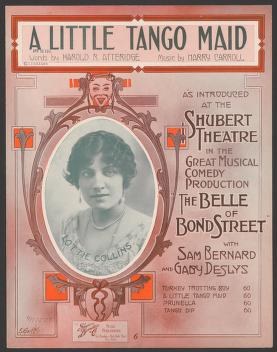
A Little tango maid
Unknown artist
- Source:
- Library of Congress
- Rights:
- Public domain — free to use, share and adapt.
- Recorded as:
- Public Domain
This work shows how the tango became a theatrical commodity in American popular culture within two years of its arrival from Argentina. It reveals the machinery by which dance crazes reached audiences: not through concert performance but through commercial musical theater, and the poster itself—a democratic, throwaway medium—became the primary visual contact most people had with the dance.
What you are looking at
This is a theatrical cover or poster for a musical production, centered on a portrait of a female performer in an oval frame. The frame is ornate, rendered in art deco or early modernist style with geometric patterning in coral and cream tones. Above the portrait appears the title "A LITTLE TANGO MAID" in bold sans-serif lettering. Below the portrait are printed production credits identifying this as introduced by Shubert Theatre in their "Great Musical Comedy Production" titled "The Belle of Bond Street," with cast including Sam Bernard. The bottom of the page lists standard theatrical information—presumably cast, credits, and ticket information in small type. The woman's portrait shows a soft-focus, romanticized rendering typical of early 20th-century theatrical promotion: she has dark hair styled in period waves, a direct gaze, and an oval face. The overall design is characteristic of American theatrical printing from 1914: bold typography meets soft figurative imagery, with the geometry of the frame contrasting the naturalism of the face.
The dancing
The figure is presented frontally and statically—a posed portrait rather than a dynamic dance image. There is no visible body position, hold, or footwork; the frame cuts off at the shoulders, showing only the face and upper torso. This is a publicity portrait of a named performer rather than documentation of choreography or movement.
The dance depicted
The title invokes Argentine tango, the dance craze that had swept North America and Europe in the early 1910s. However, the image itself shows no dance movement or posture. This is promotional material for a Broadway musical comedy that incorporated tango as a fashionable element—likely a song, a scene, or a specialty number rather than a full-evening tango performance. The tango was already moving from ballroom into theatrical contexts by 1914, where it served as exotic, mildly scandalous entertainment within a comedy framework.
How it was made
This is a color lithograph or color-printed theatrical poster, a standard mass-production format for Broadway promotion in 1914. The soft-focus portrait is rendered photographically or painted, then color-separated and printed. The bold typography and geometric frame are typical of early art deco commercial design. The technique allowed rapid, affordable production of posters for distribution to theaters, newspapers, and public spaces, making the performer and production widely visible.
About this work
This is a Broadway theatrical poster from 1914 advertising a musical comedy that capitalized on the international tango craze of that era. The work sits at the intersection of dance history and theatrical marketing: it documents not a choreographer's vision but the commercialization of a fashionable social dance within mass entertainment. The tango appears here as a title, a selling point, and a marker of modernity and excitement—a thumbnail sketch of how dance trends moved from ballroom to stage to mass media within a single decade.
How to look at it
Look at how the poster uses the performer's face as the primary selling tool, with the tango title as secondary: this tells you that star power mattered more than dance content. The soft, romanticized rendering of the face is calculated to create emotional investment and sympathy with audiences. The geometric, modernist frame signals novelty and fashion—tango as the latest thing—while the figure inside it remains timeless and human. This double gesture—old-fashioned celebrity portraiture inside a modern frame—captures how theatrical marketing of the period worked: reassurance through the familiar face, excitement through contemporary design.
The artist
The artist is not recorded. The work is a commercial product of the Shubert theatrical organization, one of the dominant Broadway producers and theater owners of the era. Such posters were typically designed by studio artists, lithographers, and commercial designers working for printing houses and theatrical production offices, not individual painters or printmakers seeking artistic recognition.
The period
In 1914, tango was at the height of its first international craze. It had entered North America around 1910–1911, imported by Buenos Aires musicians and dancers and initially viewed with scandal and moral anxiety. By 1913–1914, it had been absorbed into respectable theatrical entertainment and high-society ballrooms alike. Simultaneously, Broadway was consolidating into a mature commercial industry centered on large musical comedies with star performers, spectacle, and topical song numbers. The tango's exotic otherness—its South American origin, its sensual reputation—made it perfect theatrical material: exciting but already domesticated enough for family audiences when packaged as comedy.
Where it lives
The work comes from the Library of Congress theatrical poster collection, a standard source for Broadway and entertainment ephemera. It is a mass-produced commercial object—not a unique artwork but one of an unknown print run, many copies of which would have been pasted on theater walls, distributed to newspapers, or discarded after the run of the production ended.
Dance in this work
Questions about this work
Did they actually dance tango in this show, or was it just in the title?
We cannot tell from the poster alone. Broadway musical comedies of 1914 often included topical song numbers and specialty dances without building an entire show around them. 'A Little Tango Maid' may have been a single song or scene, or it may have been woven through the evening. Theater reviews or scripts would tell us; the poster does not.
Why is there no dancing figure on a dance poster?
This is not a dance poster in the modern sense—it is a star vehicle. Theatrical promotion in 1914 prioritized the performer's name and face above all else. The tango is a selling point (exotic, fashionable, exciting), but the actual draw was seeing this particular actor in this particular production. A photograph or painted portrait of the star was far more valuable to producers than any image of movement.
What is the Shubert Theatre?
The Shubert organization was the largest theatrical production and theater-ownership company in early 20th-century America. They produced hundreds of Broadway shows and controlled a national chain of theaters. By 1914, a Shubert production was a sign of major investment, major stars, and major publicity—which is why this modest poster still survives in the Library of Congress.
More dance artwork





