49 works in this view — arrow keys or swipe to move between them.
Dance in Art · 1884
My first minuet
Unknown artist
- Source:
- Library of Congress
- Rights:
- Public domain — free to use, share and adapt.
- Recorded as:
- Public Domain
The minuet had been dead as a living social dance for a century by 1884, yet its ghost persisted in the instruction of children. This print captures the peculiar 19th-century habit of teaching historical dances as exercises in posture and propriety rather than as living cultural practices. For dance historians, it documents how the minuet functioned as a technology of class formation and gender training, transmitted through the body in the privacy of the home.
What you are looking at
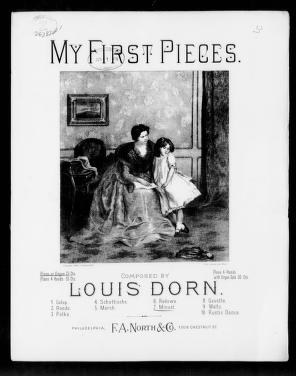
A young girl in a white dress stands in an interior domestic space, her posture upright and formal. She is positioned in three-quarter view, facing toward the left of the frame, with her body aligned in the classical minuet stance. Behind her sits an older woman in dark clothing—likely her mother or governess—observing from a chair. The setting is a parlor or drawing room with patterned wallpaper, a framed picture on the wall, and what appears to be a doorway or tall mirror on the right. The lighting is soft and naturalistic, suggesting daylight from an unseen window. The composition captures a moment of instruction or performance: the child appears to be demonstrating the minuet, her small frame poised with deliberate formality against the domestic comfort of the room.
The dancing
The child's body is held erect with shoulders back, arms positioned in the characteristic minuet frame: her right arm extended gracefully at about shoulder height or slightly below, her left arm at her side or similarly extended. Her left foot appears to be forward, weight balanced in the formal stance required by the dance. The posture shows training—the alignment is deliberate, the carriage controlled. The seated woman watches with apparent attention, her dark form providing visual weight and authority to the scene. The contrast between the child's bright white dress and the woman's dark clothing creates a narrative of instruction and observation.
The dance depicted
This depicts the minuet, the central courtly dance of the 18th and early 19th centuries, here shown as part of a child's musical and social education. The minuet remained a staple of genteel instruction well into the 19th century, taught to young girls of the middle and upper classes as an essential accomplishment. The image captures not performance but pedagogy: a lesson in deportment and formal grace. The title 'My First Pieces' suggests this is one of a series documenting childhood milestones, with the minuet standing as a marker of social refinement and coming of age.
How it was made
This is a black-and-white engraving or lithographic print, likely from the 1880s based on the style and reproduction techniques of the period. The tonal range and line work suggest a reproductive print, possibly engraved from a drawing or painting. The soft modeling of light and shadow, particularly in the treatment of the child's dress and the woman's face, indicates skilled hand-work. The composition and technique are consistent with domestic genre prints published for middle-class audiences during the Gilded Age, when such images were widely distributed as book illustrations or independent prints.
About this work
This engraving documents a moment in the private instruction of a young girl in the minuet, the formal court dance that remained central to genteel education throughout the 19th century. Though the minuet's heyday as a ballroom dance had passed by 1884, it retained symbolic value as a marker of refinement, grace, and social status. The image belongs to a body of Gilded Age genre prints depicting childhood, education, and the transmission of cultural accomplishment within the domestic sphere. It is both a record of actual pedagogical practice and a sentimental celebration of childhood innocence and maternal guidance.
How to look at it
Attend to the deliberate formality of the child's stance: every element—the angle of the foot, the curve of the arm, the carriage of the head—speaks of training and control. Note how the artist has frozen the moment not mid-movement but in a posed attitude, the stance itself the subject. The older woman's watchful presence is crucial: this is not a performance for an audience but a private lesson, a moment of transmission between generations. The bright dress against the dark interior creates both a visual focal point and a symbolic contrast between youth and age, innocence and knowledge.
The artist
The artist is not recorded. The print is composed by Louis Dorn (as stated in the inscription) and published by F. A. Kümper & Co., a German publishing house active in the late 19th century. The composition and style are consistent with the sentimental domestic genre prints that were widely produced for middle-class European and American markets during the 1880s and 1890s.
The period
By 1884, the minuet had been out of fashion as an actual ballroom dance for nearly a century. Its preservation in the instruction of children reflects broader 19th-century anxieties about refinement, propriety, and the transmission of cultural values. The Gilded Age saw intense interest in childhood education, propriety, and the visual documentation of domestic life—this print sits within a rich tradition of genre imagery celebrating the sentimental bonds of family and the careful formation of the next generation. At the same time, the minuet's survival in pedagogical form speaks to its symbolic power: even as waltz, polka, and later dances dominated the ballroom, the minuet retained cultural prestige as a marker of old-world grace.
Where it lives
The print is held by the Library of Congress. It is a published reproductive print, one of a series titled 'My First Pieces,' composed by Louis Dorn and published by the German firm F. A. Kümper & Co.
Dance in this work
Questions about this work
Why would a child in 1884 be learning the minuet?
The minuet remained a standard element of genteel education for girls well into the 19th century, valued not as a living dance but as a training ground for posture, grace, and the deportment expected of respectable women. It functioned as both physical discipline and cultural marker, a way of transmitting class status and refinement through the body.
Is this a real lesson or a sentimental fantasy?
Likely both. Private dancing masters did teach minuets to children of the educated middle and upper classes, often in domestic settings much like this one. However, the composition is also idealized—the soft light, the rapt attention of the older woman, the child's perfect posture all serve a romantic vision of childhood and maternal care.
What does the minuet require from the body?
The minuet demands upright carriage, controlled arm movements, precise footwork, and a measured, unhurried tempo. It is essentially a walking dance, performed in 3/4 time, with elaborate court etiquette governing direction, partners, and acknowledgment. The emphasis is on grace and control rather than vigorous movement.
More dance artwork





