49 works in this view — arrow keys or swipe to move between them.
Dance in Art · 1909
Hungarian dance and song
Unknown artist
- Source:
- Library of Congress
- Rights:
- Public domain — free to use, share and adapt.
- Recorded as:
- Public Domain
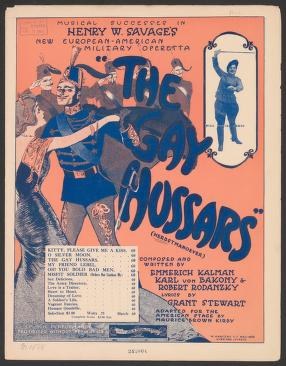
This poster documents the theatrical life of folk dance in early 20th-century American popular culture, showing how Hungarian traditions were adapted, marketed, and consumed as stage entertainment. For dance historians, it reveals the visual vocabulary—the pose, the silhouette, the gesture—that producers used to signal 'folk' and 'ethnic' dance to audiences unfamiliar with these traditions. The work is valuable evidence of how dance moved from community context into mass entertainment and how that translation was conveyed visually.
What you are looking at
A theatrical poster advertising a musical production featuring Hungarian dance and song. The composition is divided into two register: on the left, a dynamic scene of figures in motion against a warm coral background, with bold blue silhouettes of dancers caught mid-gesture; on the right, a smaller inset shows a standing figure in what appears to be traditional or stylized costume. The poster's design is characteristic of early 1900s theatrical advertising, with large blue lettering announcing the title "THE BOSSES" at bottom. The central figures display energetic, asymmetrical poses suggesting folk or character dancing rather than ballroom formality. The warm color palette and dynamic composition convey theatrical spectacle and entertainment.
The dancing
The principal figures are rendered as bold blue silhouettes in various poses of apparent motion and interaction. Multiple dancers occupy the left composition, their bodies angled and overlapping to suggest rapid movement and social interaction rather than formal ensemble alignment. At least two prominent figures appear to be in close proximity, their gestures suggesting partnered or group activity. One figure displays a raised arm and turned torso, while others lean or pivot. The single upright figure in the inset on the right stands in profile, displaying a more contained, formal stance. No formal ballroom hold is evident; the bodies suggest looser, more folk-based movement vocabulary.
The dance depicted
The title 'Hungarian dance and song' indicates this production featured Hungarian folk dance traditions, likely in a theatrical or musical-comedy context given the production credits and venue information visible. The silhouettes suggest vigorous, socially interactive group dancing rather than choreographed classical form. Hungarian folk traditions of the period would have included circle dances, couple dances, and celebratory movement, though the theatrical setting and the jazz-age presentation suggest these may have been adapted or stylized for an American stage audience. The poster's emphasis on dynamism and gaiety, rather than technical display, points toward entertainment dance suited to a general theatrical public.
How it was made
This is a lithographed theatrical poster, a mass-produced advertising medium that allowed for bold color separation and legible typography at distance. The technique permitted the dramatic use of flat color fields—the warm coral ground and bold blue figures—that would read effectively from the street. The artist employed silhouette as a primary compositional device, which was economical in lithography and created graphic punch. This medium and format indicate the work was distributed widely and intended for public visibility in theaters, lobbies, or streets; it survives as evidence of how dance was marketed to general audiences in the early 1900s.
About this work
This is a lithographed theater poster from 1909 advertising a musical production featuring Hungarian dance and song. The work showcases early 1900s theatrical advertising practice, using bold silhouettes and warm color fields to convey energy and spectacle. The composition divides between a dynamic group scene and a more formal inset figure, suggesting both social interaction and theatrical presentation. The poster records how folk dance traditions were packaged and promoted for American stage audiences in the Gilded Age, presenting Hungarian material through a lens of entertainment and visual dynamism rather than ethnographic accuracy.
How to look at it
Observe the use of silhouette to convey motion and energy: the overlapping figures, the variety of poses, and the asymmetrical composition all work to suggest liveliness and spontaneity rather than formal choreographic order. Note the distinction between the dynamic group on the left and the more restrained figure on the right—this may reflect a contrast between ensemble celebration and individual character or specialty. The warm color field and bold typography create an immediate emotional impression of warmth and festivity, which is the poster's primary persuasive aim.
The artist
The artist is not recorded in the catalogue. The work is a commercial theatrical poster, likely produced by a professional printing house or theater's advertising department rather than a named fine artist. The style is consistent with early 1900s American theatrical lithography, employing the graphic conventions of the period.
The period
The early 1900s saw a surge in theatrical consumption in American cities, with immigrant communities and their cultural traditions becoming subjects of commercial entertainment. Hungarian and Eastern European material was fashionable in American musical theater during this period, often presented with a degree of romanticization and stylization for mainstream audiences. Simultaneously, the rise of lithographic color printing made theatrical advertising increasingly sophisticated and visually compelling, establishing the poster as a major artistic medium in its own right.
Where it lives
The work is housed in the Library of Congress and represents theatrical advertising material from the early 1900s. It survives as a printed artifact of popular culture, distributed for public viewing to promote a theatrical production.
Dance in this work
Questions about this work
What is 'The Bosses' and when was this produced?
The catalogue dates this poster to 1909. Beyond the title and the credits visible on the poster, further production history is not recorded in the available metadata. The work was theatrical entertainment marketed to a general American audience.
Is this showing authentic Hungarian folk dance?
No. This is a theatrical adaptation presented to an American stage audience. The silhouetted figures and the theatrical context suggest the material was stylized and reinterpreted for entertainment purposes rather than documentary or ethnographic presentation. The poster's visual language is designed to signal 'folk' and 'exotic' through gesture and energy rather than accuracy.
Why are the dancers shown as blue silhouettes?
Silhouette was an economical and graphically striking technique in lithographic printing, allowing the artist to convey motion and variety of pose with minimal color separation. The bold blue figure against the warm coral ground creates visual punch and readability at a distance—essential for street-level advertising.
More dance artwork





