49 works in this view — arrow keys or swipe to move between them.
Dance in Art
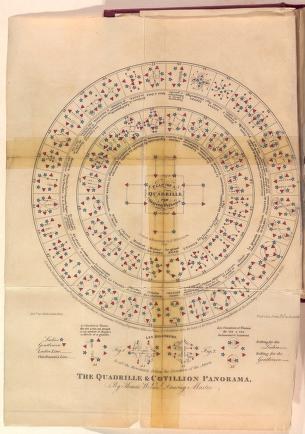
The quadrille and cotillion panorama, or, Treatise on quadrille dancing, in two parts: with an explanation, in French and English, of all the quadrille & cotillion figures generally adopted, as described by diagrams on the plate,
Unknown artist
- Source:
- Library of Congress
- Rights:
- Public domain — free to use, share and adapt.
- Recorded as:
- Public Domain
This diagram is material proof that quadrille and cotillion dancing—social events we now know primarily through literary description and paintings—were formalized, teachable systems with written and printed pedagogies. It shows that by the 19th century, popular ballroom dance had become codified enough to warrant published instruction, a milestone in the professionalization of dance teaching.
What you are looking at
This is a instructional diagram printed on a single sheet, showing concentric circles filled with small dots representing dancers arranged in geometric patterns. The central circles are smallest and densest, expanding outward to larger rings with more space between figure-dots. A vertical axis line runs through the center, with horizontal cross-lines marking cardinal directions. At the bottom, the title reads "THE QUADRILLE AND COTILLION PANORAMA" with additional text indicating it is a treatise on quadrille dancing in two parts, with explanations in French and English. The paper shows age-toning and a vertical crease down the center, consistent with a historical printed broadsheet or fold-out instructional plate. Small letter or number labels appear around the margins, presumably keying the diagram to explanatory text not visible in this image.
The dancing
The dancers are represented as abstract dots arranged in precise concentric rings rather than as drawn figures, preventing any assessment of hold, frame, or arm position. Each dot likely represents one dancer or couple positioned at specific points in the floor pattern. The geometric regularity of the placement emphasizes the mathematical precision required of quadrille and cotillion formations rather than individual movement quality.
The dance depicted
This is a didactic diagram for the quadrille and cotillion, social ballroom dances of the 18th and 19th centuries. The concentric-circle structure suggests this illustrates either the progression of figures within a single dance (inner to outer circles representing successive phases) or comparative formations of the two dances shown in two parts. The quadrille was typically danced by four couples in a square; the cotillion was a more elaborate formation dance that evolved throughout the period. The diagram's purpose was to teach the floor patterns and relative positions dancers must occupy, making it a pedagogical tool rather than a representation of a live performance.
How it was made
The work is a printed engraving or lithograph, evident from the precision of the concentric circles and the uniform printing of the dot patterns. The technique allowed for mass distribution of instructional materials, essential for ballroom dance pedagogy in the 19th century when these dances were at the height of fashion. The survival of this broadsheet—creased, aged, but intact—suggests it was a working document, possibly mounted or folded for use during lessons. The technical precision of the printing indicates it was professionally produced for a substantial market of dance teachers and students.
About this work
This is a rare instructional diagram produced to teach the geometric floor patterns of two fashionable 19th-century ballroom dances: the quadrille and cotillion. Rather than depicting a dance in action, it abstracts the essential information a dancer or teacher needed to master—the precise spatial relationships and progression of figures. The concentric-circle structure reveals how these dances moved through increasingly complex or widening formations, transforming the kinetic experience into a legible diagram. It belongs in a dance archive not as a representation of dancing bodies but as evidence of how dance knowledge was encoded, transmitted, and professionalized during the Regency and early Victorian eras.
How to look at it
Read the diagram from the center outward: the innermost circles likely represent the opening positions and earliest figures, while expanding circles show the progression or widening of the formation as the dance unfolds. The precision with which each dot is placed is the content—this is not artistic but architectural, showing that dancing in this era meant occupying exact points in space in exact sequence. Notice how the pattern fills the page uniformly, suggesting either that this fold-out displayed both dances side by side or that the back side carried complementary diagrams. The regularity itself is a statement: these are not improvisational dances but learned, repeatable, teachable sequences.
The period
The quadrille and cotillion dominated European and American ballroom culture from roughly 1800 through the late 19th century. The quadrille, which originated in France and spread rapidly across the continent, was a figure dance for four couples arranged in a square; it required coordination, memory of set patterns, and the ability to execute changes of direction and formation in unison. The cotillion evolved as a variation allowing for more elaborate, often flirtatious figures. Both dances required instruction: they could not be learned by social convention alone, as one might learn a waltz or galop. The proliferation of printed dance manuals, diagrams, and notation systems in the 19th century reflects the commercial and social importance of ballroom dance as a leisure activity and social skill, particularly for the growing middle classes. This diagram is contemporary with the peak popularity of these dances and with the emergence of professional ballroom dancing as a teaching profession.
Where it lives
The work is identified in the Library of Congress collection. The object type and publication details are not recorded, but the printed format, paper aging, and fold suggest it is a 19th-century instructional broadsheet or plate from a dance manual, possibly separated from its original binding or context.
Dance in this work
Questions about this work
What is a quadrille?
A quadrille is a ballroom dance for four couples (eight people) arranged in a square formation. Originating in France in the late 18th century, it became the dominant social dance across Europe and America through much of the 19th century. Unlike the waltz or galop, the quadrille consists of a series of prescribed figures that the four couples execute together, requiring coordination and memory of the sequence.
What is a cotillion?
The cotillion (or cotillon) began as a variation of the quadrille but evolved into an increasingly complex dance with more figures, often more playful or flirtatious in character. While quadrilles followed relatively fixed patterns, cotillions allowed for more elaboration and regional variation, and could involve multiple couples or groups.
Why would dancers need a printed diagram like this?
Quadrilles and cotillions are too complex to learn by watching; they require precise knowledge of where to stand, when to move, and how to transition between figures. Dance teachers used diagrams like this to explain the floor patterns to students and to plan lessons. Dancers might also consult them before attending a ball to refresh their memory of a particular quadrille's sequence.
How does this diagram show the dance?
The dots represent dancers or couples positioned at specific points in the floor pattern. The concentric circles likely show either the progression of figures as the dance moves forward in time, or the comparative formations of the quadrille and cotillion. The geometric precision reflects the mathematical character of these dances—they are sequences of formations, not improvisations.
More dance artwork





