49 works in this view — arrow keys or swipe to move between them.
Dance in Art · 1873
Waverly Quadrille
Unknown artist
- Source:
- Library of Congress
- Rights:
- Public domain — free to use, share and adapt.
- Recorded as:
- Public Domain
For dance historians, this print is evidence of the deep integration of dance into Victorian domestic and public life, and of how the music industry catered to that demand. The quadrille required no professional training and was within reach of any household with a piano or access to a musician, making it a democratizing force in social dancing. The print also reveals how composers and publishers capitalized on literary fashion—naming dances after Scott's novels was a strategy to attract purchasers and ensure a piece's topicality and appeal.
What you are looking at
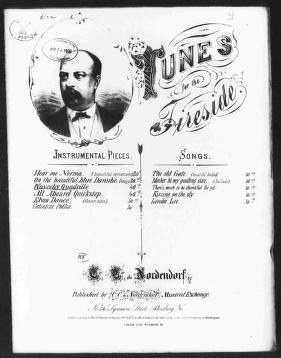
This is a printed cover or title page for instrumental music and songs associated with the Waverley Quadrille, a fashionable ballroom dance of the mid-nineteenth century. The composition is divided into two halves. On the left is a portrait bust of a bearded man in formal dress, identified as the composer or arranger. To the right, in large ornamental lettering, is the title "TUNES" with "Waverley" below it, and a decorative floral or scroll element above. Below the portrait are listed instrumental pieces—"Instrumental Pieces" is legible—and on the right side "Songs" with what appear to be song titles. At the bottom is a publisher's imprint: "Boosey & Co" with an address in London, and a note about copyright and binding. The printing is a wood-engraved or letterpress production typical of Victorian music publishing, with fine detail in the portrait and neat, orderly typography throughout. The overall design is functional and commercial rather than artistic—this is a page produced for sale to the public who would purchase the music to perform at home or in the ballroom.
The dancing
The portrait shows only a head and shoulders, so no dance posture is visible. The figure's formal attire—high collar, jacket—and groomed appearance indicate a gentleman of some standing, presumably the composer or musical arranger. No dancers appear in the image. The visual weight of the composition is on typography and the commercial presentation of the music rather than on choreographic content.
The dance depicted
The Waverley Quadrille was a quadrille—a formal square dance in four or five figures, usually danced by four couples arranged in a square formation. The title references Sir Walter Scott's *Waverley* novels, suggesting this was a themed dance, likely named to capitalize on the popularity of Scott's historical fiction. Quadrilles were central to ballroom dancing in the Victorian era and required a caller or musician to guide dancers through the prescribed figures. This printed music would have been used by musicians (pianists, violinists) to accompany dancers in drawing rooms and at public balls. The presence of both instrumental pieces and songs suggests the music could be performed in various settings and arrangements.
How it was made
This is a wood engraving or steel engraving, printed by letterpress, a standard and economical method for music covers and title pages in the 1870s. The fine lines of the portrait and the crisp typography indicate a skilled engraver. Such prints were mass-produced and widely distributed through music publishers' sales networks, making them affordable to middle-class households. The medium allowed for rapid reproduction and stable pricing, which was essential for a commercial music publication.
About this work
This is a printed cover or catalog page for the instrumental and vocal music of the Waverley Quadrille, produced by the London music publisher Boosey & Co. in 1873. It documents a specific ballroom dance that would have been performed by amateurs in Victorian drawing rooms and at public assemblies. The quadrille was one of the most popular social dances of the era, and themed quadrilles named after literary works or current events were common marketing devices. This object is both a practical guide for musicians and a document of Victorian leisure culture—it shows what music was available, who was publishing it, and implicitly, who was dancing.
How to look at it
Look at the title and publisher imprint to understand the commercial context. The portrait conveys authority and respectability—this is serious, publishable music from an established London house. The division of content (instrumental pieces on the left, songs on the right) reflects the dual purpose of the music: it could be used for dancing or for domestic singing. The orderly typography and fine engraving signal quality and professional production, reassuring purchasers that they were buying a reputable product. The absence of any illustration of the dance itself is notable—the focus is entirely on the music and the composer, reflecting the era's assumption that purchasers would know what a quadrille was and how to execute it.
The artist
The artist and engraver are not identified on the record. The portrait style and engraving technique are consistent with commercial Victorian music publishing of the 1870s. Many such portraits were created by house engravers or journeyman artists whose names were not recorded; attribution would require further research in publisher records or the British Museum's collection of prints.
The period
The 1870s were the height of the Victorian ballroom dance revival. After a period of relative decline in the 1850s–60s, quadrilles and other formal dances experienced renewed popularity in fashionable society and among the growing middle class. Sir Walter Scott's novels had been popular for decades but remained culturally powerful in the 1870s; naming dances after his works was a common marketing strategy. The rise of affordable home piano ownership and the expansion of published sheet music meant that dances that had once been confined to professionals and the wealthy became accessible to ordinary families. This print is a product of that democratization.
Where it lives
This print is held by the Library of Congress. It is a published commercial music cover from the London firm Boosey & Co., one of the major music publishers of the nineteenth century. Such prints were produced in quantity and distributed through music shops, making them common surviving objects.
Dance in this work
Questions about this work
What is a quadrille?
A quadrille is a square ballroom dance, usually for four couples, performed in a set of prescribed figures. Each figure is a distinct choreographic unit, often lasting 32 or 64 bars of music. A dancer or caller would announce or signal the figures to guide participants through the sequence. Quadrilles were the dominant social dance of the nineteenth century and were performed at all levels of society, from royal courts to village assemblies.
Why would a dance be named after a novel?
Victorian composers and publishers were highly responsive to current cultural trends and fashions. Naming a quadrille after a popular literary work (like Scott's *Waverley*) was a marketing strategy: it gave the dance a narrative theme, made it topical, and leveraged the existing popularity of the work to sell sheet music. Themed quadrilles often became fashionable, and ambitious hostesses would learn them to impress their guests.
Who would have bought this music?
This music was aimed at the Victorian middle and upper classes—households with pianos and the leisure time to learn and practice dances. A piano teacher, a young woman in a respectable family, or an amateur musician preparing for a social event would purchase this from a music shop. The relatively inexpensive price of printed sheet music (compared to hiring a professional orchestra) made ballroom music accessible to anyone with a modest income and a drawing room.
How do we know it was actually danced?
The title, publication by a reputable house, and the listing of both instrumental and vocal arrangements all confirm that this music was intended for actual use in dancing and social events. Surviving account books from publishers, dance manuals, and period diaries all document the quadrille as a staple of Victorian social life. This print is a product of real demand and real dancing.
More dance artwork





