49 works in this view — arrow keys or swipe to move between them.
Dance in Art · 1917
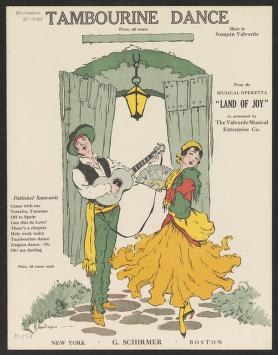
Tambourine dance : Danza de Crotalos
Unknown artist
- Source:
- Library of Congress
- Rights:
- Public domain — free to use, share and adapt.
- Recorded as:
- Public Domain
This image shows us how ballroom dance was presented to the public in 1917—as elegant, theatrical, and aspirational. It is also evidence of the standardized pedagogy of ballroom technique: the closed position, the frame, the led-and-follower relationship are all clearly depicted and would have been recognizable to anyone learning to dance at the time. The survival of such commercial materials tells us what dances were popular, how they were taught, and how they were sold.
What you are looking at
A couple dances in an elegant interior, framed by swaged curtains and a hanging lantern. The man, in dark formal attire with a white shirt, holds the woman in a ballroom frame. She wears a voluminous yellow skirt with a red bodice, her skirt billowing dramatically as though caught mid-turn. The floor is patterned, and potted plants flank the scene at ground level. The composition captures a moment of motion: the woman's body is angled and her weight appears to shift, while the man's frame is upright and controlled. The lighting is soft and theatrical, with the warm glow of the lantern above. The overall effect is that of a stage performance or illustration from a music cover or dance manual.
The dancing
The dancers are in a ballroom position with the man's right hand at the woman's back and their outside hands joined at shoulder height. The woman's body shows rotational energy—her torso is slightly twisted and her skirt and body create a spiral line upward. The man's posture is formal and stationary, providing the frame within which the woman executes a turning movement. The woman's arm position and the angle of her head suggest she is mid-rotation or mid-extension. The two figures are clearly in a led-and-follower relationship typical of ballroom technique.
The dance depicted
This is most likely a formal ballroom dance, possibly a waltz or one-step, based on the closed position, the woman's billowing skirt, and the theatrical setting. The title references 'Danza de Crotalos' (Castanets Dance), but the image depicts ballroom dance rather than Spanish or flamenco forms. The tambourine and castanets associations in the title may be decorative or may indicate a costume or theatrical version. The image suggests this was either a promotional illustration for a dance performance or a cover for published sheet music, a common format for disseminating dance culture in the 1910s.
How it was made
This is a color lithograph or chromolithograph, a technique that allowed for mass production of illustrated covers and promotional materials. The soft gradations of tone, the flat color fields (particularly in the yellow skirt and background drapery), and the use of multiple color layers are characteristic of lithography. The style is consistent with commercial theatrical printing of the 1910s–1920s era. The technique made such images affordable and widely circulated, especially as sheet music covers and dance instruction materials.
About this work
This is a commercial dance illustration from 1917, likely the cover of sheet music or a dance instructional publication. It depicts a couple in ballroom position executing a formal danced turn, with particular attention to the woman's voluminous skirt and the elegant interior setting. The work belongs in a gallery of dance imagery because it documents both how ballroom dance was performed and how it was marketed and consumed as popular entertainment in the early twentieth century. It is an artefact of the ballroom dance boom and of the commercial illustration industry that promoted it.
How to look at it
Observe the arrested moment of the turn: the woman's weight is clearly shifting, her body is rotating, and her skirt is flying. The artist has chosen the instant at which movement is most visible and most beautiful. Note the precision of the frame—the man's posture and the positioning of the hands are anatomically correct and would have been instructive to anyone learning ballroom technique. The setting, with its theatrical drapery and lantern, tells you this was aspirational entertainment, not everyday social dancing; this is dance as spectacle and as a mark of refinement.
The artist
The artist is not recorded. However, the style, technique, and subject matter are consistent with commercial theatrical lithography of the 1910s–1920s. The publishers listed on the cover—G. Schirmer in New York and Boston—suggest this was part of the major sheet music and dance instruction publishing apparatus of the period. The unsigned work was likely the product of a studio or commercial art department rather than a fine artist.
The period
The 1910s were the height of the ballroom dance craze in the United States and Europe. Dances like the Foxtrot, Waltz, and One-Step dominated popular entertainment, and sheet music covers were a primary medium for marketing both the music and the dance itself. Lithography made it possible to produce thousands of copies of attractive, color-printed covers that would hang on pianos and in dance studios. Simultaneously, ballroom dancing was being formalized into a codified technique with standardized positions and movements—the closed position and frame depicted here were part of that standardization. The theatrical presentation of dance, and the commercial mediation of dance knowledge, were both at their height.
Where it lives
The work comes from the Library of Congress and is catalogued as an illustrative cover or print, likely from sheet music or a dance instruction booklet. The publishers G. Schirmer (New York and Boston) were among the largest music publishers in the United States and also published dance instruction materials.
Dance in this work
Questions about this work
Is this a flamenco dance or a ballroom dance?
Despite the title's reference to 'Danza de Crotalos' (Castanets Dance), the image clearly depicts ballroom dance. The closed position, the frame, the woman's partner-supported turn, and the formal interior setting are all characteristic of European and American ballroom technique, not Spanish or flamenco forms. The title may be decorative or may indicate a theatrical or costume version, but the dance depicted is ballroom.
What can I learn about 1910s ballroom technique from this image?
The image documents the standardized closed position, the frame (man's right hand at woman's back, outside hands joined), and the led-and-follower relationship that were central to ballroom pedagogy. The woman's posture and rotation, and the man's stable frame, illustrate the principles of frame and lead that defined modern ballroom technique. This would have been instructive to a dancer of the period.
Why was this image made?
This was almost certainly a sheet music cover or dance instruction illustration, designed to be mass-produced and circulated. Such covers were marketing tools for both the music and the dance itself, and they hung on pianos and in dance studios. They were also instructive, showing dancers how to hold and move.
What does the lithography technique tell us?
Lithography made it possible to produce thousands of affordable, color-printed copies. This democratized dance imagery and marketing—a middle-class family could buy sheet music with an attractive cover, and a dance student could study such an image to learn technique. The technique was central to the commercialization of dance in the early 20th century.
More dance artwork





