49 works in this view — arrow keys or swipe to move between them.
Dance in Art · 1735
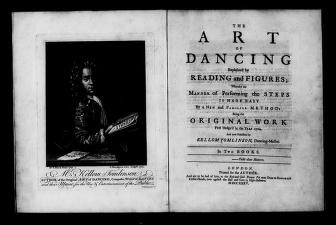
The art of dancing explained by reading and figures, whereby the manner of performing the steps is made easy by a new and familiar method: being the original work, first design'd in the year 1724, and now published by Kellom Tomlinson, dancing-master ... In two books
Unknown artist
- Source:
- Library of Congress
- Rights:
- Public domain — free to use, share and adapt.
- Recorded as:
- Public Domain
This is one of the earliest systematic attempts to codify and teach baroque dance technique through published notation and engraved illustration. The work shows how dance was understood in early 18th-century Britain: as a discipline requiring precise training of the body, teachable through visual and written instruction, and worthy of the same serious documentation as other arts and sciences. For anyone studying the history of dance pedagogy, notation systems, or the transmission of technique across generations, this frontispiece is foundational evidence.
What you are looking at
This is the title page and frontispiece of Kellom Tomlinson's *The Art of Dancing Explained by Reading and Figures*, a foundational 18th-century dance instruction manual. The left page shows a full-length portrait engraving of a male dancer in aristocratic dress: a coat with ornate buttons, breeches, and heeled shoes, posed in an elegant stance that demonstrates the upright carriage and turned-out legs characteristic of baroque dance technique. His posture is formal and composed, one arm extended gracefully, the other at his side. The right page is the ornate title page in serif typeface, indicating this work was designed in 1724 and published by Tomlinson himself, a dancing-master of the period. The engraving style and layout signal a work intended for serious study by the dancing profession and educated amateurs of means.
The dancing
The single male figure is shown standing in what appears to be a first or third position, with legs turned out at the hip in the classical manner. His posture is upright and refined, the spine extended, shoulders level. Both arms are positioned in a restrained, controlled manner—one raised to approximately shoulder height in a graceful line, the other held at the side. The positioning of the feet and the overall frame indicate the formal deportment required of a gentleman dancer of the period. This is not a moment of dynamic movement but rather a demonstration stance: the figure holds a pose that would teach by example.
The dance depicted
This is a portrait of a baroque dance master or accomplished amateur dancer, shown in the characteristic upright stance and turned-out leg position of 17th- and 18th-century courtly dance. The work documents the physical vocabulary of baroque dance technique—the carriage, the arm frame, the leg position—at a moment when such technique was being systematized into a teachable method. Tomlinson's manual, first designed in 1724, was one of the earliest attempts to notate and explain baroque dance steps through both written description and engraved figures. The portrait functions as both demonstration and ideal: showing the body properly trained in the art of dance as understood in the Georgian period.
How it was made
This is an engraving, a print made from an incised metal plate. The technique allows for fine detail in the rendering of fabric, musculature, and the subtle posture of the figure, and the high contrast between black line and white paper gives clarity to the demonstration of bodily position. Engravings were expensive to produce and therefore circulated among the educated and professional classes—in this case, dancing masters, their students, and aristocratic patrons who could afford instruction. The quality of the execution suggests a skilled hand, and the prominence of this portrait as frontispiece to Tomlinson's method signals the importance placed on visual as well as textual instruction in dance pedagogy of the period.
About this work
This is the frontispiece engraving to Kellom Tomlinson's *The Art of Dancing Explained by Reading and Figures*, a landmark work in dance notation and pedagogy first designed in 1724. The image shows a gentleman dancer in baroque courtly dress, posed to exemplify the upright carriage, turned-out legs, and restrained arm position that defined the technique of his era. As the visual introduction to a systematic method, the engraving served both to demonstrate proper form and to signal the professionalization of dance teaching in 18th-century Britain.
Tomlinson's work was radical in its ambition: to render dance—an art traditionally learned through imitation and live instruction—legible through notation and engraved figures. The frontispiece portrait announces this project visually: the dancer is not caught in a moment of narrative or entertainment, but posed as a type, a teaching model. For historians and dancers, this image documents both the technical ideal of baroque dance and the emerging belief that dance could and should be recorded, studied, and transmitted through the printed page.
How to look at it
Notice the precision of the posture: the turned-out legs, the extended spine, the controlled arm position. This is not a candid or naturalistic body, but a disciplined one, held in a specific alignment that was learned through repetition and correction. The engraver has been careful to show the musculature and weight distribution that support this posture. The formal, frontal presentation of the figure—not mid-leap or mid-turn, but standing still—emphasizes that this is a demonstration of underlying principle rather than a moment of theatrical spectacle. The elegance of the clothing reinforces that this is a gentleman's accomplishment, not a professional performer's trade.
The artist
Kellom Tomlinson (c.1697–1753) was a London dancing-master and choreographer of the Georgian period. He is documented as having taught dance to members of the aristocracy and gentry, and his published method was an attempt to systematize the teaching of baroque dance at a moment when the style was beginning to give way to newer fashions. Tomlinson's work is valued by historians as one of the most detailed surviving accounts of how baroque dance was actually performed, step by step, in the early 18th century. The engraved figures in his manual remain among the clearest visual documents of period technique.
The period
The early 18th century saw an emerging interest in systematizing and recording dance knowledge. The aristocratic pastimes of the late 17th century were being codified into teachable methods; professional dancing masters like Tomlinson sought to establish their authority through publication and notation. This period also saw the rise of the engraved dance manual as a genre: Raoul Auger Feuillet's notation system, published in Paris in 1700, had influenced thinking across Europe about how dance could be recorded and transmitted. Tomlinson's work, combining written explanation with engraved demonstration figures, belongs to this moment of professionalization and documentation. Simultaneously, baroque dance itself was gradually being superseded by the emerging styles of the mid-18th century, making Tomlinson's careful record all the more valuable to posterity.
Where it lives
This frontispiece comes from the Library of Congress, which holds copies of Tomlinson's *Art of Dancing Explained*. The work is known through surviving copies held in major institutional collections, indicating that it circulated among the educated and professional classes of 18th-century Britain and beyond.
Dance in this work
Questions about this work
What is this person doing?
He is standing still in a posed position that demonstrates correct baroque dance posture and technique. This is a teaching image: the position shown—upright spine, turned-out legs, controlled arm position—was the foundation of courtly dance training in the early 18th century. He is not performing a specific step or dance, but rather holding a stance that could be analyzed and imitated by students.
Who was Kellom Tomlinson?
A London dancing-master active in the early 18th century, Tomlinson taught aristocratic and upper-class students and published his method in 1735 to systematize the teaching of baroque dance. His manual, combining written descriptions with engraved figures like this one, is one of the most detailed surviving records of how baroque dance was actually performed.
Why does this matter for dance history?
This is one of the earliest examples of dance being recorded and transmitted through publication. At a moment when dance was still primarily learned through live imitation, Tomlinson argued that it could—and should—be notated and illustrated for study. The work captures baroque technique at a moment when it was being professionalized and codified, just before it began to go out of fashion.
What style of dance is this?
This is baroque dance, the courtly style of the 17th and early 18th centuries. The technique is characterized by turned-out legs, an upright carriage, small precise steps, and controlled arm movements. By the time Tomlinson published his method in 1735, this style was already beginning to be superseded by lighter, more mobile forms of dance.
More dance artwork





