49 works in this view — arrow keys or swipe to move between them.
Dance in Art
Urban Social Dance, Jamaica Fieldwork
Unknown artist
- Source:
- Library of Congress
- Rights:
- Public domain — free to use, share and adapt.
- Recorded as:
- Public Domain
Most archival photographs of Caribbean dance from this period were either staged performances or posed studio shots; unguarded documentation of social dance in its actual context is rare. This image provides evidence of the informality, spacing, and body mechanics of Jamaican social dance outside the frame of concert or tourist performance, making it an important ethnographic record for understanding the vernacular roots of later dancehall and reggae culture.
What you are looking at
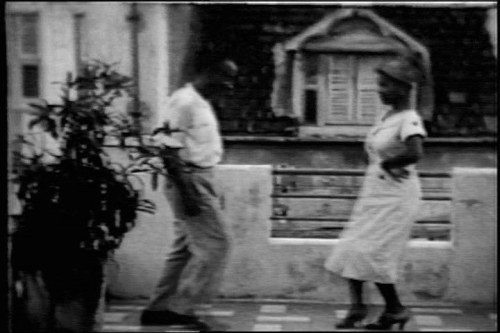
A black-and-white photograph captures an outdoor social dance scene in Jamaica, shot from a medium distance. Two figures dominate the frame: a man in light-colored shirt and trousers on the left, and a woman in a light-colored dress on the right, both in active dance posture. A third figure appears partially visible in the background. The setting is a residential street or yard with wooden structures—a house with shuttered windows visible behind the dancers, and what appears to be a small outbuilding or shed with a peaked roof to the right. Tropical vegetation (a potted plant or shrub) sits in the foreground to the left. The ground is unpaved or lightly surfaced. The photograph's grain and contrast are consistent with mid-20th-century fieldwork documentation.
The dancing
Both visible dancers are upright and mobile, their bodies angled toward each other in social engagement rather than formal partnered hold. The man's posture suggests forward motion or weight shift; the woman's body orientation and arm position indicate dynamic response. Neither dancer exhibits the closed frame or rigid frame of ballroom dance. The spacing between them and their relative positions suggest a social, participatory style rather than choreographed sequence. A third figure is barely resolved in the background, suggesting this is one moment within ongoing group activity.
The dance depicted
This is a documentation of Jamaican urban social dance, likely from the mid-20th century based on the photographic style and the record's indication of fieldwork. The outdoor residential setting, informal grouping, and the relaxed but energetic postures of the dancers are consistent with Caribbean social dance practice—potentially mento, ska, or an early form of dancehall, all of which were danced socially in community spaces. The photograph captures vernacular dance as lived practice rather than performance, showing how dance functioned in everyday social life. The exact style cannot be determined from posture alone, but the informality and context strongly suggest diaspora-afro-popular tradition.
How it was made
This is a black-and-white photograph, likely a gelatin silver print or similar period process. The grain, contrast range, and depth of field are consistent with hand-held documentary photography of the 1940s–1960s. The source attribution to the Library of Congress suggests this is part of a larger fieldwork collection, possibly ethnographic or folkloristic in purpose. The technical qualities—sharp enough to read posture and setting, but without studio lighting—indicate a photographer working with available light in an uncontrolled environment, prioritizing documentation over aesthetic refinement.
About this work
This photograph documents a moment of social dance in Jamaica, captured as fieldwork material. It shows two dancers in an outdoor residential setting, engaged in what appears to be vernacular Caribbean social dance. The image is valuable precisely because it captures dance as a lived, informal social practice rather than a staged performance—the dancers are unaware of or indifferent to the camera, and the setting is everyday rather than ceremonial. It belongs in a dance gallery because it preserves evidence of how urban Caribbean communities danced together in the mid-20th century, offering a window into diaspora-afro-popular tradition as practiced in domestic and community space.
How to look at it
Notice the woman's weight and the angle of her spine—she is responding to the man's movement, not following a predetermined pattern. Watch the space between them: it is neither the closed frame of ballroom nor the entirely separate spacing of line dance, but something in between, characteristic of Caribbean social dance where partners maintain connection through spatial awareness and eye contact rather than hand hold. The outdoor setting is not incidental: Caribbean social dance happened in these spaces, at this social distance, with this informality.
The artist
The photographer is not recorded. The image is held by the Library of Congress and appears to be part of a larger fieldwork project, likely conducted by an ethnographer, folklorist, or cultural documentarian in Jamaica. The systematic nature of the archive suggests institutional affiliation rather than casual tourism.
The period
Jamaica in the 1940s–1960s was a site of dynamic cultural synthesis: colonial-era folk traditions (mento), newly emerging urban styles (ska, developing dancehall), and African diaspora practices were all active and mutually influencing. Social dancing in streets and yards was a primary mode of musical and physical expression, especially in Kingston and other urban centers. Simultaneously, Western academic and institutional interest in Caribbean folklore and ethnography was growing, explaining the presence of fieldwork documentation.
Where it lives
The photograph is held by the Library of Congress and is catalogued as part of Jamaica fieldwork documentation. No accession number, date, or photographer name are recorded in the current catalogue entry.
Dance in this work
Questions about this work
What dance is this?
The exact style cannot be named from posture alone, but the context—outdoor Jamaica, mid-20th century, informal social setting—points toward mento, ska-era social dance, or an early form of dancehall. The relaxed spacing and responsive body positioning are characteristic of Caribbean diaspora-afro-popular tradition.
Is this a performance or social dancing?
This is social dancing in its actual context. The dancers are in a residential yard or street, engaged in community socializing, not performing for an audience. The photograph documents dance as lived practice rather than staged entertainment.
Why is this in the Library of Congress?
The image is part of a larger fieldwork or ethnographic documentation project on Jamaican culture, suggesting it was collected by an academic or institutional researcher interested in preserving evidence of Caribbean folk and social practice.
More dance artwork





