49 works in this view — arrow keys or swipe to move between them.
Dance in Art · 1918
Dance or die
Unknown artist
- Source:
- Library of Congress
- Rights:
- Public domain — free to use, share and adapt.
- Recorded as:
- Public Domain
This poster is a rare surviving document of early American theatrical dance production, showing both how classical dance was performed and how it was sold to the public in the early 20th century. The gap between the poster's title ("Pamela") and the generic headline ("Dance or Die") suggests narrative sophistication and emotional stakes that distinguished theatrical dance from pure spectacle. For historians and dancers, it preserves visual evidence of costuming, figure type, and aesthetic values in a period when American dance was forming its institutions and identities.
What you are looking at
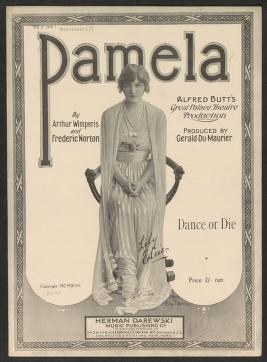
This is a theatrical poster for a dance production or performance, printed in a classical early 20th-century style with ornamental borders. The central image shows a single female figure in a flowing, classical Greco-Roman style draped gown, posed in a contemplative stance with one hand raised to her head. She wears what appears to be a simple tunic or peplos with a sash or girdle at the waist, and her hair is styled in a classical manner. The figure is set against a plain background, positioned centrally within a decorative rectangular frame. At the top of the poster, the title "Pamela" appears in large serif lettering. Below the image are printed credits listing the cast and creative team, including names such as Arthur Majors, Frederic Norton (suggesting music and direction), Alfred Batts, and information about producers Gertrude Maurice. The bottom of the poster bears a Library of Congress mark and a date of June 27, 1918, identifying this as a surviving theatrical advertisement document.
The dancing
The single dancer stands with weight distributed evenly, her body upright but not rigid. Her left arm is raised with the elbow bent, the hand brought near to her head in a gesture that suggests pensiveness or sorrow. Her right arm hangs at her side. The pose is static and sculptural rather than dynamic, emphasizing classical stillness over movement. The flowing drapery of her costume obscures the legs and feet, so no footwork is visible. The overall frame is dignified and statuesque, suggesting a moment of emotional pause rather than active choreography.
The dance depicted
The costume, classical drapery, and statuesque pose indicate this is likely classical ballet or interpretive/theatrical dance in the early 20th-century fashion—what was then called "classical" or "art" dance, distinct from popular or ballroom forms. The emphasis on Greco-Roman aesthetic conventions, the contemplative gesture, and the title "Pamela" suggest this was a narrative or character-driven piece rather than abstract movement. The 1918 date and theatrical credits place this within the era of theatrical dance performance in America. Without access to reviews or programs, the specific choreography cannot be determined, but the visual language clearly belongs to theatrical rather than social dance.
How it was made
This is a commercial theatrical poster, likely a lithograph or photomechanical print from 1918, designed for public display and circulation. The quality of line work, the uniform tonal values, and the decorative border treatment are consistent with early 20th-century printing techniques. The use of photographic imagery of an actual performer combined with printed text and ornamental design elements was standard for theatrical marketing of the period. The survival of this object through the Library of Congress indicates its value as a historical record of American theatrical production.
About this work
"Dance or Die" (titled "Pamela" on the poster itself) is a 1918 American theatrical dance production preserved as a printed promotional poster. The image documents a moment in early 20th-century American dance performance when classical ballet and interpretive dance were beginning to establish themselves as legitimate theatrical genres. The classical costume and statuesque pose of the single figure suggest a narrative work—likely a one-act piece or a scene from a longer production—that drew on European classical aesthetics while being mounted for an American audience. As a poster, the work is significant not as a dance artwork itself but as evidence of how dance was marketed, imagined, and commodified in 1918 America.
How to look at it
Note the stillness of the pose and the prominence given to the fabric and drapery rather than to dynamic movement or complex footwork. This reflects early 20th-century theatrical aesthetics, which often preferred the tableau, the held gesture, and classical proportion to rapid or virtuosic movement. The raised hand and downward gaze suggest a narrative moment—the viewer is invited to imagine the story and emotion that surrounds this instant. The decorative border and symmetrical composition reinforce the sense of a formal, precious object rather than a document of actual motion.
The artist
The poster credits list Arthur Majors, Frederic Norton, and Alfred Batts, with production by Gertrude Maurice. Beyond these names, the individual artists responsible for the poster's design, photography, or lithography are not documented in the record. These individuals were part of the theatrical apparatus of 1918 New York or another major American theatre center, working in the standard commercial mode of theatrical marketing.
The period
In 1918, American theatrical dance was in transition. Ballet was not yet institutionalized in the United States (the first American ballet companies would not be founded until the 1930s), but interpretive and classical dance forms—influenced by European models and the American tradition of physical culture—were establishing themselves on stage. Isadora Duncan and Ruth St. Denis had already transformed American attitudes toward dance as an art form. The Greco-Roman costuming visible in this poster reflects the early 20th-century taste for classical references in interpretive dance, a legacy of Duncan's influence. Theatrical posters of this period used photography combined with printing to create a sense of authenticity and star appeal, making the performer's image the primary vehicle of marketing.
Where it lives
This poster is held in the Library of Congress collections and is catalogued as a theatrical advertisement from 1918. It represents the standard survival pattern for early theatrical materials: printed promotional matter survives more frequently than photographs, programs, or dance notation, making posters among the primary visual sources for reconstructing early 20th-century dance.
Dance in this work
Questions about this work
Is this a painting or a print?
This is a theatrical poster, almost certainly a lithograph or photomechanical print combining a photograph of a performer with printed text and decorative design. It was produced for mass distribution and public posting, not as a unique artwork.
What does the title 'Dance or Die' mean?
This appears to be either the title of the entire production or a subtitle indicating its dramatic stakes. The actual work seems to have been called "Pamela," which appears as the primary title on the poster. Without surviving reviews or programs, the exact meaning is unclear, but the phrase suggests a work with emotional or narrative intensity.
What kind of dance is this?
Based on the classical costume, the statuesque pose, and the date, this is likely classical ballet or theatrical interpretive dance in the American style of the early 20th century. The emphasis on Greco-Roman aesthetics and still poses rather than dynamic action suggests the influence of artists like Isadora Duncan.
Who danced in this production?
The poster credits name Arthur Majors, Frederic Norton, and Gertrude Maurice, but it is not entirely clear from the poster alone whether any of these individuals were the performer shown in the image. Additional research would be needed to identify the dancer definitively.
More dance artwork





