49 works in this view — arrow keys or swipe to move between them.
Dance in Art · 1881
Tempo di menuetto
Unknown artist
- Source:
- Library of Congress
- Rights:
- Public domain — free to use, share and adapt.
- Recorded as:
- Public Domain
This piece documents the cultural afterlife of the minuet in the industrial age. It shows that formal dances did not simply disappear from memory; they were actively taught, published, and performed, particularly in concert and ballroom contexts. For historians of both music and dance, it is evidence of how a 300-year-old form remained part of educated culture well into the modern era.
What you are looking at
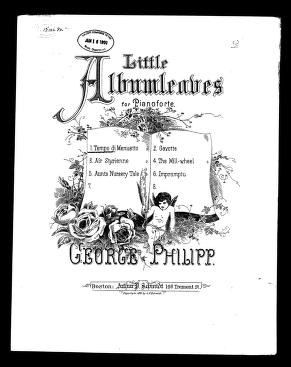
This is the title page of a published dance score or instructional work, printed in 1881. At the top, an oval vignette frames the words "Little Alcmeneaves" or similar; below it stands an ornamental design of flowers and foliage in a romantic style typical of Victorian music publication covers. The central text reads "Tempo di menuetto" in large decorative lettering, surrounded by a border of roses and scrollwork. Below the title appears a list of dance figures or movements (the text is small but includes entries like "J. Mosant," "J. Stern," "J.K. Donarita," and others, suggesting these are either steps, variations, or credited contributors). At the bottom, in smaller type, appears the composer or publisher credit: "GEORGE PHILIPP" with what appears to be a publication line. The overall aesthetic is that of a mid-Victorian printed score—engraved or lithographed, with hand-lettered or hand-drawn decorative elements integrated into the typography. The paper is aged and shows foxing characteristic of 19th-century printing.
The dancing
No actual dancers appear in this image. This is a title page or cover sheet, not a depiction of dance in motion. The work would document or prescribe the minuet—a dance form that requires two dancers in formal closed position, moving with small, deliberate steps and a characteristic rise and fall of the body—but the visual evidence for how those steps were executed is absent from this particular page.
The dance depicted
The title *Tempo di menuetto* ("minuet tempo") indicates this is a score or instruction for the minuet, the formal court dance that dominated European ballrooms from the 17th century through the 19th. By 1881, the minuet was primarily an historical or ceremonial dance, though it remained part of classical ballet vocabulary. The attribution to George Philipp (likely a pianist or composer) and the presence of what appear to be step names or variation titles suggest this is either a musical composition in minuet time, or possibly a choreographic notation or instruction guide. The minuet was always danced by couples in strict formation, with precise, measured timing and an emphasis on deportment and elegance.
How it was made
This is a printed page, most likely an engraving or lithograph on paper, typical of late-Victorian music publishing. The decorative borders and lettering show the hand of a skilled music engraver. The process allowed for wide circulation of dance and music instruction to middle-class and aristocratic households. The elaborate floral ornament and careful typography reflect the high production standards of Philipp's publisher (the imprint line is not fully legible but likely identifies a European music house). Such covers were designed to appeal to amateur pianists and dancers learning the form at home.
About this work
This is the cover or title page of a published work documenting or teaching the minuet, dated 1881. Although the minuet's heyday had long passed, it remained culturally significant as both a historical dance and a fundamental part of classical ballet education. The publication speaks to the persistence of the form in late-Victorian musical and social life, particularly among the educated middle classes who could afford printed scores and instruction. The work is an artifact of how dance knowledge was transmitted through the 19th century—not through visual notation or photography, but through the marriage of music and written or choreographic instruction.
How to look at it
This page is best understood as a material artifact rather than a depiction. Look at the quality of the engraving, the choice of ornamental devices, and the hierarchy of type to understand how dance knowledge was packaged and sold in the Victorian period. The formal, symmetrical layout and the refined floral ornament communicate a sense of elegance and propriety associated with the minuet itself. The title *Tempo di menuetto* is the key visual element—it tells the dancer and musician what rhythm and character to expect, even before a single note is heard or step taken.
The artist
George Philipp is not immediately identifiable from this page alone. The name suggests a German or Continental composer, but without further research into the publisher's imprint or music library catalogues, no firm biographical statement can be made. The quality of the engraving and the professional presentation suggest a reputable music house and an artist with training and standing in the publishing world.
The period
The 1880s were a time of rapid change in both dance and music publishing. Classical ballet was undergoing revival and codification under figures like Enrico Cecchetti, while ballroom dancing was evolving into the modern international standard and Latin styles. Simultaneously, music printing had become highly industrialized and affordable, allowing popular and historical music to reach a mass market. The minuet, by this date, was primarily a historical form studied by dancers, pianists, and music students, or occasionally revived in operatic or theatrical contexts. Its presence in printed form in 1881 reflects nostalgia for courtly manners and classical form during an era of rapid social and artistic change.
Where it lives
The source is listed as 'loc' (Library of Congress). This is a published score or instructional work from a commercial music house, likely part of a series or catalogue. It survives as a printed artifact in a major institutional collection.
Dance in this work
Questions about this work
Is this a score, a dance notation, or an instruction book?
It appears to be a title page for a published musical score in minuet form, possibly paired with choreographic instruction or intended for ballroom or concert use. Without seeing the interior pages, the exact nature cannot be determined, but the presence of what appear to be step or variation names suggests it combines musical and choreographic information.
Why would anyone publish the minuet in 1881, when it was already centuries old?
The minuet remained central to classical ballet training, was frequently performed in theatrical and concert contexts, and was still taught in ballroom dancing. Its formal structure and historical prestige made it a standard part of musical and dancerly education for the middle and upper classes.
Who was George Philipp?
Without access to music library records or further research, he cannot be definitively identified from this page alone. The quality and style of the work suggest a competent composer or musician working within the professional publishing world of Continental Europe.
More dance artwork





