49 works in this view — arrow keys or swipe to move between them.
Dance in Art · 1906
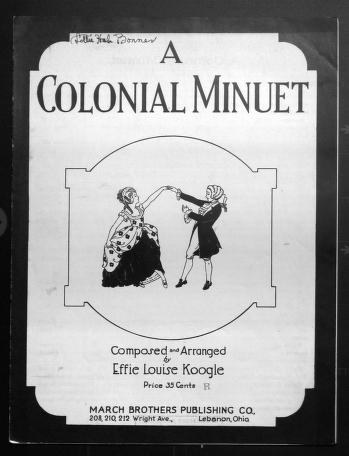
A colonial minuet
Unknown artist
- Source:
- Library of Congress
- Rights:
- Public domain — free to use, share and adapt.
- Recorded as:
- Public Domain
The cover illustrates how the minuet persisted in American cultural memory well into the twentieth century, reconstructed as a historical reference point and marketed as a genteel accomplishment. The stylized, diagrammatic rendering of the dancers reveals the period's understanding of what 'colonial' dancing looked like—upright, formal, property-conscious—and how that image was reproduced and sold.
What you are looking at
A sheet music cover presents two figures in eighteenth-century dress against a plain white background. On the left, a woman in a floral patterned gown with full skirts stands in a composed pose, her torso upright and her right arm extended. Opposite her stands a man in dark coat and breeches, also in an upright posture, with his right arm raised in a gestural movement. Both figures maintain clear separation and formal bearing. The composition is framed within a rounded rectangle, and the overall design is spare and schematic rather than naturalistic—the figures read as type examples or dance position illustrations rather than a narrative moment.
The dancing
The woman stands with weight centered, her extended arm at shoulder height in an open, welcoming gesture. The man faces her with an elevated arm position that reads as courtly address or invitation. Neither figure leans toward the other; instead, they maintain formal distance characteristic of courtly protocol. The postures suggest the kind of stylized, upright carriage expected in eighteenth-century dance, with no apparent weight shift or dynamic propulsion—the bodies are still and positioned rather than moving.
The dance depicted
This is a minuet, one of the most formal and widely documented court dances of the seventeenth and eighteenth centuries. The title 'A Colonial Minuet' and the 1906 date suggest an American arrangement or composition evoking the colonial period's dance culture. The minuet was characterized by measured, stately movement in triple time, with dancers maintaining upright posture and moving through specific step patterns and geometric figures. The distance between the figures and their formal address gestures reflect the minuet's conventions of courtly politeness and restraint—this was a dance of social propriety, not intimacy.
How it was made
This is a printed sheet music cover, likely a lithograph or letterpress reproduction from the early twentieth century. The flat, graphic style and clean line work are consistent with commercial music publishing of the period. The design uses minimal illustration—the figures are rendered schematically in black line against white, relying on type and composition rather than detailed artistic rendering. This format and approach suggests wide distribution through the music publishing industry, reaching domestic consumers purchasing popular or pedagogical pieces for home performance.
About this work
This is a cover design for a published minuet composition titled 'A Colonial Minuet,' arranged by Effie Louise Koogle and published by March Brothers Publishing Company in 1906. It preserves the visual language of eighteenth-century courtly dance through simplified, typological figures positioned in formal address. The work exemplifies how early twentieth-century American culture packaged colonial aesthetics as decorative and purchasable—a form of historical nostalgia rendered as domestic entertainment. For students of dance history, the sheet music cover documents both the minuet's enduring cultural prestige and the conventions by which period dance was communicated to amateur performers a century after its heyday.
How to look at it
Attend to the formal distance and upright posture of both figures—this is the opposite of the fluid, forward-moving dynamics of later ballroom dance. The raised arm of the male figure is a gesture of address or invitation, a moment of social negotiation rather than physical momentum. The woman's composed stance, with her patterned gown fully displayed, reflects the minuet's function as a showcase for dress and courtly manners. The graphic simplicity is itself instructive: the cover conveys the essential positions and social bearing of the minuet without naturalistic detail.
The artist
Effie Louise Koogle is credited as the composer and arranger. The March Brothers Publishing Company, based in Lebanon, Ohio, published popular music and educational pieces for the home market during the early twentieth century. No further information about Koogle's biographical background or other compositions is available from the catalogue record.
The period
The minuet was created in seventeenth-century France and became the central social and theatrical dance of the eighteenth century throughout Europe and colonial America. By 1906, when this arrangement was published, the minuet had been out of active social practice for nearly a century, yet it retained powerful cultural associations with refinement, history, and genteel femininity. The early twentieth-century American fascination with colonial aesthetics—furniture, architecture, dress—extended to dance, and the minuet became a symbol of the nation's imagined cultured past. Publishing didactic or nostalgic minuet arrangements was a commercial response to this cultural appetite.
Where it lives
This is a sheet music cover held by the Library of Congress. It represents the commercial music publishing industry's production of dance-related material for domestic and educational consumption in the early twentieth century.
Dance in this work
Questions about this work
What is a minuet?
The minuet is a stately court dance in triple meter that originated in seventeenth-century France and dominated European ballrooms and theatrical stages throughout the eighteenth century. It was characterized by measured steps, upright carriage, and formal geometric patterns, and it served as a primary vehicle for displaying courtly politeness and social rank. The dance required training and was considered a marker of gentility.
Why did early twentieth-century Americans care about colonial minuets?
The early 1900s saw a widespread American fascination with the colonial period as a source of national identity and refined heritage. Dance instruction books, sheet music arrangements, and household music publishing capitalized on this nostalgia by offering minuet pieces and recreations. These materials allowed middle-class Americans to access (or imagine they accessed) the genteel culture of their historical past.
How do you dance a minuet?
A minuet is danced in couples or small groups, moving through prescribed step patterns in triple time. The basic step (called a 'minuet step') involves a step forward, bringing the feet together, and stepping back, executed with grace and lift. Dancers maintain upright posture, move through geometric floor patterns, and perform arm gestures and bows that signal courtesy and social hierarchy.
Is this sheet music still in use?
Not in active social dancing—the minuet is now primarily historical, reconstructed by dance historians and performed in theatrical contexts or educational demonstrations. However, minuet arrangements continue to be published for piano students and in educational recordings of baroque and classical music.
More dance artwork





