49 works in this view — arrow keys or swipe to move between them.
Dance in Art · 1917
Dance and grow thin
Unknown artist
- Source:
- Library of Congress
- Rights:
- Public domain — free to use, share and adapt.
- Recorded as:
- Public Domain
This object reveals how dance was marketed and understood in the American 1910s, not as an art form to be studied but as a consumption experience linked to bodily discipline and entertainment. The gendered promise encoded in 'dance and grow thin' illuminates the intersection of performance, fitness, and consumer capitalism that would shape dance culture for the century to follow.
What you are looking at
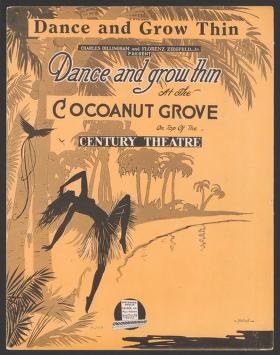
This is a printed cover for sheet music, rendered in sepia tones with decorative Art Deco styling. A solitary female figure dominates the composition, posed in a dynamic diagonal lean that suggests movement through space. She wears a sleeveless dress or performance costume and extends her limbs in an elongated, graceful silhouette. The setting is stylized rather than realistic: a tropical landscape of palm trees in simplified forms creates a leisure-destination backdrop, while the figure herself seems almost to glide above the ground. The text "Dance and grow thin" appears twice—once at the top in cursive lettering and again in the center—alongside venue information identifying the Cocoanut Grove and Century Theatre. The overall effect is that of a fitness-adjacent entertainment advertisement, where dance is positioned as both spectacle and bodily transformation.
The dancing
The single figure is depicted in a striking contrapposto pose, weight shifted to one leg while the other extends behind in a trailing gesture. Her arms are asymmetrically arranged—one reaching forward or upward, the other trailing back—creating a sense of forward propulsion. The body is rendered with elongated proportions characteristic of Art Deco illustration, emphasizing the line of the spine and the extension of the limbs. There is no closed hold, no partner, and no group formation; this is a solo figure frozen in what reads as a moment of sustained glide or sustained leap.
The dance depicted
The image does not depict any specific codified dance style. Instead, it advertises a performance or exhibition of social/exhibition dancing marketed under the slogan "Dance and grow thin," a weight-loss pitch common in the 1910s–1920s fitness culture. The figure's pose—elongated, graceful, deliberately languid—reads as theatrical rather than ballroom or vernacular. The absence of any identifiable hold, costume detail, footwork, or companion suggests this is a stylized idealization of the female dancing body as an instrument of slimming and bodily discipline, not a representation of how any actual dance style was performed.
How it was made
This is a printed sheet-music cover, likely a lithograph or letterpress reproduction given the consistent color register and the quality of line reproduction visible in the image. The technique allowed for mass circulation at low cost, making this an artifact of commercial popular culture aimed at amateur musicians and dancers, not concert audiences. The sepia palette and simplified forms suggest a hand-drawn or hand-colored original, reproduced for wide distribution. The presence of typography, venue names, and commercial framing confirms its function as a marketing document as much as a work of visual art.
About this work
This is a commercial sheet-music cover from 1917 that uses the figure of a dancing woman to advertise both a performance and an implicit promise of physical transformation through dance. The work sits at the intersection of entertainment marketing, fitness culture, and modernist design: the Art Deco simplification of the human figure coincides with early-twentieth-century discourse about dance as a tool for weight management and modern feminine embodiment. It represents not a dance tradition or technique, but rather the commodification of the dancing body in the Jazz Age, when performances at venues like the Cocoanut Grove drew urban leisure audiences seeking novelty, exoticism, and the promise of bodily improvement.
How to look at it
Attend to the exaggeration of the figure's proportions: the impossibly long limbs and slender torso are not naturalistic but aspirational, encoding the visual fantasy the cover is selling. Notice the asymmetry of the pose—the trailing gestures, the forward lean—which conveys motion and energy without depicting actual technique. The tropical setting is purely decorative, a cliché of leisure and escape. The typography and venue names are integral to the image's meaning; this is not fine art but an advertisement, and the way it frames both the venue and the promise ('grow thin') reveals the commercial logic driving the work.
The period
The work dates to 1917, near the height of the ragtime and early jazz era, when social dance venues in major American cities became sites of mass entertainment and moral anxiety. The Cocoanut Grove was a fashionable Los Angeles nightclub of the era, part of a boom in theatrical and dance-hall venues. Simultaneously, the 1910s–1920s saw intense promotion of physical culture, gymnastics, and dance as tools for women's health and beauty—a discourse that positioned movement as both liberatory (in the context of new freedoms for women) and disciplinary (in its focus on the body as an object to be shaped and reduced). The Art Deco visual language—simplified forms, elongated figures, geometric clarity—was just emerging as the dominant modernist aesthetic for commercial design.
Where it lives
This object is held at the Library of Congress and represents their collection of popular sheet-music ephemera. It is a mass-produced commercial item, not a unique work, and would have been accessible to amateur musicians and dancers as an affordable cultural product.
Dance in this work
Questions about this work
What does 'dance and grow thin' mean?
In the 1910s–1920s, dance was actively marketed as a form of physical exercise and weight loss. This slogan reflects early fitness culture, when dance classes and performances were promoted to women as a way to achieve a slim figure. The promise on this cover combines entertainment with implicit bodily discipline.
Is this showing a real dance style?
No. The pose is stylized and idealized, not the representation of any specific dance technique. It is a modernist graphic interpretation of the female dancer as a symbol of contemporary leisure and physical transformation, not a documentation of how any particular dance was performed.
Why is the figure alone?
The isolation of the figure emphasizes the individual female body as the object of transformation and display. Unlike ballroom or social dances, which are partnered, this image positions dance as a solo practice of self-improvement, reflecting broader trends in women's fitness culture of the era.
More dance artwork





