49 works in this view — arrow keys or swipe to move between them.
Dance in Art · 1921
L'Heure du dancing
Unknown artist
- Source:
- Library of Congress
- Rights:
- Public domain — free to use, share and adapt.
- Recorded as:
- Public Domain
This image captures the mythology of the modern dance hall and the Roaring Twenties at the moment when dancing became a mass-market entertainment and social institution. For dance historians, it documents not choreography or technique but the culture and visual economy surrounding dance—how the body was displayed, how audiences were positioned, and how dancing women were represented in commercial visual media. The work shows the intimate connection between modernism, leisure, gender, and the rise of nightlife as a defining feature of 20th-century urbanism.
What you are looking at
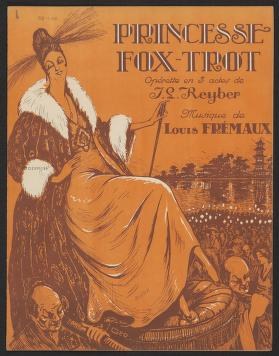
A woman in an exotic costume sits enthroned above a crowd of onlookers in what appears to be a fashionable dance venue or cabaret. She wears a long golden-yellow gown with voluminous skirts and a fur-trimmed wrap or shawl draped across her shoulders, her dark hair arranged in an elaborate upswept style adorned with feathers or ornaments. The composition is theatrical and hierarchical: she dominates the upper portion of the frame in a pose of leisure and display, while below her a dense crowd of men in dark suits and hats gazes upward in rapt attention. The setting suggests the interior of a nightclub or dance hall, with the crowd arranged as if witnessing a performance or spectacle. The art style is an ornate color lithograph with rich ochre and gold tones dominating the palette, the figures rendered in bold outline with flattened perspective typical of early 20th-century poster art.
The dancing
The central figure reclines in a posed, stationary position rather than demonstrating active movement—her body is elongated and relaxed, one leg extended, her torso angled for visual display rather than kinetic purpose. Her arms and hands are positioned to frame and present herself. The crowd below consists of static male spectators arranged in loose groupings, their postures bent forward or upturned in attention. No dancers are shown in active hold or partnered movement; the composition separates the displayed female body from the male gaze rather than depicting an interaction between dance partners.
The dance depicted
This is not a depiction of dance technique or a dance in motion, but rather the visual representation of a dance-hall or cabaret culture—specifically the moment of display and spectatorship that surrounds performance. The image captures the social milieu of 1920s ballroom and club culture rather than a specific dance style. The woman is presented as a performer or attraction, and the composition emphasizes the theatrical staging and voyeuristic structure of the venue rather than choreography or movement quality. The title and context suggest this is related to the culture of dancing (le dancing) and the fashionable leisure activities of the period, but it is fundamentally a genre scene of nightlife rather than a technical study of dance.
How it was made
This is a color lithograph, a printmaking technique that allowed for mass production and distribution as a poster or advertisement. The bold outlines, flattened forms, and vivid color palette are characteristic of the Art Deco and poster-art aesthetic of the 1920s. Lithography's capacity for rich color and graphic impact made it the dominant medium for advertising entertainment venues and events of this era. The technique enabled this image to function as both fine art and commercial publicity, reaching a wide urban audience through distribution in cafés, dance halls, and shop windows.
About this work
This is a French poster or print from 1921 advertising or celebrating the culture of le dancing—the fashionable dance halls and cabarets that defined urban leisure and modernity in the Jazz Age. Rather than depicting a specific dance or dance technique, it captures the social spectacle and gendered dynamics of the ballroom venue: the presentation of the female performer to an enraptured male audience. The work is a artifact of dance culture in its commercial and social dimension rather than its technical or artistic practice. It belongs in a gallery of dance in art because it documents how dance and dancers were imagined, marketed, and consumed in early 20th-century popular culture, and because the figure of the dancing woman and the nightclub scene became central to modernist art and literature.
How to look at it
Attend to the composition's division between the displayed female body and the male gaze: note how the woman is positioned above and apart, recumbent and presented, while the men below are arranged as an audience. Observe the luxurious detail lavished on her costume—the furs, the jewels, the elaborate hair—and how the poster style flattens and stylizes her body for decorative impact. The work is not about dancing as movement but about the theater of the dance hall itself—the ritualized display, the separation of performer from spectator, and the commodification of the female figure within that economy.
The artist
The artist is not recorded. The style is consistent with French Art Deco and poster design of the 1920s, a period when commercial lithography flourished as both advertising medium and artistic practice. The composition and aesthetic vocabulary suggest a designer trained in the decorative arts tradition rather than fine art academicism.
The period
In the 1920s, the dance hall emerged as one of the defining spaces of modernity and urban leisure across Europe and America. Jazz, ragtime, and new social dances like the fox-trot, one-step, and Charleston had recently arrived and were transforming both high and popular culture. The cabaret and nightclub became symbols of liberation, particularly for women, and also sites of moral anxiety and regulation. Simultaneously, visual artists and designers were embracing new forms—Art Deco, Cubism, and commercial lithography—to represent modern life. The dancing woman became an iconic figure in avant-garde and commercial art alike, representing both progress and transgression.
Where it lives
The work is held in the Library of Congress collections and is identified as a French poster from 1921. It is catalogued as a lithograph, a commercial art form that was printed in quantity and circulated as advertisement and decoration.
Dance in this work
Questions about this work
Is this poster advertising a specific dance or venue?
The title and context suggest it celebrates the culture of le dancing—fashionable modern dance halls and cabarets—rather than promoting a single venue or event. The figure may be a famous performer of the period, but without further documentation this cannot be confirmed.
What dance is being shown?
No dance technique is actually demonstrated. The image represents the social spectacle of the dance hall rather than a specific choreography. The woman is posed for display rather than captured in motion.
Why are all the faces in the crowd male?
The composition emphasizes the gendered gaze of the period: the woman as performer and object of display, the men as spectators. This reflects both the actual demographics of cabaret audiences and the visual conventions used to market nightlife entertainment to male consumers.
What is the artistic style?
This is Art Deco lithography, a commercial design tradition that dominated poster and advertising art in 1920s France. The bold outlines, flattened forms, and vivid colors are characteristic of the period's decorative modernism.
More dance artwork





