49 works in this view — arrow keys or swipe to move between them.
Dance in Art · 1882
Album leaf
Unknown artist
- Source:
- Library of Congress
- Rights:
- Public domain — free to use, share and adapt.
- Recorded as:
- Public Domain
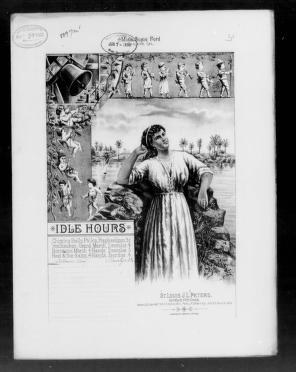
The piece is a rare visual document of how social dancing was integrated into broader cultural narratives of feminine beauty, leisure, and refinement during the Gilded Age. It shows that dance in this period was understood as both an idle pleasure and a marker of genteel cultivation, worthy of the same artistic treatment as classical allegory.
What you are looking at
This is a composite illustration featuring a female figure in classical drapery as the central subject, positioned in profile gazing toward a pastoral landscape. She wears a loose Grecian gown and is surrounded by decorative floral borders. The title "Idle Hours" appears at lower left. Above the main figure runs a frieze or band showing multiple female dancers in what appears to be a line or processional arrangement, rendered in a lighter, sketch-like style. The overall composition suggests leisure, contemplation, and classical or mythological reference. The work employs a mixture of photographic or photomechanical reproduction with hand-rendered elements, typical of illustrated periodicals or gift-book culture of the 1880s.
The dancing
The central figure stands in a relaxed, contemplative pose with one arm partially raised, weight shifted in a manner suggesting ease rather than active movement. The frieze above shows multiple female figures in a line, their bodies angled and limbs extended in what suggest social or recreational dancing rather than formal ballet technique. The poses are varied and informal, consistent with the 'idle hours' theme—these are dancers at leisure rather than professional performers in structured technique.
The dance depicted
The upper frieze depicts social or recreational dancing, likely waltz or parlor dance suited to the Gilded Age leisure context. The informal postures, the presence of multiple mixed-gender pairs, and the light, sketch-like rendering suggest this is meant to evoke the casual dances of polite society rather than theatrical performance. The composition implies a contrast between idle contemplation (the static central figure) and idle recreation (the dancing figures above), both forms of genteel leisure.
How it was made
This appears to be a photomechanical print or photographic reproduction combined with hand-coloring or lithographic addition, common in 1880s periodical and book illustration. The main figure shows the halftone or photogravure quality typical of that decade, while the upper frieze has a more sketched quality. This hybrid technique allowed mass production for middle-class audiences while maintaining artistic detail, making the work accessible to readers of illustrated journals or gift books.
About this work
An 1882 illustrated album leaf combining classical allegorical imagery with contemporary leisure dancing. The work captures a moment in the Gilded Age when 'artistic' or classical subjects coexisted with depictions of modern social dancing in the same composition. The female figure in classical drapery represents aesthetic or intellectual leisure, while the dancing figures above represent physical recreation and sociability—both valued aspects of genteel femininity. This is a work about how dance functioned in the visual and social imagination of the 1880s middle class, not primarily a dance instruction or record.
How to look at it
Note the contrast the artist creates between the static, gazing central figure and the mobile figures dancing above. The frieze is deliberately lighter and more sketch-like, suggesting informality and spontaneity, while the central figure is rendered with photographic precision. The classical drapery and landscape setting elevate the 'idle' pursuits depicted—dancing and contemplation are presented as refined activities worthy of artistic attention, not merely frivolous pastimes. This visual hierarchy reflects the cultural work the image performs: legitimizing feminine leisure through artistic and classical reference.
The period
The 1880s were the height of the Aesthetic Movement and the beginning of mass circulation of illustrated materials in America and Europe. Waltz and polka were the dominant ballroom dances, though by this date they had become so established as conventional that their depiction in genteel contexts required little explanation. The ideal of 'idle hours' for respectable women reflected the cult of leisure and beauty central to the period; artistic representation often used classical imagery to legitimize contemporary social practices. Illustrated albums, gift books, and periodicals were major vehicles for distributing imagery of dance and leisure.
Where it lives
Held by the Library of Congress. Listed as an album leaf, suggesting it originated as a single page in a bound collection of prints or illustrations, possibly from a commercial gift album or the illustrated pages of a periodical.
Dance in this work
Questions about this work
What does 'idle hours' mean in this context?
In Victorian and Gilded Age culture, 'idle hours' referred to leisure time for genteel pursuits—a valued and carefully curated form of rest. For women, this included artistic contemplation, reading, light social dancing, and aesthetic appreciation. The term was not pejorative but celebrated refined relaxation as a mark of social status and cultivation.
What dance is shown in the frieze?
The upper frieze most likely depicts waltz or general ballroom dancing of the 1880s. The informal grouping, mixed gender pairs, and relaxed postures are consistent with social or parlor dancing rather than performance dance. The specific steps are not clearly rendered, suggesting the image aims at atmosphere rather than technical record.
Why combine classical imagery with contemporary dancing?
By the 1880s, using classical or allegorical figures to frame contemporary social scenes was a standard practice in decorative arts and periodical illustration. It elevated modern leisure and particularly female activities by associating them with timeless beauty and antiquity, making them suitable subjects for respectable homes and publications.
More dance artwork





