49 works in this view — arrow keys or swipe to move between them.
Dance in Art · 1922
The latest method, home instruction by mail, dancing courses
Unknown artist
- Source:
- Library of Congress
- Rights:
- Public domain — free to use, share and adapt.
- Recorded as:
- Public Domain
For dance historians and practitioners, this image is a material record of how ballroom technique was standardised, disseminated, and democratised in the early twentieth century. It shows the exact body position and frame that a 1920s student would have studied, making it primary source evidence for reconstructing period-authentic technique and understanding how dance knowledge circulated before video.
What you are looking at
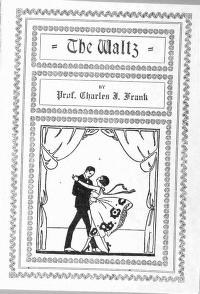
A instructional diagram for ballroom dancing rendered as a line engraving or lithograph with decorative borders. The image shows a man in formal evening dress—tailcoat, white shirt front, and bow tie—partnered with a woman in a long, voluminous skirt typical of 1920s evening wear. The couple are positioned in a classical closed ballroom hold, the man's right hand at the woman's back, his left hand extended to clasp hers. The woman's posture is upright and formal. The setting is spare: a simple interior suggested by draped curtains at top left and right, creating a frame-within-frame effect that isolates the dancing figures. The composition is symmetrical and didactic, designed to be read as instruction rather than observed as spectacle. The typography at top reads 'The latest method, home instruction by mail, dancing courses,' marking this as a commercial instructional document from the early twentieth century.
The dancing
The male dancer supports his partner in a textbook closed position: he stands slightly taller, weight forward, right hand placed mid-back, left arm extended at shoulder height with palm up to receive the woman's right hand. The woman mirrors his frame, her left arm resting on his right shoulder, body aligned with his in the formal upright carriage required by ballroom technique of the 1920s. Both figures are rendered with anatomically coherent posture and weight distribution appropriate to the frame being taught. The hold is neither relaxed nor exuberant—it is precisely the standardised position a correspondence course would need to convey to students learning without a live instructor.
The dance depicted
This depicts social ballroom dancing of the 1920s, most likely the Waltz or Foxtrot—the canonical couple dances of the interwar period taught through correspondence schools. The engraving serves as a visual template for the fundamental closed position that underlies both dances. The standardised, symmetrical composition is characteristic of early twentieth-century instructional material, where the 'correct' form had to be rendered with enough clarity that a remote student could hold a photograph or print beside a mirror and adjust their own position. The didactic purpose—conveyed by the title and the commercial framing—suggests this is part of a larger instructional series, likely a sequence of images showing progressive stages of basic steps.
How it was made
The work is a line engraving or transfer lithograph, identifiable by its crisp linear construction, uniform line weight, and the decorative ornamental border characteristic of early twentieth-century commercial printing. This technique was ideal for mass reproduction: the image could be printed cheaply and clearly on paper suitable for mailing, and the linework rendered the figures legible even at small scale or when printed in multiple copies. The medium suggests a correspondence school or dance instruction publisher with moderate commercial reach—too professional to be a local amateur production, but not wealthy enough for colour printing or fine art reproduction techniques. The standardised border and typography indicate this was one of many similar instructional images issued by the same publisher.
About this work
This is a commercial instructional image from an American or European correspondence dance school, dated 1922, teaching the fundamental closed position of ballroom dance through a clear, symmetrical engraving of a correctly positioned couple. It belongs in a dance history collection as documentary evidence of how dance instruction was transmitted in the early twentieth century—a period when printed materials, photographs, and correspondence schools democratised access to ballroom technique beyond the ballroom itself. The image is instructional rather than artistic in intention, yet it is invaluable precisely because it captures the standardised, codified body position that defined social dance during the Jazz Age.
The work documents a specific historical moment: the 1920s explosion of commercial dance instruction in print and by post, when ballroom dancing was becoming a mass social practice and entrepreneurs produced instructional materials for kitchen living rooms and small-town dance halls. It shows us not a moment of dance frozen from life, but the ideal form that instructors wanted students to achieve—a visual contract between teacher and distant pupil.
How to look at it
Look at the precision of the hand and arm placement, the angle of the bodies, and the distance between the partners—all of these are the crucial variables in ballroom frame, and they are rendered with the clarity of a diagram. The upright posture and the formal distance between the partners reflect the decorum expected in 1920s social dancing; this is not close partnering or the modern competitive frame. Notice how the engraver has used line weight and anatomical clarity to guide the viewer's eye to the key points of contact and position: hands, arms, and the vertical alignment of the torsos. This is not a snapshot of a moment in movement, but a static anatomical ideal—the position a student would hold and check repeatedly while learning. The ornamental border frames it as both instructional document and commercial product.
The artist
Unknown. The image was produced by a commercial correspondence school or dance instruction publisher. The style and execution suggest professional printing-house work rather than an individual artist; the engraver's name, if recorded, is not preserved in the catalogue. The anonymity is typical of commercial instructional printing, where the visual clarity of the instruction mattered more than the identity of the craftsperson.
The period
The 1920s saw an unprecedented boom in commercial dance instruction, driven by the social acceptability of ragtime and jazz-influenced ballroom dancing and the rising demand from middle-class and working-class dancers who wanted to learn without paying for private lessons. Correspondence schools, mail-order instruction booklets, and cheap printed dance manuals proliferated. This coincided with innovations in printing technology that made photographic halftone and high-quality line engraving affordable for commercial publishers. Simultaneously, ballroom dancing itself was undergoing standardisation: the formation of competitive dancing organisations and the codification of technique into teachable, reproducible positions and steps meant that 'correct' form could be defined and illustrated. This image is a product of that convergence of commercial printing, dance standardisation, and democratic access to instruction.
Where it lives
The work is held by the Library of Congress and is catalogued as a commercial instructional print from 1922, part of the documentation of American ballroom dancing and popular dance instruction materials from the early twentieth century. The source information and the condition of the record suggest it is part of a larger collection of correspondence-school and commercial instruction materials.
Dance in this work
Questions about this work
How do I know what dances this position was used for?
The closed position shown here—with the man's right hand on the woman's back, left hand extended, and the woman's left hand on his shoulder—is fundamental to both Waltz and Foxtrot. Both were extremely popular in 1922, and this position is generic to both dances. Without additional context or captions from the original instructional series, it is impossible to be certain which dance this particular image was teaching, though it likely appeared in sequences for both.
Was learning to dance by mail really common?
Yes, especially in the 1920s–1930s. Correspondence schools offered dance instruction to people in rural areas, smaller towns, and cities without access to good private teachers, or who could not afford private lessons. These schools mailed instructional booklets, photographs, and diagrams, and students often had to send back photographs or notes describing their progress. It was not ideal, but it was affordable and brought ballroom dance instruction to a much broader market.
Is this the same position dancers use today?
The fundamentals are the same, but the frame has evolved. Modern competitive ballroom dancing uses a tighter, more closed frame and different arm angles depending on the specific dance. Social dancing in the 1920s used a more open, formal distance between partners, with the man's right arm extended less far around the woman's back. This image shows period-authentic frame for the 1920s.
Why is the image surrounded by a decorative border?
The ornamental border was a standard commercial printing convention of the era, used to frame instructional images and give them a finished, published appearance. It also helped the printed page look more authoritative and professional—important for marketing instructional materials to customers who were making a purchase decision.
More dance artwork





