49 works in this view — arrow keys or swipe to move between them.
Dance in Art · 1847
Canadian quadrilles
Unknown artist
- Source:
- Library of Congress
- Rights:
- Public domain — free to use, share and adapt.
- Recorded as:
- Public Domain
This object shows how quadrilles circulated and were consumed in the nineteenth century: not as descriptions or depictions of dancers, but as published music for performance. It documents the existence of regional or nationally themed quadrille variations and reveals the audience for such works—literate, piano-owning households in English-speaking regions. For historians of social dance, it is material evidence of the quadrille's dominance in ballroom culture at this moment.
What you are looking at
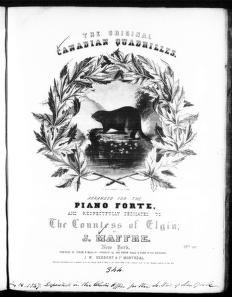
This is a title page for a musical composition featuring an ornamental engraved border. At the center is a vignette showing a grand piano in an interior setting, framed by elaborate laurel wreaths and foliage. The composition is symmetrical and formal, with decorative typography at the top reading "THE CELEBRATED" and below it "CANADIAN QUADRILLES." The piano is rendered in perspective, positioned as the focal point of the design, suggesting this is a musical work for solo piano or small ensemble. The ornamental framing and refined engraving technique indicate this was a published work of some commercial and cultural significance. The date 1847 and the inscription "PIANO FORTE" at the bottom confirm this is sheet music. The overall design is typical of mid-nineteenth-century music publishing, with the laurel wreaths signifying prestige and artistic merit.
The dancing
No dancers are depicted in this work. The image is a title page for sheet music, not a dance scene. The only figure present is an inanimate piano, rendered in architectural perspective within an interior space.
The dance depicted
Although this is a title page rather than a depiction of dance in action, the work documents a "Canadian Quadrille"—a social ballroom dance that was extremely popular in the nineteenth century. Quadrilles were typically performed by four couples arranged in a square formation, executing a series of figures set to music in sections. The publication of this title page in 1847 indicates that the quadrille had become so fashionable that variations named after regions or themes (here, "Canadian") were being composed and published for domestic performance. The piano arrangement suggests this was intended for household or ballroom use, where the piano would accompany dancers or be played for social entertainment.
How it was made
This is an engraving on paper, typical of mid-nineteenth-century music publishing. The fine lines of the ornamental border, the lettering, and the interior scene of the piano were all executed by hand engraving, a labor-intensive process that produced crisp, repeatable impressions. This technique allowed for multiple copies to be printed and distributed widely, making the composition available to a middle-class domestic market. The quality of the engraving and the elaborate ornamentation suggest this was a popular and commercially successful publication.
About this work
This is the title page of a published piano arrangement of the "Canadian Quadrilles," a social dance composition from 1847. Although it does not depict dancers in motion, it is an important document of quadrille culture in the nineteenth century—evidence that this social dance form was not only performed but actively composed and published for domestic and ballroom use. The title page itself, with its refined engraving and decorative framing, testifies to the cultural status of dance music in the period, presenting the piano (the instrument that accompanied or substituted for dancers) as a symbol of refinement and social grace.
How to look at it
A viewer should recognize this as a material artifact of music publishing rather than a representation of dance itself. The ornamental design and central placement of the piano emphasize that this is a commodified product meant for purchase and domestic use. The title—"Canadian Quadrilles"—should prompt the question: what made a quadrille "Canadian," and to whom was such a title marketed? The formal elegance of the engraved border positions the work within a tradition of refined amateur musicianship, suggesting the intended audience: skilled pianists in middle-class households, not professional dancers or musicians.
The period
The quadrille was introduced to England and North America in the early nineteenth century and became the dominant form of social ballroom dancing by the 1830s–1850s. Unlike older country dances, which could accommodate any number of dancers, the quadrille's rigid structure (four couples in a square) made it elegant and fashionable among the rising middle and upper-middle classes. Publishing houses responded by issuing hundreds of quadrille compositions, often named after places, events, or celebrities to market them as novel variations on the basic form. By 1847, when this "Canadian Quadrilles" was published, the form was already well-established; the regional title suggests both the reach of English-language publishing into North America and the appetite for exotic or geographically themed variations.
Where it lives
The work is held by the Library of Congress and is catalogued in their collections of printed music. It is a published score, not a manuscript or unique work, and exists in multiple copies.
Dance in this work
Questions about this work
What is a quadrille?
A quadrille is a social ballroom dance for four couples arranged in a square formation. It consists of five sections or figures, each set to music, and was the most popular ballroom dance of the nineteenth century. Dancers moved through prescribed patterns in response to calls or to the structure of the music.
Why would a quadrille be called 'Canadian'?
By the 1840s, quadrille compositions were often given regional, national, or thematic names to distinguish them and make them marketable. A 'Canadian Quadrille' may have incorporated melodic or stylistic elements thought to evoke Canada, or it may simply have been titled to appeal to a North American market or to commemorate a place or event.
Who would have played or danced to this music?
The piano arrangement was intended for domestic use by skilled amateur pianists, typically women of the middle or upper-middle class. The music would have been played at social gatherings, balls, or in the home to accompany dancing or as solo entertainment.
Is this an artwork depicting dance, or a functional object?
It is a functional object—published sheet music—but it is also an artwork in its design and engraving. It belongs in a dance history collection as evidence of how dance music was produced, distributed, and consumed in the nineteenth century, even though it does not show dancers in motion.
More dance artwork





