49 works in this view — arrow keys or swipe to move between them.
Dance in Art · 1970
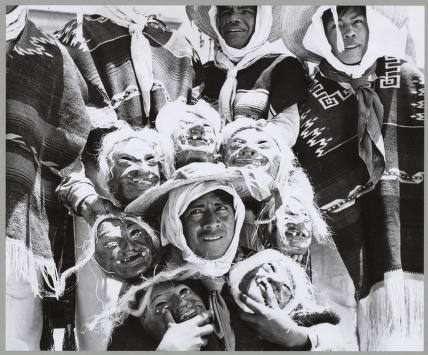
Masks Used in Native Dance.
Unknown artist
- Source:
- Library of Congress
- Rights:
- Public domain — free to use, share and adapt.
- Recorded as:
- Public Domain
For dancers and historians, this image is valuable as a document of how masks functioned in Native ceremonial contexts—as integral visual elements that transformed the wearer and communicated identity and spiritual role. The photograph's existence in archival collections also raises important questions about who documents Indigenous dance, under what terms, and how such documentation shapes later understanding.
What you are looking at
A black-and-white photograph shows a group of people wearing elaborate masks and traditional dress, arranged in a close huddle facing the camera. The masks are striking: some appear to be carved with exaggerated features, painted faces with prominent expressions. The wearers are dressed in what appear to be woven or textured garments and wrapped cloths, with some figures wearing head coverings or elaborate headpieces that integrate with the masks. The photograph captures them tightly grouped, their masked faces creating a dramatic, almost theatrical composition. The setting and cropping suggest this may be documentation of performers or a ceremonial gathering, with the focus entirely on the masks themselves and their wearers' costuming.
The dancing
The masked figures are positioned close together in a dense cluster, creating visual compression that emphasizes the masks rather than individual bodies or movement. Their posture is largely static and frontal, facing the camera directly. The bodies are visible from roughly mid-torso upward, obscured in parts by the wrapping and layering of their garments. There is no visible active dance movement; the photograph appears to capture a moment of presentation or pause rather than motion.
The dance depicted
The masks and dress suggest this is likely documentation of Native American ceremonial dance, probably from a powwow or intertribal gathering. The emphasis on masks, regalia, and the formal presentation mode is consistent with sacred or ceremonial contexts. However, the photograph itself does not capture dance in motion—it is a portrait of masked dancers or ceremony participants at rest, making it difficult to determine the specific dance style or movement vocabulary from the image alone.
How it was made
This is a black-and-white photograph, likely gelatin silver or a similar mid-twentieth-century photographic process. The contrast is sharp, the focus precise on the masks and faces, and the cropping intentionally tight to emphasize the masks as the subject. The documentary quality suggests it was made for archival or ethnographic purposes rather than artistic exhibition.
About this work
This photograph documents masked participants in what is labeled as 'Native Dance,' captured in 1970. The image prioritizes the visual drama of the masks themselves—their carving, painting, and integration into the performers' costuming—over the documentation of movement or choreography. The work sits at the intersection of ethnographic documentation and performance art, recording both the material culture of ceremonial regalia and the people who wear it. As a 1970 photograph, it reflects mid-century documentary practices that treated Indigenous ceremonies as objects of visual study.
How to look at it
Focus on the masks themselves: their construction, the painted details, the way they frame and alter the faces beneath. Notice how the masks are integrated into the full costume—the relationship between headpiece, facial covering, and body garment. The static, frontal pose is typical of ethnographic documentation rather than artistic performance photography; it allows clear viewing of the regalia. The tight framing and direct confrontation with the camera creates intensity rather than narrative.
The artist
The photographer is not recorded. The image comes from the Library of Congress, suggesting it was created as part of documentary or archival work, possibly a government, academic, or public folklife project of the era.
The period
In 1970, ethnographic and documentary photography of Native American ceremonies was active, though often conducted with limited consultation or consent from the communities involved. This period saw growing interest in preserving and recording traditional practices, but also rising Indigenous advocacy for control over representation of their own cultures. The formal, archival approach to this photograph reflects mid-century anthropological practice.
Where it lives
The image is held by the Library of Congress. It was catalogued with minimal descriptive information, suggesting it may have been acquired as part of a larger collection or project without full individual documentation.
Dance in this work
Questions about this work
What tribes or nations are represented here?
The catalogue record does not specify. The masks and dress suggest this may be from a powwow or intertribal gathering, which could involve participants from many nations. Without additional documentation or consultation with Indigenous communities, the specific tribal origins cannot be determined from the photograph alone.
Are these masks worn in a specific dance?
The photograph does not show the masks in motion or within a choreographic context. They appear to be documented as material culture objects. To understand which dances they belong to would require additional historical or ethnographic information.
Why is this documented in such a formal way?
The style reflects mid-twentieth-century ethnographic and archival practice, which often approached Indigenous material culture and performance as objects for visual documentation and preservation. Modern practice increasingly involves collaboration with and consent from the communities whose practices are being recorded.
More dance artwork





