49 works in this view — arrow keys or swipe to move between them.
Dance in Art
Urban Social Dance, Jamaica Fieldwork
Unknown artist
- Source:
- Library of Congress
- Rights:
- Public domain — free to use, share and adapt.
- Recorded as:
- Public Domain
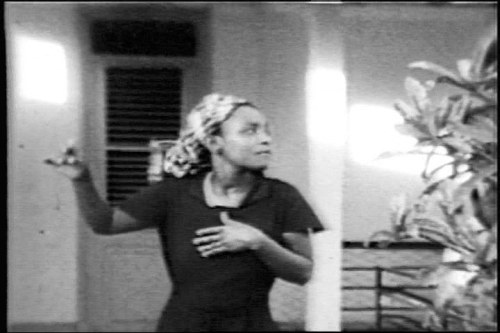
This photograph documents Jamaican urban social dance as lived practice rather than staged performance, preserving movement knowledge from a pivotal moment in Caribbean cultural history. It exemplifies the ethnographic and documentary approach to dance research that was standard in mid-20th-century anthropology, showing how scholars used photography to record vernacular movement forms before they were codified or commercialized.
What you are looking at
A woman in a dark short-sleeved shirt dances alone in what appears to be an indoor domestic or institutional space. The photograph is black and white and somewhat grainy, suggesting mid-20th-century origin. She is captured mid-movement, her body angled away from the camera, one arm raised and extended. The setting is sparse: plain walls, a louvered window or vent visible in the background, and a potted plant on the right edge of the frame. The lighting is flat and even, characteristic of documentary or fieldwork photography. Her hair is light-colored and curled, and her posture suggests energetic, social dancing rather than staged performance.
The dancing
A single female dancer, photographed from roughly waist-level. Her weight appears to be in her lower body while her upper body twists and her right arm extends upward in a relatively open gesture. Her left arm is less visible. The stance suggests weight on the balls of the feet and hip movement typical of social dance. The frame and arm position do not suggest ballroom closed hold or the rigid posture of theatrical dance; instead the movement reads as improvisational and organic to the body.
The dance depicted
This appears to be social dance documented in a fieldwork context, likely mento, ska, or another Jamaican vernacular social dance form common in the mid-20th century. The title explicitly states 'Urban Social Dance, Jamaica Fieldwork,' which positions this as ethnographic documentation rather than performance. The single dancer, the domestic interior setting, the casual dress, and the loose upper-body movement with extended arms are consistent with Jamaican popular social dances. Without more specific visual markers—particular drum patterns visible, distinctive footwork clearly shown, or regional costume detail—the precise style cannot be determined from the photograph alone.
How it was made
This is a black-and-white photograph, likely shot on 35mm or medium-format film stock typical of mid-20th-century anthropological fieldwork. The grain structure and slight blur in the figure suggest hand-held documentary photography rather than studio portraiture. The flat, diffuse indoor lighting and the candid framing indicate this was shot as documentary evidence of movement in situ rather than a posed study. The medium's strengths—immediacy, the capture of a fleeting moment—are at work here, though the static frame cannot convey the full rhythmic and spatial complexity of the dance.
About this work
This is a mid-20th-century black-and-white photograph documenting urban social dance in Jamaica, shot as part of ethnographic fieldwork. It captures a single woman in an interior space performing what is likely a vernacular dance form—possibly mento or an early ska precursor—in a domestic or community setting rather than on a stage. The image is valuable precisely because it documents dance as lived social practice rather than as performance art, showing the body, gesture, and context of popular movement in Jamaica during a period of significant cultural change and musical innovation.
The work belongs in a dance archive because it represents the documentation methods of mid-20th-century dance ethnography and because it captures a form of cultural expression—urban Jamaican social dance—that was rapidly evolving during this era. It testifies to the research interests of the period and to the role of photography in preserving evidence of vernacular movement practices.
How to look at it
The photograph freezes a moment of hip rotation and upper-body extension—a characteristic gesture in many Caribbean social dances where the pelvis and legs carry the primary rhythmic movement while the arms respond with more open, varied gesture. Note the indoor, non-theatrical setting and the casual clothing, which signal this is social dance in its functional context rather than performance. The single-dancer framing is itself a documentary choice: rather than showing the social formation (couples, circles, or lines) in which the dance might normally occur, the photograph isolates the individual body to document its movement qualities and posture.
The artist
The photographer is not recorded in the available catalogue entry. The image was sourced from the Library of Congress, suggesting it was part of an institutional fieldwork collection, possibly from a named anthropologist or folklorist's research project. Without more information, the specific research program, institution, or scholar cannot be identified. The style of documentation—candid, interior, focusing on a single dancer—is consistent with dance ethnography methods practiced by American and Caribbean scholars in the 1940s–1960s.
The period
This photograph was made during a period of rapid cultural change in Jamaica and the broader Caribbean. The mid-20th century saw the emergence of ska and the codification of mento as recognizable genres, alongside broader processes of urbanization and cultural contact. In the same period, ethnographic and anthropological approaches to dance documentation were becoming more systematic, moving away from purely descriptive writing toward photographic and film evidence. The photograph reflects both the dance practices of urban Jamaica in this era and the documentary methods of mid-century dance scholarship.
Where it lives
The photograph is held in the Library of Congress collections. It is catalogued as part of fieldwork documentation on urban Jamaican social dance, though the specific research project, photographer, and accession details are not recorded in the available catalogue entry. This positions it within the institutional archiving of Caribbean dance ethnography conducted in North America.
Dance in this work
Questions about this work
What dance is this?
The catalogue record identifies it as 'Urban Social Dance' from Jamaica, but the specific dance form is not named. The posture, arm gesture, and setting are consistent with mento, ska, or related Jamaican vernacular dance forms of the mid-20th century. Without additional documentation or contextual information from the fieldwork project, the precise identification cannot be certain.
Why was this photograph taken?
The title 'Jamaica Fieldwork' indicates this was made as ethnographic documentation—evidence of how dance was performed and embodied in urban Jamaica during a specific period. The candid, interior setting and focus on the dancer's body suggest the photographer was interested in recording movement practice as it occurred socially, not staging a performance.
Who is the dancer?
The catalogue record does not identify the dancer by name. Ethnographic fieldwork documentation of this era often did not record individual names, treating the dance form and movement practice as the primary subject rather than the performer's identity.
When was this photograph taken?
The exact date is not recorded. Based on the photograph's grain structure, film stock, and documentary style, it was likely made between the 1940s and 1960s, a period of significant cultural change in Jamaica and increased scholarly interest in Caribbean dance forms.
More dance artwork





