49 works in this view — arrow keys or swipe to move between them.
Dance in Art · 1972
At the Dance Lesson.
Unknown artist
- Source:
- Library of Congress
- Rights:
- Public domain — free to use, share and adapt.
- Recorded as:
- Public Domain
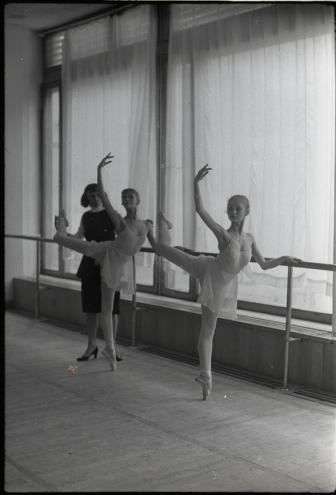
This photograph documents the fundamentals of classical ballet training: the isolated repetition of basic steps, the role of the barre as a training tool, and the visual discipline of alignment and turn-out that defines the form. For historians and dancers, it is a record of what ballet pedagogy actually looked like in the 1970s—not a performance, but the daily work.
What you are looking at
A black-and-white photograph of a ballet class in progress. Three dancers occupy a studio with a barre visible along the right side and large windows behind them admitting bright daylight. The dancer on the right, in the foreground, stands en relevé with one leg extended in arabesque, her raised arm curved gracefully overhead; she wears a pale leotard. Two other dancers stand further back near the barre in similar poses—one in a dark leotard, one in pale—suggesting they are executing the same combination. The lighting is even and documentary; the composition has the clarity and immediacy of a candid studio photograph rather than a staged portrait.
The dancing
Three dancers performing what appears to be an arabesque combination. The rightmost figure is most clearly rendered: she rises on pointe on her supporting leg, extends her back leg long and high behind her, and lifts her arm forward and slightly upward in the classical arm position that balances the extension of the leg. The two background figures echo this pose, indicating simultaneous execution of the same step. The dancers' carriage is upright and controlled; the weight is distributed with the precision of trained ballet dancers working at the barre.
The dance depicted
This is a ballet class, most likely at the level of basic technique work or rehearsal refinement. The step is almost certainly an arabesque (leg extended behind at 90 degrees or higher, supporting leg turned out, body aligned vertically), one of the fundamental positions in classical ballet vocabulary. The setting—a barre, multiple dancers repeating the same step, bright daylight suggesting a working studio rather than a performance—indicates this is a training session, not a performance. The uniformity of pose and the presence of what may be an instructor observing suggests this is formal technical instruction.
How it was made
This is a black-and-white photograph, likely gelatin silver print or similar mid-twentieth-century photographic process. The image shows the crisp detail and high contrast characteristic of professional studio photography of the 1970s. The photograph was taken with available natural light from the windows; no flash appears to have been used, which allowed the photographer to capture the dancers at work without the distraction of artificial lighting. The documentary quality—sharp focus, careful composition, absence of theatrical lighting or staging—suggests this was either a professional documentation of a class or a high-level amateur record.
About this work
A photograph of a ballet class in session, showing three dancers performing arabesques at the barre under natural light. The image captures the precision and repeatability central to classical ballet training: the same step executed simultaneously by three dancers, observed and refined. The photograph is a record of the working studio, not the performance stage, and documents the unglamorous, rigorous daily practice that underlies ballet technique. This is a common subject in twentieth-century dance documentation—the class as a site of instruction and discipline—and represents the shift in how dance was recorded once photography became reliable enough to capture motion in studio conditions without performance costume or theatrical framing.
How to look at it
Observe the alignment of the three dancers: despite the differences in their lighting and position in the frame, each maintains the same geometric relationship between supporting leg, extended leg, and upper body. Note the use of the barre by the background dancers—how the hand rests on it lightly rather than gripping it, a sign of dancers who no longer need it for balance but use it as a reference point and to establish line. The photograph captures the moment of stillness at the height of the arabesque; the dancers are holding the position, not moving through it, which allows the photographer to render the spatial relationships clearly. This moment of held extension is a hallmark of ballet training and performance alike.
The period
By the 1970s, photography of dance had become both more common and more varied in purpose. While early twentieth-century dance photography focused heavily on performance documentation and posed studio portraits, by mid-century photographers were regularly documenting rehearsal, class, and informal moments. This shift reflected broader changes in dance itself—the legitimization of modern dance, the expansion of dance training in universities and schools, and the growth of dance history and criticism as disciplines that required visual documentation. The photograph's documentary plainness is typical of this era's approach to dance photography, which valued clarity and visual evidence over theatrical presentation.
Where it lives
This photograph is held in the Library of Congress, likely part of its American memory or documentary photography collections. The 1972 date suggests it was taken during an active period of cultural documentation in the United States.
Dance in this work
Questions about this work
Why are there three dancers doing the same step?
In a ballet class, an instructor typically puts all the students through the same combination of steps, either together or in groups. Here, the three dancers are executing the same arabesque, likely on the instructor's count, so that the teacher can observe and correct their alignment and technique across multiple bodies simultaneously.
What is the barre used for?
The barre is a wooden rail at hip height that runs along the studio wall. In ballet class, it is used first for balance while learning new steps, and later as a reference point and light support while executing more complex combinations. These dancers are using it lightly, indicating they are past the beginner stage.
Is this a performance or a rehearsal?
This is a class, neither a performance nor a rehearsal for performance. The natural studio setting, the multiple dancers repeating the same step, and the apparent presence of an instructor all indicate that this is a training session—the daily work of ballet dancers.
More dance artwork





