49 works in this view — arrow keys or swipe to move between them.
Dance in Art · 1934
Ballet Fedre
Unknown artist
- Source:
- Library of Congress
- Rights:
- Public domain — free to use, share and adapt.
- Recorded as:
- Public Domain
This poster documents a crucial moment in American dance history: the Federal Theatre Project's effort to democratize access to classical ballet and to integrate Black dancers into professional theatrical performance. Katherine Dunham's presence on the cast list is historically significant, as she became one of the most influential dancers and choreographers of the twentieth century, pioneering the integration of Caribbean, African, and modern dance vocabularies with classical technique. The affordable ticket prices and the public scale of this promotion reveal how dance was being positioned as a public good during the Depression.
What you are looking at
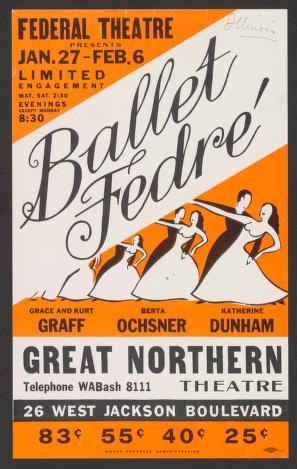
This is a theatrical poster for a ballet performance at the Federal Theatre, printed in 1934. The composition is split between text and image: on the left, bold orange and black typography announces the venue, dates (January 27–February 6), and ticket prices in a range from 25¢ to 83¢. On the right, a stylized illustration shows four female dancers in classical ballet poses, rendered in black line drawing against the orange background. The dancers are arranged in a diagonal line, each in a different attitude or arabesque position, with one figure kneeling or in a low lunge. Their bodies are elongated and graceful, with the nearest dancer's raised leg extended high behind her. The composition emphasizes lightness and elevation typical of ballet imagery of the period. The poster's lower section lists the cast—Grace and Kurt Graff, Berta Oechsner, and Katherine Dunham—and provides practical information: the venue name "Great Northern Theatre," address (26 West Jackson Boulevard, Chicago), and a telephone number.
The dancing
Four dancers are shown in succession, each demonstrating different classical ballet positions. The nearest figure appears to be in an arabesque or similar extension, with her raised leg creating a strong diagonal line through her body. The dancers wear simple, unadorned costumes that suggest classical ballet dress without the full theatrical tutu of some traditions. Their frames are upright and controlled; the poses emphasize vertical alignment and extended limbs characteristic of academic ballet training. The artist has rendered the figures with attention to balletic proportion and the controlled elegance of the port de bras (carriage of the arms).
The dance depicted
This poster advertises a theatrical ballet performance. The style depicted is consistent with American theatrical ballet of the 1930s—a period when classical ballet was being promoted in U.S. cities through regional and federally-supported theatre companies. The presence of Katherine Dunham, a pioneering Black dancer and choreographer, is notable; she was known for blending classical ballet with Caribbean and African diasporic movement vocabularies, though this poster's imagery emphasizes classical positions. The poses shown—arabesque, développé, and similar extensions—are core to the ballet technique being taught and performed in American theatres at this time. The work advertises classical ballet as entertainment accessible to a broad public through affordable ticket pricing.
How it was made
This is a lithographic poster, a commercial printing technique well-suited to bold color reproduction and wide distribution. The design uses a two-color palette (orange and black) typical of WPA and Federal Theatre Project materials, which prioritized economical production and high visibility. The stark graphic style, with simplified figures and large sans-serif typography, was characteristic of 1930s American poster design and reflected modernist influences adapted for public communication. The technique allowed for rapid, cost-effective printing and distribution to advertise performances to working-class and middle-class audiences across Chicago.
About this work
This is a Federal Theatre Project poster from 1934 advertising a ballet performance at the Great Northern Theatre in Chicago. The Federal Theatre Project (1935–1939) was a New Deal program that made theatrical performance accessible and affordable to American audiences during the Great Depression. This poster exemplifies the aesthetic and mission of that program: striking graphic design, inclusive pricing, and promotion of classical dance as public culture. The inclusion of Katherine Dunham, an important figure in twentieth-century dance history, signals the programme's role in bringing Black performers into mainstream theatrical spaces at a time of profound racial segregation.
How to look at it
Attend to the sequence of poses shown: the artist has frozen not a single moment but a progression of attitudes, suggesting the fluidity and continuous extension of classical ballet technique. Notice how the figures are arranged diagonally across the composition, creating a sense of movement even in stillness. The stylization—simplified, elongated bodies—is not naïveté but a deliberate graphic choice that makes the image bold and readable at a distance, as a street poster needs to be. The presence of Katherine Dunham's name among the cast, set in equal typography to her white colleagues, was itself a statement worth looking at.
The artist
The artist is not recorded in the catalogue. The design is consistent with the visual language of Federal Theatre Project posters produced by a range of graphic designers and lithographers, many of whom worked anonymously or are now unattributed. The style reflects the influence of WPA design standards: bold typography, simplified figures, and economical use of color for maximum visual impact and printing efficiency.
The period
In 1934, American ballet was in early development as a national cultural institution. Classical ballet had been the province of elite audiences and touring European companies; the Federal Theatre Project (which launched in 1935, the year after this poster) made theatrical performance, including dance, a subsidized public service. This was also a period of rapid change in American modern and theatrical dance, with pioneers like Martha Graham, Lester Horton, and Katherine Dunham creating new forms that blended classical training with vernacular and non-European movement traditions. The Great Depression had created both economic crisis and a political commitment to arts as public culture; this poster is a product of that moment.
Where it lives
This object is held by the Library of Congress, from which this digital image is sourced. It is a printed ephemeral object—a theatrical poster designed for immediate public display and short-term promotion. Such materials survive in limited quantities and document the visual culture and theatrical practices of their moment.
Dance in this work
Questions about this work
Who was Katherine Dunham?
Katherine Dunham (1909–2006) was a dancer, choreographer, and anthropologist who pioneered a technique blending classical ballet with Caribbean, African, and modern dance. She was one of the first Black dancers to perform in major American theatrical companies and went on to establish her own company and school. Her presence on this 1934 poster is significant evidence of the Federal Theatre Project's role in integrating Black performers into mainstream performance.
What was the Federal Theatre Project?
The Federal Theatre Project (1935–1939) was a New Deal program that employed theatre workers and made theatrical performance accessible to Americans during the Great Depression. It produced plays, musicals, dance, and experimental work across the country, with the explicit goal of making culture available to all economic classes. This poster advertises one of many productions supported by the programme.
Why are the ticket prices so low?
The Federal Theatre Project was designed to make performance affordable to working-class audiences. Ticket prices ranged from 25¢ to 83¢ during the Depression, when a loaf of bread cost approximately 8¢. This pricing structure was political: theatre was understood as a public good, not a luxury commodity.
What kind of ballet is this?
The poses shown are consistent with academic classical ballet, but the programme's inclusion of Katherine Dunham suggests an openness to new forms blending classical technique with other traditions. The poster itself does not distinguish stylistically; it presents classical positions as the visual language of 'ballet' itself.
More dance artwork





