49 works in this view — arrow keys or swipe to move between them.
Dance in Art · 1934
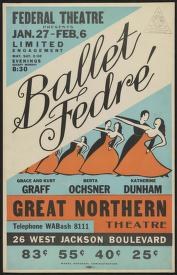
Ballet Fedre
Unknown artist
- Source:
- Library of Congress
- Rights:
- Public domain — free to use, share and adapt.
- Recorded as:
- Public Domain
Katherine Dunham's presence on this poster, in a major New York venue, in 1934, demonstrates the Federal Theatre's role in creating opportunities for Black artists at a time of severe racial segregation. The poster is a primary document of WPA cultural work and of the conditions that enabled Dunham's early career.
What you are looking at
A theatrical poster advertising Ballet Fedre at the Federal Theatre in New York, January 27 to February 6. The composition is dominated by large stylized lettering spelling "Ballet Fedre" in an art deco script. Below the title, four figures in classical ballet poses are arranged in a horizontal line, rendered in simplified forms typical of 1930s graphic design. The dancers wear pale, ethereal costumes suggesting tutus or classical dress. The setting is a stage interior suggested by architectural framing. The poster lists performers—Ochsner and Dunham are named—and practical information: performance times, ticket prices (83¢, 55¢, 40¢, 25¢), and the theater's address on 42nd Street near Hudson Boulevard. The color palette is muted, dominated by cream, gray, and black with minimal accent color, characteristic of WPA-era theatrical printing.
The dancing
Four dancers are depicted in a line, each in a distinct classical ballet attitude or arabesque position. The figures are highly stylized and geometricized in the manner of art deco design, with simplified limbs and elongated proportions. Two dancers appear to be en arabesque or in extended positions; the poses suggest classical ballet vocabulary rather than any other genre. The dancers are shown at the same scale and evenly distributed across the poster's width, emphasizing symmetry and decorative balance over narrative or dramatic composition.
The dance depicted
Ballet Fedre was a work presented by the Federal Theatre Project, a New Deal arts initiative that operated 1935–1939 and brought theatrical productions to American audiences at minimal cost. The title and the classical poses of all four figures establish this as classical ballet. The presence of Katherine Dunham—credited on the poster—is significant: Dunham was a pioneering Black dancer and choreographer who blended classical ballet with Caribbean and African movement vocabularies, though her early work within the Federal Theatre Project occurred before her own company was founded (1945). Without access to reviews or playbills, the actual movement vocabulary cannot be determined from the image alone, but the classical poses suggest a production grounded in academic ballet technique.
How it was made
This is a lithographic poster, a mass-production technique ideal for theatrical promotion in the 1930s. The bold lettering and simplified figural forms are characteristic of WPA poster design, which prioritized clarity, legibility from a distance, and economical use of color to reduce printing costs. The art deco styling—geometric forms, linear simplification, and careful composition—was the dominant graphic language of the period and conveyed modernity and cultural legitimacy. Lithographic posters like this were printed in large quantities and distributed to street kiosks, theaters, and public buildings, making them the primary public-facing advertisement for Federal Theatre productions.
About this work
Ballet Fedre is a poster from the Federal Theatre Project, a Depression-era government arts initiative that democratized access to professional theater and dance. The work announces a ballet production featuring Katherine Dunham, a transformative figure in twentieth-century American dance who pioneered the integration of black classical ballet training with modern, Caribbean, and African movement forms. The poster itself is an artifact of American cultural policy during the New Deal: a lithographic object designed to be public, affordable, and visually compelling, reflecting the era's belief in art as a public good.
The poster belongs in a gallery of dance imagery not primarily as a representation of dance movement—the simplified figures offer limited insight into actual choreography or technique—but as evidence of how dance was circulated, valued, and made visible in American culture at a moment of profound social and economic crisis. It documents the infrastructure through which working Americans encountered professional dance, and it preserves the name and image of a Black female artist during a period when such visibility was exceptional.
How to look at it
Look at the four dancers as a formal, decorative arrangement rather than a narrative scene. Notice how the poses—extended legs, lifted spines, arms in classical positions—communicate 'ballet' through silhouette and proportion rather than through actual anatomical precision or dynamic movement. The poster prioritizes legibility and graphic impact; the dancers are costume elements within a larger design that includes typography, practical information, and compositional balance. The art deco simplification transforms human bodies into elegant, geometric forms, reflecting both the aesthetic priorities of 1930s graphic design and the aspirational, cultured identity the Federal Theatre wanted to project.
The period
The Federal Theatre Project (1935–1939) was part of the Works Progress Administration, a New Deal program that employed artists during the Great Depression. It funded theater, dance, and performance work across the United States, operating on a principle of public access and affordable ticket prices. The Project was explicitly committed to racial integration in casting and creative work, making it exceptional for the era and a crucial incubator for Black artists including Katherine Dunham. Dunham, born in 1909, was trained in classical ballet and modern dance; the 1930s were her years of study and early professional work before she established her own school and company in the 1940s. Lithographic poster design was the standard medium for theatrical promotion and advertising in this period, and the art deco style visible here was the dominant visual language of entertainment publicity.
Where it lives
This poster is held in the Library of Congress as part of its WPA Poster Collection, a comprehensive archive of Federal Theatre Project and Works Progress Administration promotional materials. Posters like this one were printed in runs of hundreds or thousands and distributed to public spaces, making them common artifacts of the era but valuable primary documents for the history of American public culture and Black artistic life during the Depression.
Dance in this work
Questions about this work
Who was Katherine Dunham?
Katherine Dunham (1909–2006) was a pioneering Black dancer, choreographer, and anthropologist who fundamentally changed American dance by blending classical ballet technique with Caribbean, African, and Black vernacular movement vocabularies. In the early 1930s, she was a young dancer training in Chicago; by the 1940s, she had established her own school and company, and by the 1950s she was an internationally recognized artist. Her work on this poster in 1934 documents her early professional visibility.
What was the Federal Theatre Project?
The Federal Theatre Project (1935–1939) was a New Deal program that funded theater and dance productions across the United States, employing thousands of artists and providing live performance to communities that had little access to professional theater. It was unusual for its era in being racially integrated and in supporting work by artists of color. The Project closed in 1939 after conservative political opposition.
What can we learn from the poster about how the ballet was performed?
The poster tells us that the work used classical ballet vocabulary—all four dancers are shown in recognizable academic positions (arabesque, attitude, or similar). It does not, however, show us the actual movement quality, speed, or style, or whether Dunham's training in vernacular forms was integrated into the choreography. For that, we would need reviews, playbills, or film documentation of the work itself.
Why are the dancers so simplified and stylized?
Art deco graphic design of the 1930s favored geometric simplification, elongation, and decorative symmetry. This style was modern, fashionable, and economical to print—fewer colors and cleaner lines reduced production costs. The stylization also elevated the dancers into the realm of high art and culture, signaling that this was a significant cultural event, not mere entertainment.
More dance artwork





