49 works in this view — arrow keys or swipe to move between them.
Dance in Art · 1843
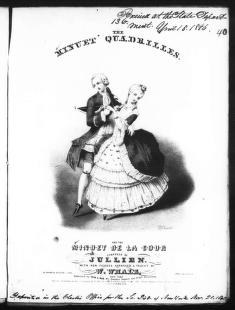
The minuet quadrilles
Unknown artist
- Source:
- Library of Congress
- Rights:
- Public domain — free to use, share and adapt.
- Recorded as:
- Public Domain
For dancers and historians, this image is a precise record of posture, frame, and presentation in the quadrille era—showing the standard by which bodies and movement were judged in polite society. It also illustrates how ballroom dance was taught and understood through printed visual models, a major pathway for dance transmission before film and video.
What you are looking at
A woman in full Regency dress stands at center in a formal dancing posture, her arms raised in a graceful frame. She wears a high-waisted white gown with a full skirt caught mid-motion, and her dark hair is styled in the fashion of the 1840s. The composition is tightly cropped, presenting her as a solitary figure against a plain background, with what appears to be a simple architectural or interior element sketched behind her. The engraving is delicate and precise, rendered in fine lines with careful attention to the drape of fabric and the line of the body. The title at the foot identifies this as "The Minuet Quadrilles," and a date of 1843 or nearby appears in the upper margin.
The dancing
The dancer stands in an open, upright posture with arms extended at approximately shoulder height, palms open in a manner consistent with formal Regency-era ballroom carriage. Her weight appears to be centered, and her body maintains the elongated line characteristic of refined ladies' deportment in the period. The pose is static rather than captured mid-step, suggesting a moment of poise or presentation rather than active movement. There is no partner visible, making this a study or demonstration figure rather than a scene of interaction.
The dance depicted
The title specifies quadrilles, a group dance that dominated ballrooms from the 1810s through the 1860s, often danced to minuet music or minuet tempos. Quadrilles were typically performed by four couples in a square formation, executing a sequence of figures with precise geometric clarity. This single figure is presented as a type or exemplar—the posture and deportment of a quadrille dancer, particularly a woman of the middle to upper class in formal ballroom contexts. The minuet influence on quadrilles was significant, and this image may represent either the minuet quadrille proper or the general aesthetic of minuet-inspired ballroom dance of the 1840s.
How it was made
This is a wood engraving or steel engraving, identifiable by the fine parallel lines (hatching) used to create tone and form, the crisp edges, and the overall print character. The technique allowed for sharp detail in costume and figure, and the work was almost certainly produced for circulation as a print—likely as a fashion plate, a dance instruction illustration, or a periodical insert. The medium's precision made it ideal for documenting the exact posture and dress conventions of the period, and its reproducibility ensured wide distribution among middle and upper-class households and dance academies.
About this work
This is a formal study of a Regency-era quadrille dancer, presented as a type rather than a narrative scene. The engraving documents the posture, dress, and bearing expected of a ballroom dancer in the 1840s, at a moment when the quadrille was the dominant social dance of European and American ballrooms. The work is both an art object and a practical document—a record of how bodies were positioned, dressed, and presented in one of the nineteenth century's most formalized social rituals. As such, it belongs in a dance history collection as evidence of embodied social convention and the visual transmission of ballroom culture.
How to look at it
Observe the precision of the line and the geometry of the posture: the vertical axis of the body, the height of the arms, the angle of the hands, the proportions of the gown. Notice how the artist has frozen a moment of stillness and presentation rather than motion—this is how quadrille dancers were meant to appear between figures, composed and formalized. The absence of a partner or other dancers may be deliberate: this is a figure of instruction or type, meant to be copied and emulated by readers learning ballroom deportment from a print.
The period
The quadrille emerged in France in the early 1800s and became the defining ballroom dance of the Victorian and Regency periods. By the 1840s, it was danced everywhere—in London drawing rooms, Paris salons, and American assemblies—and its geometry and formality reflected the period's emphasis on order, decorum, and precise social hierarchy. The minuet, though no longer danced in its baroque form, remained a touchstone for refined movement; the minuet quadrille preserved its musical style and dignified tempo. Engraved fashion and dance plates were a major medium for cultural transmission, allowing people outside major cities to learn the latest movements and styles. This print sits at the intersection of fashion documentation, dance instruction, and social aspiration.
Where it lives
The image is held in the Library of Congress collections and identified as coming from their dance image holdings. It is an engraved print from the mid-nineteenth century, the kind that would have been produced for sale or distribution to dance schools, periodicals, and fashionable households.
Dance in this work
Questions about this work
What is a quadrille?
A quadrille is a formal group dance for four couples arranged in a square. It was performed in ballrooms across Europe and America from the 1810s through the late nineteenth century. Each couple danced a sequence of geometric figures in unison with the others—promenades, balances, chassés—to orchestral music. The dance required discipline, coordination, and an understanding of floor geometry, making it a marker of social refinement.
Why is she shown alone?
This is a figure of instruction or type—a model of correct ballroom posture and dress, meant to be copied and imitated by readers. The engraving is documenting the ideal deportment of a quadrille dancer, not depicting an actual moment of dancing. Solo presentation made it easier to see the precise line of the body and the details of costume without distraction from other figures.
What does 'minuet quadrilles' mean?
Minuet quadrilles were quadrilles danced to minuet music or at minuet tempo—slower and more dignified than the typical brisk quadrille. The minuet was an older, eighteenth-century court dance that was no longer commonly performed by the 1840s, but its association with refinement and elegance made it appealing as a frame for quadrille music and movement.
More dance artwork





