49 works in this view — arrow keys or swipe to move between them.
Dance in Art · 1960
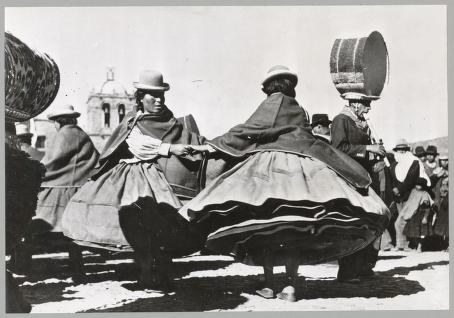
Fiesta "Huayno," a Folk Dance.
Unknown artist
- Source:
- Library of Congress
- Rights:
- Public domain — free to use, share and adapt.
- Recorded as:
- Public Domain
The Huayno remains one of the most vital living traditions in Andean culture, and documentary photographs from the mid-twentieth century are crucial records of how these dances were performed and transmitted. This image provides concrete visual evidence of the dance's aesthetic priorities—the transformation of the female body through costume and controlled rotation—at a moment when such documentation was becoming a priority for both anthropologists and cultural activists. For dancers and cultural historians, the photograph offers both historical testimony and kinetic instruction, showing posture, dress, and the relationship between body and garment that remains central to Huayno practice today.
What you are looking at
A black-and-white photograph captures an outdoor performance or documentation of the Huayno, an Andean folk dance. Two or three dancers dominate the frame, wearing traditional full skirts with deep pleats and folds that billow dramatically around them. The dancers appear to be in motion, their voluminous skirts creating striking geometric shapes that suggest rapid rotation or swaying movement. The photograph is taken outdoors in bright daylight, with clear shadows visible on the ground. In the background, onlookers and what appears to be film or documentary equipment can be seen, suggesting this is either a staged performance for recording or a public festival setting. The composition emphasizes the sculptural quality of the dancers' garments in motion.
The dancing
The dancers shown are wearing full, tiered skirts characteristic of Andean dress, which dominate the visual composition. Their bodies are captured mid-movement, with the skirts lifted and spread outward in a manner suggesting spinning or rapid turning. The posture appears upright and controlled, with arms visible but the focus decidedly on the lower body and skirt movement. The weight appears to be centered through rapid rotation, a hallmark of many Andean dances. At least two distinct dancers are visible, and their proximity and synchronized motion suggest they may be dancing as partners or in formation.
The dance depicted
The Huayno (also spelled Huayñu, Wayno, or Huaino) is one of the most important pre-Columbian and indigenous Andean dances, performed throughout Peru, Bolivia, and parts of Ecuador and Chile. It is typically danced by couples or groups and is associated with celebrations, festivals, and communal gatherings. The dance is characterized by a distinctive rotational movement, often performed to music in 2/4 or 3/4 time played on traditional instruments. The photograph appears to document an authentic or semi-staged performance, likely from a folk festival or ethnographic recording project. The prominence of the full skirts and the rotational movement visible here align with documented descriptions of how the Huayno emphasizes the lower body and the dramatic display of traditional dress.
How it was made
This is a black-and-white photograph, likely taken in the 1950s or early 1960s based on the photographic quality, film stock characteristics, and the presence of what appears to be documentary or ethnographic recording equipment visible in the background. The photograph was taken in natural outdoor light and captures motion relatively sharply, suggesting a reasonably fast shutter speed for the film stock of the era. The presence of documentary equipment suggests this may have been part of a larger ethnographic or folkloric documentation project, possibly by an academic institution or cultural organization. The photograph's archival quality and Library of Congress provenance indicate it was preserved as part of systematic documentation efforts.
About this work
This photograph documents the Huayno, a foundational Andean folk dance that has remained central to Peruvian, Bolivian, and wider Andean cultural identity from pre-Columbian times to the present. Captured in motion during what appears to be a public performance or documentation session in 1960, the image foregrounds the dramatic interplay between the dancers' bodies and their traditional full skirts, which become the primary visual and kinetic medium of the dance. The photograph is neither staged for aesthetic purposes nor a casual snapshot, but rather a deliberate ethnographic record—the visible presence of recording equipment and spectators frames this as a moment of cultural preservation and public performance simultaneously.
How to look at it
Attend first to the relationship between the body and the skirt: the photographer has captured the moment of maximum spread and lift, when the rotational force of the dance makes the garment a visible expression of movement and energy. Notice the geometry created by the pleated folds and their shadows on the ground—this shows how thoroughly the skirt participates in the dance, not merely as decoration but as a kinetic element. The presence of spectators and equipment in the frame anchors this as a real moment of performance, not a posed studio study, which adds documentary weight. The brightness and clarity of the outdoor light emphasizes texture and volume, making the skirt's architecture as legible as the dancer's body.
The period
The 1960 date places this photograph at a pivotal moment in the history of Andean cultural documentation. The mid-twentieth century saw increasing efforts by folklorists, anthropologists, and cultural nationalists throughout Latin America to record indigenous and campesino traditions before they were assumed to be disappearing under modernization. In Peru and Bolivia especially, the Huayno was being documented, performed, and celebrated as a cornerstone of national cultural identity. The photograph's presence in the Library of Congress collection suggests it may have been part of an official documentation project or exchange program. This was also a period when Andean dances were beginning to be adapted for theatrical performance and concert stages, though the outdoor setting and apparent spontaneity here suggest a more grassroots or festival context.
Where it lives
The photograph is held by the Library of Congress and is catalogued as a folk dance documentation. It appears to be part of a larger collection of Andean cultural documentation, though the specific project, photographer, and exact location are not recorded in the available catalogue data.
Dance in this work
Questions about this work
Is the Huayno still danced today?
Yes, the Huayno remains a vital and widely performed dance throughout the Andes. It is danced at festivals, celebrations, and communal gatherings, and has also been adapted for theatrical and concert performance. The basic structure and aesthetic priorities documented in this 1960 photograph remain recognizable in contemporary practice.
What is the music for the Huayno?
The Huayno is typically performed to music in 2/4 or 3/4 time, played on traditional Andean instruments including pan pipes (zampoña), flutes (quena), drums, and charango (a small stringed instrument). The rhythm is steady and moderate, supporting the dancers' rotational movement.
Why do Huayno dancers wear such full skirts?
The full, voluminous skirts are both a practical and aesthetic element of traditional Andean dress. They allow freedom of movement for the rapid spinning characteristic of the dance, while also creating a dramatic visual effect. The skirts are often made of multiple layers and tiers, and the way they move in the dance is considered essential to its beauty and meaning.
Where was this photograph taken?
The catalogue record does not specify the location. The outdoor setting, style of dress, and context suggest somewhere in the Andean highlands of Peru, Bolivia, or Ecuador, but the exact site is not recorded.
More dance artwork





