49 works in this view — arrow keys or swipe to move between them.
Dance in Art · 1843
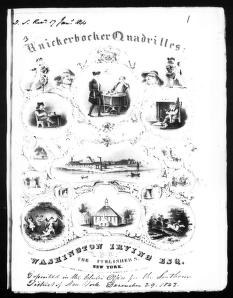
Knickerbocker quadrilles
Unknown artist
- Source:
- Library of Congress
- Rights:
- Public domain — free to use, share and adapt.
- Recorded as:
- Public Domain
For dance historians, this print is primary evidence of how quadrilles were performed, taught, and circulated in 1840s America. For social historians, it documents the economics of fashionable dance—its reliance on printed instruction, music, and commercial distribution. The specificity of the 'Knickerbocker' title connects a European dance form to a specific American elite and geographical moment.
What you are looking at
This is a composite print centered on the title 'Knickerbocker Quadrilles' in ornamental lettering. The composition arranges multiple vignettes around a central landscape scene showing a country estate or manor house. The central rural scene depicts a large building with grounds, trees, and what appears to be a formal garden or park setting. Surrounding this are eight smaller illustrated scenes in a symmetrical arrangement—four in the corners and four along the sides—each showing different indoor social activities and figures in 19th-century dress. The style and execution suggest this is a wood engraving or similar relief print, with fine linear hatching creating depth and shadow. The overall layout resembles a fashionable dance instruction card or social entertainment broadside of the 1840s, designed to be both decorative and informative.
The dancing
The figures in the surrounding vignettes are rendered in silhouette and half-tone, dressed in formal 1840s attire—women in full skirts and bonnets, men in tailcoats and top hats. In the readable scenes, figures appear in pairs and small groups in indoor parlor and ballroom settings. The postures suggest social interaction and formal dance positioning rather than vigorous movement; bodies are upright, arranged in ordered groupings typical of quadrille formation. No individual bodies are drawn with anatomical precision sufficient to determine exact hold or footwork.
The dance depicted
The title explicitly identifies this as a quadrille, one of the most popular ballroom dances of the 1840s in America and Europe. Quadrilles were performed by four couples arranged in a square formation, executing a series of prescribed figures. The Knickerbocker reference suggests an American context—likely New York society dancing. The print appears designed as promotional or instructional material for this specific dance, with the vignettes possibly depicting different figures or moments from the dance sequence, though the reduction in scale makes precise identification of individual movements impossible.
How it was made
This is a wood engraving or wood-cut based relief print, identifiable by the linear hatching technique, the fine detail possible in the lettering, and the characteristic way shadows and depth are created through parallel lines. The date 1843 and the composite advertising format are consistent with commercial dance instruction broadsheets and popular music covers of the period. The technique allowed rapid, affordable reproduction for a mass market of dancing-masters, music publishers, and genteel households. The presence of text, decorative borders, and multiple scenes packed into one sheet indicates this was likely bound into a musical score, published as a stand-alone print, or distributed as promotional material for a dancing academy.
About this work
The 'Knickerbocker Quadrilles' is a 1843 composite print documenting one of the most fashionable couple-dances of its era. Quadrilles dominated the ballrooms of Europe and America from the 1830s through the 1880s, and this print captures both the social geography of the dance—the formal parlor settings where it was performed—and its cultural prestige. The title references New York society and the Dutch-descended Knickerbocker elite, situating the dance within American social history. As a printed object, it belongs to a rich tradition of dance ephemera: instruction cards, music covers, and promotional broadsides that shaped how ordinary people learned and performed fashionable dances.
The work is valuable precisely because it is ordinary. It shows how quadrilles were merchandised, distributed, and imagined in the popular imagination. The multiple vignettes suggest an attempt to represent different moments or figures in the dance, translating complex choreography into static visual scenes. The centrality of the country estate in the composition may reference the rural origins of quadrille figures or the aspirational leisure of the ballroom-dancing classes.
How to look at it
Attend first to the title and the framing: 'Knickerbocker Quadrilles' is printed as a commercial product, not as a documentary report. The vignettes around the border are decorative and aspirational, showing fashionable dress and refined interiors rather than precise choreographic instruction. The central landscape may have been added for visual interest or may reference a specific estate associated with the dance. Notice how the print balances legibility (the title and text are clear) with ornamental complexity (the border scenes and hatching). This is a design meant to be both functional (teaching the dance) and desirable (worth owning as a print).
The period
The quadrille emerged in Paris in the early 19th century and became the dominant ballroom dance across the English-speaking world by the 1830s. Unlike the waltz—which featured couple-based closed holds and continuous rotation—the quadrille was a figure-dance performed by four couples in a square, with a caller or printed guide directing the sequence. It was considered more decorous and less intimate than the waltz, and therefore more acceptable in conservative society. In America, the quadrille's popularity peaked in the 1840s–1860s, particularly among urban elites. Dancing-masters published hundreds of variations and 'national' quadrilles (including the Scottish, French, and—in this case—Knickerbocker versions). The printed broadside or bound collection was the primary medium for distributing both the music and the choreographic instructions, making objects like this central to how the dance was learned and performed.
Where it lives
The work is held in the Library of Congress and sourced from their collections. It is classified as a historical print document, likely either a stand-alone broadside or a page from a bound collection of dance music and instructions.
Dance in this work
Questions about this work
What is a quadrille and how was it danced?
A quadrille is a figure-dance for four couples arranged in a square, popular from the 1830s through the 1880s. Dancers executed a prescribed sequence of movements (figures) directed by a printed guide or a dancing-master calling the steps. Unlike the continuous rotation of the waltz, quadrilles alternated between active figures (chassés, balancés, turns) and stationary positioning. Each dance typically lasted 5–10 minutes and required coordination and memorization rather than improvisation.
Why does this print show so many different scenes?
The vignettes likely represent different figures or moments within the Knickerbocker Quadrilles choreography, though the small scale makes precise identification difficult. Alternatively, they may simply be decorative flourishes added to make the print visually appealing and marketable. The central estate scene may reference the rural origins of quadrille figures or the aspirational setting of the ballroom.
How were people in the 1840s supposed to learn a quadrille?
Primarily through a dancing-master, who taught the figures in person and often provided printed guides like this one. Musical scores for specific quadrilles were published and distributed as sheet music or in bound collections. This print may have been sold alongside or as part of a score, allowing people to reference the choreography while learning from an instructor or practicing at home.
Why 'Knickerbocker'?
The Knickerbocker name references the Dutch-descended New York families who claimed Knickerbocker ancestry and represented the city's elite. By the 1840s, 'Knickerbocker' had become synonymous with genteel New York society. Naming a quadrille after this group was a marketing strategy to signal social prestige and aspirational upper-class identity.
More dance artwork





