49 works in this view — arrow keys or swipe to move between them.
Dance in Art · 1934
The Minuet
Unknown artist
- Source:
- Library of Congress
- Rights:
- Public domain — free to use, share and adapt.
- Recorded as:
- Public Domain
This work is valuable precisely because it is not a straightforward dance documentation but rather an artistic interpretation that reveals how artists and photographers of the 1930s understood and reimagined historical dance. The inclusion of the cage as a framing device raises questions about constraint, display, and the gendered dynamics of courtly dance—concerns that would have been emerging in modernist artistic practice. It is a rare example of the minuet as subject matter in early 20th-century visual culture.
What you are looking at
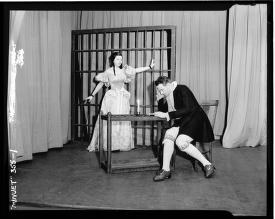
A black and white photograph showing two figures in what appears to be a staged interior setting. A woman in a light-colored dress with puffed sleeves stands within a large birdcage-like structure, her arms raised and body in an upright, formal posture. A man in dark formal attire (dark suit and white shirt) bends forward toward her in a gesture of courtship or deference, his posture suggesting a bow or deep lean. The cage dominates the composition, its vertical bars creating a strong graphic frame around the woman. Sheer curtains are visible in the background, suggesting a domestic or theatrical interior. The lighting is bright and even, typical of studio photography of the 1930s.
The dancing
The woman's posture is notably vertical and restrained, with arms extended sideways and slightly raised—a pose of formal presentation rather than dynamic motion. The man leans inward with considerable forward inclination, his weight shifted toward her, his body language submissive or deferential. There is no contact between them; the cage maintains physical separation. Neither figure is in motion, and no footwork is evident. The composition emphasizes stillness and formal positioning over the kind of flowing, partnered movement characteristic of the minuet.
The dance depicted
The title identifies this as a minuet, the courtly baroque dance of the 18th century characterized by measured steps, formal posture, and elaborate courtesy between partners. However, the image presents a static tableau rather than a moment within actual dance movement. The woman's upright carriage and the man's bow gesture do evoke the formal courtship rituals of minuet dance, but the cage—seemingly a modern theatrical device—and the absence of any suggestion of locomotion or the characteristic three-quarter time stepping pattern make this appear to be a stylized or symbolic representation rather than a documentation of the dance itself. This may be a theatrical or avant-garde interpretation of the minuet's social meaning rather than a representation of its actual performance.
How it was made
This is a silver gelatin or similar gelatin-based black and white photograph, identifiable by its continuous tonal range, the uniform lighting characteristic of studio portraiture, and the photographic medium's capacity to capture sharp detail. The studio setting, posed arrangement, and careful composition suggest this is a professional theatrical or promotional photograph rather than candid documentation. The bright, shadowless lighting and controlled environment indicate studio flash or tungsten lighting, typical of 1930s portrait and theatrical photography. As a photograph, this would have circulated among theater professionals, historians, and collectors of dance documentation.
About this work
This 1934 photograph presents a symbolic or theatrical interpretation of the minuet, the formal courtly dance of the baroque era. Rather than capturing actual minuet steps, it stages a moment of courtship and deference between two figures, with a large cage as the dominant visual element. The woman's formal upright posture and the man's elaborate bow invoke the minuet's ceremonial courtship ritual, but the static, posed quality and modernist device of the cage suggest this is a conceptual or avant-garde work about the minuet's social meaning rather than a straightforward record of its performance. The photograph documents not the dance itself but a theatrical or artistic meditation on its themes of formality, gender relations, and constraint.
How to look at it
Observe the formal vertical alignment of the woman's body and the dramatic forward lean of the man—these are poses of ceremony and submission that reference minuet etiquette rather than steps. The cage is not incidental: it is the photograph's central formal device, and viewers should consider whether it represents a theatrical property, a symbol of constraint, or a modernist frame that comments on the formality and artificiality of courtly dance. The stillness of the composition is key: this is a photograph of a posed tableau vivant, not of movement in progress.
The period
The minuet remained culturally significant in the 1930s as a symbol of refinement, courtship, and historical elegance, even though it had not been a living social dance for over a century. The 1930s saw a resurgence of interest in historical dance through historical societies, ballet companies staging baroque repertoire, and modernist artists drawing on historical material as subject for experimental reinterpretation. The use of theatrical props and symbolic staging reflects 1930s modernist practice in theater and photography, where literal representation gave way to psychological or conceptual interpretation.
Where it lives
The photograph is held at the Library of Congress and sourced from its collections, where it is catalogued as a dance-related work from 1934. The sparse catalogue information—no artist, medium, or collection details recorded—is typical of early 20th-century archival photographs that entered institutional collections without full documentation.
Dance in this work
Questions about this work
Is this an actual minuet being danced?
No. This is a posed, static tableau photograph, not a document of minuet movement. It captures the postures and gestures of courtship and deference associated with the minuet, but not the stepping, turning, or locomotion that define the dance itself. It appears to be a theatrical or artistic interpretation of minuet themes rather than a record of performance.
What is the cage for?
The cage is a theatrical or conceptual device that dominates the composition. It may serve as a stage prop, a symbol of constraint or display, or a modernist frame that comments on the formality and artificiality of courtly dance. Without artist documentation, its precise meaning remains open to interpretation.
When was the minuet actually danced?
The minuet was the dominant courtly dance of the 18th century and remained fashionable in some circles into the early 19th century. By 1934, when this photograph was made, it had been a historical dance for over a century, known through written descriptions, music, and artistic representations rather than living practice.
More dance artwork





