49 works in this view — arrow keys or swipe to move between them.
Dance in Art · 1895
Barn dance
Unknown artist
- Source:
- Library of Congress
- Rights:
- Public domain — free to use, share and adapt.
- Recorded as:
- Public Domain
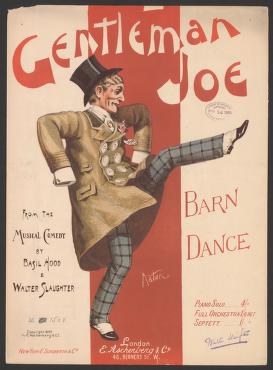
This cover documents how American barn dances were understood and marketed in the 1890s: not as the structured group dances they actually were, but as occasions for explosive individual expression and comedy. It shows the theatrical and commercial framing of rural dance by an urban entertainment industry, and how printmaking made dance imagery a consumable product for mass audiences.
What you are looking at
A single male dancer dominates this sheet music cover, shown mid-leap or high-kick in a exuberant pose. He wears a tan wool jacket with contrasting plaid trousers—one leg extended skyward—and a top hat tilted at a jaunty angle. His posture is expansive and comedic, with arms spread wide in celebration. The setting is ambiguous but suggests rural informality; the title "Barn Dance" appears in large red lettering at top and bottom. The composition is bold and graphically simple, with the figure silhouetted against a cream ground and red vertical band that frames and emphasizes his leaping form. His expression and body language read as unbridled joy—the visual epitome of country dancing enthusiasm.
The dancing
The dancer is captured mid-jump or high extension, with weight clearly in the air rather than grounded. His right leg drives upward in a vigorous kick; his left appears to support or push off. Both arms are spread wide—the right arm particularly extended—giving the pose an uninhibited, almost theatrical flair. The top hat is tilted forward, as if about to fly off. This is not a partnered dance position but a solo explosive movement, captured at the peak of exertion. The artist has read the barn dance as a vehicle for individual, exuberant expression.
The dance depicted
This is a barn dance or country dance of the Gilded Age type—likely American rural social dancing of the 1880s–90s. Barn dances were group dances held in agricultural communities, often featuring reels, quadrilles, and other contra forms, sometimes with a soloist or enthusiastic individual dancer showing off. The image shows not the collective figure or formal hold typical of those dances, but rather the individual performer seized by the spirit of the music—the moment of abandon that made country dancing popular and transgressive in urban eyes. The exaggerated pose suggests this is theatrical or satirical representation, not documentary.
How it was made
This is a chromolithograph or color lithographic print, readable from the flat areas of color, registration of multiple plates (the red ground, the cream figure, the decorative lettering), and the characteristic slightly soft edges of stone printing. Sheet music covers were a major form of popular lithographic production in the 1880s–1890s, distributed nationally through music retailers and by mail. The bright colors and bold graphic design served both to advertise the music and to make the cover collectible as a colored print in its own right. This would have been affordable and widely circulated—a work of commercial rather than fine art, but produced with considerable skill.
About this work
This is a chromolithographic sheet music cover from the 1890s advertising a barn dance—one of the most popular dance forms in late-19th-century American entertainment. The cover captures not a formal dance instruction but the spirit of country dancing as urban audiences understood it: exuberant, chaotic, and joyfully undignified. The solo male figure, mid-leap in workingman's dress, represents the barn dance not as collective ritual but as a vehicle for individual exuberance and transgression of ballroom propriety. The work sits at the intersection of popular culture, printmaking, and the commercialization of American vernacular dance—a moment when rural dances were being packaged and sold to urban audiences as entertainment and novelty.
How to look at it
Attend to the arrested moment: the dancer at the absolute peak of his leap, one leg thrust skyward, body weightless. This is not a moment from an actual barn dance (which would be structured and group-oriented) but a theatrical distillation of the barn dance as pure energy and abandon. Note the contrast between the formal dress (jacket, top hat) and the uncontrolled movement—the comedy lies in the collision. The artist has frozen a gesture of triumph and release, and the bright colors and bold composition make it celebratory rather than mocking. This is how the 1890s imagined country dancing: wild, individual, and joyful.
The artist
The artist is not recorded. The cover credits are not fully legible in the image, but the work bears the marks of a professional commercial lithography firm—likely one of the major New York or Boston houses that dominated sheet music cover production in the 1880s–90s. The confident draftsmanship, color separation, and typography suggest a house artist working within commercial conventions rather than a named fine artist.
The period
In the 1880s–90s, barn dances and rural country dances were experiencing a boom in American urban entertainment. City dwellers, newly interested in American folk culture and rural life as urbanization accelerated, consumed barn dance imagery, music, and staged performances. Sheet music covers were a major medium for this consumption—visual, colorful, and inexpensive. At the same time, color lithography was at its technical and commercial peak in America, making chromolithographic sheet music covers a dominant form of popular visual culture. This cover sits at the intersection: the commercialization of rural dance, the dominance of lithography as a mass medium, and the 1890s fascination with American vernacular culture.
Where it lives
This is a sheet music cover from the Library of Congress, a standard item in the LOC's vast collection of American popular music ephemera. As sheet music, it was produced for commercial sale and circulation, not as a fine art object; its survival depends on its worth as both music and image.
Dance in this work
Questions about this work
What is a barn dance?
A barn dance is a social dance held in a barn or rural setting, typically featuring group dances like reels, quadrilles, and contra dances. By the 1890s, "barn dance" had become a catch-all term for any rural or country dance, and was marketed to urban audiences as entertainment. This cover shows the myth rather than the reality: a solo dancer in unbridled joy rather than the structured group dancing that actually occurred.
Who made this cover?
The artist is not recorded. This is commercial work by a professional lithography house, likely one of the major firms in New York or Boston that produced thousands of sheet music covers in the 1880s–90s.
Why is he kicking so high?
The exaggerated pose is part of the cover's appeal: it sells the barn dance to urban audiences as wild, exuberant, and comic. The high kick and flying limbs suggest unbridled individual expression—a contrast to the formal, controlled ballroom dancing that was the urban norm. This theatrical exaggeration is how the 1890s understood and enjoyed rural dance.
What kind of print is this?
This is a chromolithograph—a color lithographic print made by printing multiple colored stone plates, one for each color. Chromolithography was the standard process for inexpensive, colorful sheet music covers and became one of the dominant forms of popular visual culture in the 1880s–90s.
More dance artwork





