46 works in this view — arrow keys or swipe to move between them.
Dance in Art · 1914
Tango dip
Unknown artist
- Source:
- Library of Congress
- Rights:
- Public domain — free to use, share and adapt.
- Recorded as:
- Public Domain
This poster documents the tango at a critical moment in its cultural history—its adoption by Western theatrical producers as a fashionable spectacle and its marketing to English-language audiences as the ultimate symbol of modern heterosexual romance. The image of the dip became inseparable from tango's identity in the twentieth-century popular imagination, and this poster is evidence of how that iconography was established and circulated. For anyone studying the history of ballroom dance, the commercialization of dance, or the visual culture of early twentieth-century theater, this is a primary source.
What you are looking at
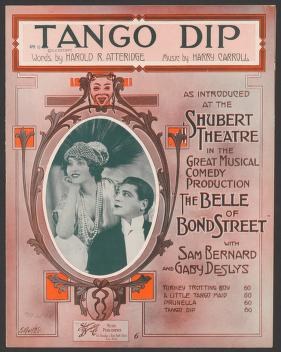
This is a printed theatrical poster advertising a 1914 musical comedy production. At the center is an oval vignette showing a couple in an intimate dance pose: a man in dark formal wear supports a woman in a pale, high-necked Edwardian gown as she leans dramatically backward in a deep dip. Her head tilts back, one arm extended, the other resting on his shoulder; his posture is upright and controlled, bearing her weight. The composition emphasizes the theatrical spectacle of the moment—the vulnerability and trust implicit in the figure's surrender. The oval frame is ornate, with decorative art nouveau flourishes in gold and rust tones. Surrounding the central image is printed text announcing the production title, creative credits, and venue information. The poster's color palette is warm—peach, cream, gold—with the formal typography and layout of early twentieth-century theatrical advertising.
The dancing
Two figures in closed ballroom hold: the man stands upright with good frame, his right arm supporting the woman's back, his left hand holding hers at shoulder height. The woman's body arcs backward in a pronounced dip, her weight fully committed to and dependent on her partner's support. Her head is thrown back, her free arm extended in an arc. The posture demands precise partnering—the man's core strength and her trust are both visible. This is an advanced figure requiring considerable ballroom skill and experience.
The dance depicted
The title and image together identify this as a Tango or Argentine Tango. The dip—a signature figure of Argentine tango—is the compositional centerpiece. In 1914, tango was at the height of its popularity in Buenos Aires, Paris, and New York as a fashionable social and theatrical dance; this poster advertises it as theatrical spectacle within a musical comedy production. The emphasis on the intimate, dramatic dip, the formal ballroom hold, and the romantic heterosexual dyad are all consistent with early twentieth-century tango as it was performed in both social and theatrical contexts. The theatrical framing suggests this is stage tango, part of a scripted entertainment rather than a dance hall performance.
How it was made
This is a color lithograph—a commercial printing process well suited to theatrical advertising. Lithography allowed for bold, flat areas of color, fine detail in the decorative typography, and economical mass production for distribution to theaters and public spaces. The technique's characteristic soft edges and warm color palette (achieved through separate stone plates for each color) are evident in the rendering of the couple and the ornamental frames. As a theatrical poster, this object was designed for public circulation and visibility, indicating the tango's status as a major commercial entertainment in 1914.
About this work
This is a theatrical poster from 1914 advertising a musical comedy production featuring tango. The work captures the moment of maximum visual drama in the dance—the deep dip that became the iconic image of tango in the early twentieth century. The poster is both an advertisement for a specific entertainment and a cultural artifact documenting the tango's arrival as a fashionable, theatrical spectacle in the English-speaking world. The image was created at a moment when tango had moved from Latin American dance halls into European salons and American musical theater, where it was marketed as an exotic, intimate, and thrilling social dance.
For dance historians, this poster is valuable as evidence of how tango was visualized and sold to theater audiences. The choice to foreground the dip—a figure that requires complete trust between partners and demonstrates the man's strength and the woman's vulnerability—tells us what impresarios believed would attract viewers. The formal, elegant dress and theatrical framing position tango not as folk or popular dance but as a sophisticated, romantic entertainment worthy of middle-class theater attendance.
How to look at it
The artist has chosen to freeze the moment of deepest vulnerability in the dip—the point at which the woman's body is most fully extended backward and the man's control is most visibly tested. This was a deliberate compositional choice designed to maximize visual drama and convey intimacy, trust, and modern sophistication. Note the woman's expression and posture: she is not resisting or defending, but surrendering entirely to her partner's support. This image of consensual vulnerability, and the man's calm, upright posture that frames it, reflects early twentieth-century romantic ideology. The oval frame and decorative flourishes signal that this is theatrical, not naturalistic—a stylized, idealized moment rather than a documentary record.
The artist
The poster credits Harold Campbell as the artist. Beyond this credit, the record provides no biographical information about Campbell. The work is representative of commercial theatrical poster design of the period, a field that employed trained graphic designers and illustrators to create eye-catching advertisements. The competent, conventional style and the professional execution suggest Campbell was an experienced poster artist working within the commercial theater industry.
The period
In 1914, tango was in the midst of an extraordinary moment of popularity and cultural controversy. The dance had emerged in Buenos Aires in the 1890s, but by 1910–1914 it had become a sensation in Paris and London, where it was adopted by fashionable society and rapidly incorporated into musical theater. In New York and other English-speaking cities, tango was simultaneously celebrated as sophisticated and modern, and condemned by moral conservatives as indecent and sexually suggestive. This poster advertises a musical comedy—a lighter, more accessible theatrical form than opera or classical drama—positioning tango as entertainment for a broad paying audience. The visual emphasis on the romantic, intimate relationship between the partners, and the theatrical framing of the dip as a moment of peak drama, reflect how tango was being reimagined for middle-class Western consumption: less as a folk or street dance, more as a vehicle for romantic fantasy and spectacle.
Where it lives
This is a theatrical poster from the Library of Congress collections, sourced from the Library's theatrical poster collection. It is a commercial object—one of many produced for distribution to theaters, print shops, and public spaces to advertise a specific musical comedy production. The Library of Congress preserves such posters as primary sources for the history of American theater, entertainment, and visual culture.
Dance in this work
Questions about this work
Why is the dip so important in tango?
The dip is a signature figure that demonstrates the partnership at the heart of tango. It requires the follower to relinquish control and trust the leader's strength and technique entirely. The visual drama of the figure—the extended body, the backward arch, the moment of suspension—made it instantly recognizable and iconic. By 1914, the dip had become tango's most recognizable image, and theatrical producers used it as the primary visual shorthand for the dance itself.
Why was tango controversial in 1914?
Tango emerged from working-class dance halls in Buenos Aires and retained associations with sensuality and sexual impropriety that scandalized bourgeois European and American society. The close hold, the hip movement, and the intimate relationship between partners were seen by moral conservatives as indecent. Simultaneously, tango was adopted by fashionable society and positioned as modern and sophisticated. This contradiction—simultaneous condemnation and desire—made tango a perfect subject for commercial theater advertising.
What is the difference between Argentine tango and ballroom tango?
Argentine tango is the original form, danced in social settings with improvisation and close partnership. Ballroom (or International) tango, standardized in the 1920s and 1930s, is a choreographed competitive dance with specific figures and frames. This 1914 poster appears to depict ballroom tango, reflecting the process by which Argentine tango was being formalized and codified for Western theatrical and competitive contexts.
Who danced in musical comedies like this one?
Musical comedies employed professional dancers, singers, and actors. Major stars of the era—such as Vernon and Irene Castle in America—became famous for their tango performances in theatrical productions. These shows were not documentaries of authentic tango but entertainment designed for paying audiences, often featuring simplified choreography, beautiful costumes, and dramatic staging rather than the improvisational, partnership-focused style of social tango.
More dance artwork





