45 works in this view — arrow keys or swipe to move between them.
Dance in Art · 1914
Julian eltinge tango
Unknown artist
- Source:
- Library of Congress
- Rights:
- Public domain — free to use, share and adapt.
- Recorded as:
- Public Domain
This image is crucial for understanding how ballroom dance crazes (particularly tango) were commercialized and domesticated through theatrical comedy and female impersonation in early 20th-century America. Eltinge's performances, though built on parody, were also significant vehicles for the dissemination of dance styles and fashions to mass audiences. The work also documents Julian Eltinge's remarkable career—a performer whose gender-fluid performances were both celebrated and controversial, and who played a more complex cultural role than the term 'impersonation' alone suggests.
What you are looking at
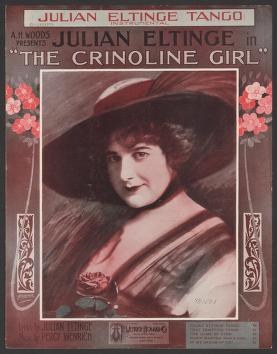
This is a promotional cover for a theatrical music number, centered on a portrait photograph of a performer in character. The subject wears an elaborate wide-brimmed hat decorated with feathers and a large rose, tilted at a jaunty angle. The face is made up with theatrical heavy eye makeup and rouged cheeks. The costume includes a striped garment (possibly a jacket or bodice) in pink and darker tones, with an ornamental rose brooch at the shoulder. The composition is formal and frontal, with the figure posed three-quarters to the camera. The background is neutral. The entire image is framed within an ornamental art-deco border in gold and darker tones. The title "JULIAN ELTINGE TANGO" appears at top in large capital letters, with "THE CRINOLINE GIRL" below, and the publisher's mark "JEROME H. REMICK & CO." visible at the bottom. Floral motifs (roses) appear symmetrically in the upper corners of the decorative frame.
The dancing
A single figure dominates the composition, posed statically for the camera rather than captured mid-movement. The posture is frontal and upright, with the body angled slightly to show the costume detail. The arms are not actively positioned for dance; instead, the figure's presence relies on the theatrical presentation of dress and makeup. There is no visible partner or ensemble, and no depiction of active movement or held dance frame.
The dance depicted
This is promotional material for a theatrical performance of a tango-influenced number, featuring Julian Eltinge, a well-known female impersonator of the early 20th century. The image does not depict dance itself but rather advertises a performance through costume and character portraiture. The "tango" reference in the title suggests the piece incorporated tango elements or was set to tango music, which was a fashionable and controversial dance craze in 1914. The "Crinoline Girl" title suggests a period comedy or burlesque with skirt-focused comedy and movement. This is a theatrical publicity image rather than a documentation of actual dance in progress.
How it was made
This is a color lithographic poster or cover, likely for sheet music or a theatrical program. The technique allowed for bright color reproduction and fine detail in the decorative border and facial features. The photographic portrait was incorporated into the lithographic process, creating a hybrid image of photography and graphic design. The bright colors (pink, rose tones, gold) and the decorative art-deco framing suggest this was a commercial mass-produced object intended for wide circulation—likely both as a theater lobby display and as the cover to marketed sheet music or theatrical souvenir material.
About this work
This is a 1914 theatrical publicity image for a musical comedy sketch featuring Julian Eltinge, one of the era's most celebrated performers of female impersonation in vaudeville and Broadway. The work belongs to a specific genre of early 20th-century entertainment—the comedy sketch or short musical play—that drew on burlesque, vaudeville, and ballroom dance crazes (here, the tango) for plot and music. As a promotional lithograph, it documents not only the performance itself but the visual culture of theatrical marketing and the aesthetic conventions of Eltinge's celebrated performances: elaborate costume, theatrical makeup, and self-aware comedic femininity. The presence of a tango reference in 1914 captures a precise historical moment when tango was the subject of intense fascination, moral anxiety, and commercial exploitation in American theater and popular culture.
How to look at it
This is not a dance image in the conventional sense—it is a static portrait designed to advertise a performance. What to attend to is the theatrical presentation itself: the exaggerated costume elements (the enormous hat, the rose, the striped garment), the deliberate artificiality of the makeup, and the frontal pose that invites the viewer's gaze. The ornamental border frames the figure as a work of art in itself, suggesting that the spectacle of appearance and costume is inseparable from the performance being advertised. The image documents not a moment of dance but rather the costume and character that would be in motion on stage.
The artist
Julian Eltinge (1881–1941) was an American vaudeville and Broadway performer famous for elaborate female impersonations in musical comedy sketches and full theatrical productions. He was one of the highest-paid entertainers of his era, and his performances were known for technical virtuosity in dance, makeup, and costume design. Eltinge performed in revues, musical comedies, and had major Broadway successes. He was celebrated for athletic grace and skilled comic timing, and his work influenced both vaudeville and later cabaret performance. The theatrical materials promoting his performances—like this one—were widely distributed and contributed significantly to his celebrity.
The period
In 1914, tango was at the height of its first American craze. Originating in Argentina, it had reached Europe and the United States by 1910 and sparked intense public debate about its propriety, sensuality, and foreignness. By 1914, tango was ubiquitous in vaudeville, Broadway revues, and popular music, but also remained subject to moral condemnation from conservative figures. The fashion industry, sheet music publishers, and theatrical producers all capitalized on tango mania. Julian Eltinge's career was at its peak during this period, and his comedic engagement with fashionable dances and costume was part of his standard practice. Lithographic theatrical posters and sheet music covers like this one were the primary means of advertising theatrical performance and selling music to the home market.
Where it lives
This is a color lithographic cover or poster from the Library of Congress collection, likely from a sheet music cover or theatrical program. It was produced by Jerome H. Remick & Co., a major Detroit-based music publisher of the early 20th century. The object's circulation would have been primarily through music retailers, theater lobbies, and the homes of people who purchased sheet music.
Dance in this work
Questions about this work
Was Julian Eltinge a dancer?
Yes, Eltinge was known for considerable dance skill in addition to comedy and costume design. His performances combined dancing, singing, and elaborate physical comedy. While he is primarily remembered as a female impersonator, he performed in musical comedies where tango, waltz, and other fashionable dances would have been incorporated.
What does 'The Crinoline Girl' refer to?
The crinoline was a stiff petticoat that created a full, dome-shaped skirt silhouette popular in the 19th century and revived in modified form in the early 20th century. In theatrical comedy of this era, crinoline-skirt comedy was a staple—jokes about the voluminous fabric, its movement, and the physical challenges of managing it were standard. The title suggests a period comedy featuring skirt-focused humor and movement.
Why was tango controversial in 1914?
Tango was seen as sexually suggestive, with close partnering, hip movement, and Argentine working-class origins that conflicted with Victorian propriety. American and European moral guardians condemned it as immoral. Religious leaders, advice columnists, and social critics published passionate objections. Paradoxically, this controversy fueled its popularity in vaudeville and commercial entertainment, where it was simultaneously celebrated and satirized.
What is Jerome H. Remick & Co.?
Jerome H. Remick & Co. was one of the largest American music publishers of the early 20th century, based in Detroit. The company published thousands of popular songs, dance numbers, and theatrical music, and distributed them through sheet music sales and theatrical licensing. Remick's publications were central to the dissemination of popular music and dance trends in America.
More dance artwork





