40 works in this view — arrow keys or swipe to move between them.
Dance in Art · 2023
Live! at the Library: Live Performance by Nen Daiko
Unknown artist
- Source:
- Library of Congress
- Rights:
- Public domain — free to use, share and adapt.
- Recorded as:
- Public Domain
Taiko represents a significant expansion of what counts as 'dance' in contemporary practice—it challenges the Western division between music and movement by treating the whole body as an instrument. This photograph is essential documentation of how taiko has become a vehicle for community identity and cultural transmission in diaspora contexts, and how amateur ensembles keep the form alive outside Japan.
What you are looking at
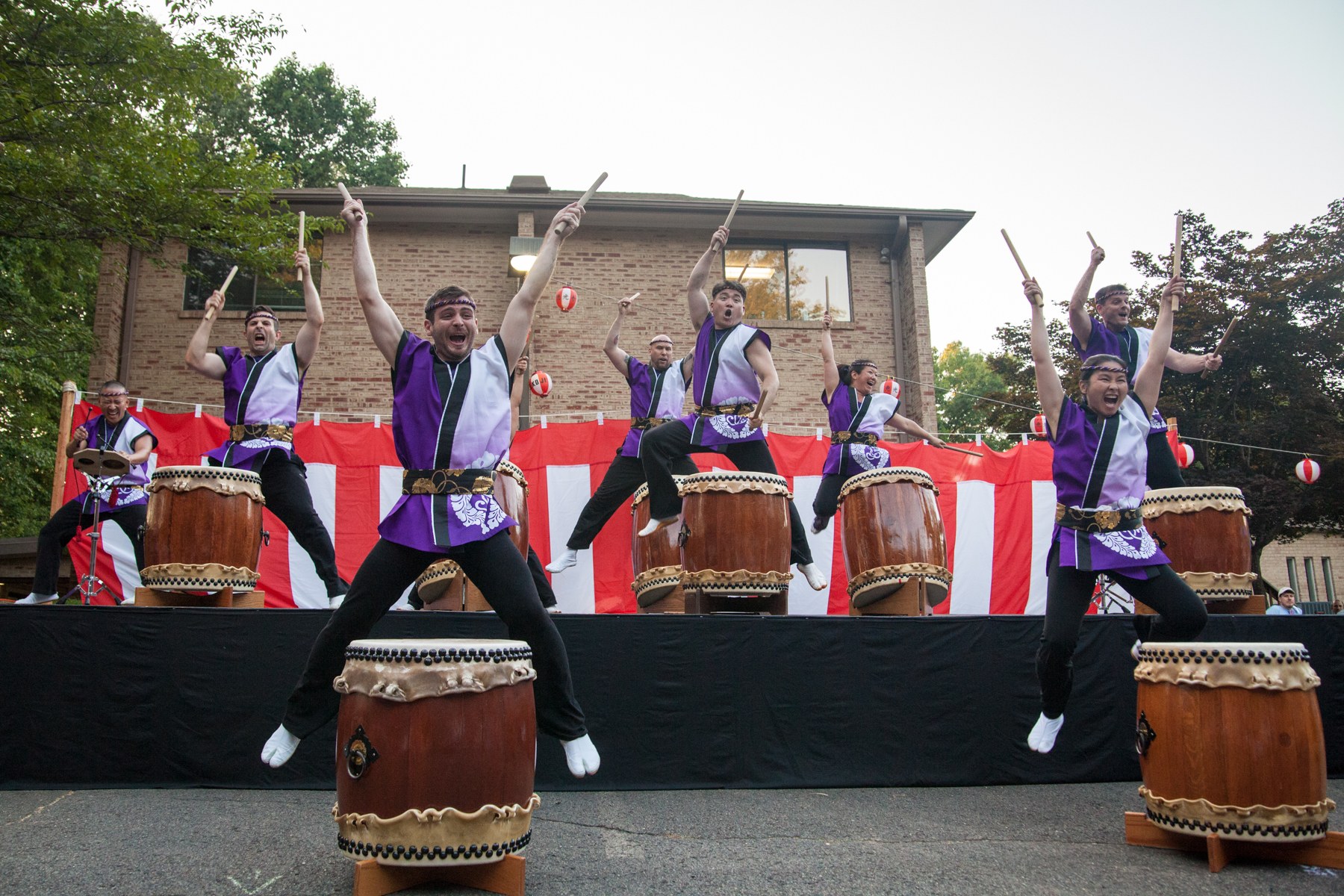
A large ensemble of performers in vibrant purple and white costumes stand on a black-fronted stage before a brick building, holding traditional wooden taiko drums decorated with cream-colored rope trim. The performers wear purple vests or sleeveless jackets over white shirts, along with black trousers and white socks. Behind them stretches a red and white striped banner. The group is captured mid-performance in a moment of exuberant celebration: most figures have their arms raised high, gripping wooden drumsticks (bachi) pointed upward, their mouths open in shouts or cries. The lighting is natural daylight, and trees are visible at the edges of the frame, suggesting an outdoor community venue. The composition emphasizes collective energy and synchronized movement across the entire ensemble.
The dancing
The performers are densely arranged across the stage in staggered rows, creating visual depth. Their bodies are upright and energized, with shoulders squared and legs planted in a stable, grounded stance. Arms are raised symmetrically overhead in unison, elbows bent, with bachi held vertically or at angles—the typical ready position before striking a taiko drum. Faces show intense concentration and vocalization, with open mouths suggesting shouts ('kiai') that accompany the performance. The synchronization of arm position across the ensemble suggests disciplined group training, though the natural variation in individual poses captures the organic energy of live performance.
The dance depicted
This is taiko ensemble drumming, a contemporary Japanese performance form that fuses rhythm, dance, and percussive technique. Taiko performances are highly choreographed events in which the body movement—posture, arm strikes, footwork, and vocalizations—is as integral to the performance as the sound production. Nen Daiko appears to be an amateur or community-based ensemble (the name suggests a group identity). The raised bachi and energized stance suggest they are either about to begin a striking sequence or are captured in the moment between phrases. Taiko is not classified as 'dance' in the Western ballroom or ballet sense, but it is fundamentally a movement practice in which striking patterns are coordinated with body position, breathing, and group synchronization.
How it was made
This is a color photograph, likely digital, taken outdoors in natural light during daylight hours. The image is sharp and well-exposed, with good depth of field showing the ensemble and setting clearly. The photograph captures a moment of live performance, making it a documentary record rather than a posed studio image. The date of July 20, 2023 suggests this was a public community event, probably a summer festival or library programming.
About this work
This photograph documents a live performance by Nen Daiko, a Japanese taiko ensemble, at a public outdoor venue. Taiko is a contemporary Japanese performance art that treats percussion, movement, vocalization, and group choreography as inseparable elements. The image captures the moment of high energy and collective intention—bodies tensed, arms raised, voices engaged—that defines taiko performance aesthetics. While taiko sits outside Western dance taxonomies, it belongs in a gallery of dance in art because it is fundamentally a coordinated movement practice in which the body, not just the hands, creates meaning.
This work is significant as documentation of grassroots cultural practice and community arts engagement. It shows how taiko has been adopted and adapted by performers outside Japan, becoming part of contemporary global culture. The photograph records not a theatrical staging but an actual communal performance, capturing the democratic and participatory ethos that taiko has fostered.
How to look at it
Watch the uniformity of the raised bachi across the ensemble—the precision of this moment is what taiko rehearsal aims for, and this photograph freezes the instant before impact. Notice how the performers' facial expressions and open mouths signal vocalization ('kiai') that will accompany the drum strikes; this is not silent musicianship but a fully embodied shout. The plant of the feet and the squared shoulders show the grounding technique essential to taiko, which requires significant physical power and control. The red and white banner behind, the outdoor setting, and the community venue suggest this is participatory cultural practice rather than professional theater, yet the coordination and energy are unmistakable.
The period
Contemporary taiko as a formalized performance art emerged in Japan in the 1960s, building on traditional festival drumming (matsuri taiko) and reimagining it as a concert and theatrical form with ensemble choreography. By the 2020s, taiko ensembles had become established in North America, Europe, and beyond, often serving Asian diaspora communities and experimental arts audiences. This 2023 performance sits within a well-developed global network of amateur and semi-professional taiko groups, many of which perform at community festivals, libraries, and cultural centers. The outdoor summer library event shown here reflects how taiko has become normalized as accessible community programming, not elite concert practice.
Where it lives
The image is held in the Library of Congress and was dated July 20, 2023. It appears to be from a public documentation initiative, likely part of the Library's community arts or local culture collecting.
Dance in this work
Questions about this work
Is taiko actually a dance?
Taiko is primarily a percussion art form, but it is danced in the sense that the entire body—stance, posture, arm mechanics, footwork, and vocalization—is choreographed and synchronized. Western dance categories often exclude forms that center on percussion or music production, but taiko performers train as movement artists. The boundary between 'music' and 'dance' is cultural and historically contingent, and taiko challenges that division.
Where does taiko come from?
Taiko has roots in Japanese festival and ritual drumming (matsuri taiko), but contemporary ensemble taiko as a concert and theatrical form developed in Japan in the 1960s. The most famous ensemble, Kodo, helped establish taiko as a global performance art. Taiko was adopted by Japanese diaspora communities in North America in the 1970s–80s and has since spread worldwide, becoming a vehicle for community building, cultural transmission, and artistic experimentation.
What is Nen Daiko?
Based on the photograph alone, Nen Daiko appears to be a community or amateur taiko ensemble performing at a public library event. The name suggests a group identity, but the record provides no further information about the ensemble's history, leadership, or composition. The photograph is documentary evidence of their performance on this date and location.
What is the vocalization in taiko?
'Kiai' (気合い) is a focused shout or cry that accompanies striking patterns in taiko and many other Japanese martial and performance arts. It serves multiple functions: it synchronizes the ensemble, channels physical power and focus, and communicates intensity and intention to the audience. In this photograph, the open mouths of the performers suggest they are shouting in unison with their arm movements.
More dance artwork





