38 works in this view — arrow keys or swipe to move between them.
Dance in Art · 1922
Dancing honeymoon
Unknown artist
- Source:
- Library of Congress
- Rights:
- Public domain — free to use, share and adapt.
- Recorded as:
- Public Domain
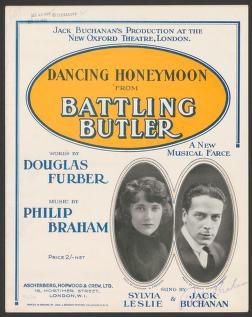
For dance historians, this poster is evidence of how dance was packaged and consumed in the early 1920s cinema: as a support for romantic narrative and star power rather than as a featured art form. The emphasis on the honeymoon narrative and the intimate positioning of the pair points to how ballroom and social dance were understood as expressions of courtship and desire rather than as technical or artistic achievements.
What you are looking at
This is a theatrical poster for a 1922 musical film titled *Dancing Honeymoon*, printed in the characteristic style of early cinema publicity. The design centers on two oval portrait photographs set against a warm golden-yellow background, the larger oval on the right containing two figures—a man and a woman—posed in close proximity suggesting romantic intimacy. The left oval shows a single woman's face. The poster employs bold typography in art nouveau and early modernist styles, with the film title dominating the upper portion in large letters within an oval frame. Credits appear below, listing the film as "A New Musical Picture" and naming director Douglas Furber and star Sylvia Leslie, alongside Jack Buchanan. The composition is symmetrical and decorative, typical of theatrical advertising from the early sound era, with careful attention to the glamorous presentation of the performers' faces as the primary draw.
The dancing
The figures in the right oval are posed in a formal, theatrical manner typical of early cinema portraiture—standing close together with composed expressions and carefully arranged clothing, rather than captured in an actual dance movement. The woman's face is turned toward the camera with a calm, professional demeanor, while the man is similarly posed. The single portrait on the left shows a woman in three-quarter view. None of the figures displays the dynamic energy or specific hold that would identify an actual dance step or ballroom position; they are theatrical celebrities presented to an audience, not dancers mid-movement.
The dance depicted
While the title promises a dancing honeymoon, the poster itself provides no visual evidence of the type of dance depicted in the film. The photograph is a publicity image designed to sell the film through the appeal of the stars rather than to document choreography. Given the 1922 date, the theatrical context, and the designation as a musical picture from the early sound film era, the dance would likely have been ballroom dance (foxtrot, waltz, or similar) or theatrical jazz, but the still image cannot confirm this. The poster is a marketing object, not a choreographic document.
How it was made
This is a chromolithographic theater poster, a mass-produced advertising medium typical of the 1920s cinema industry. The process allowed for bright, durable color printing of large images, making it affordable to distribute widely to cinemas, lobbies, and public spaces. The gilded background and bold typography reflect the technical capabilities and aesthetic preferences of color lithography in this period. The inclusion of photographic portrait elements combined with lithographic text and decoration was a standard technique for early film publicity, allowing the reproduction of the stars' faces while maintaining the flexibility of poster design.
About this work
This is a theatrical poster advertising a 1922 musical film featuring ballroom or theatrical dance. The work is significant as a document of early cinema marketing practice and of the popular perception of dance as entertainment in the emerging sound film era. The poster prioritizes the stars' faces and the film's novelty as a musical picture over any representation of the actual choreography, reflecting how dance was sold to audiences in this period—as a glamorous, intimate experience centered on celebrity performers rather than as a craft to be studied.
How to look at it
Attend to the way the faces dominate the composition: this poster sells the film through star power and romantic appeal, not through the promise of dance technique or spectacle. Note the careful symmetry and the use of gold toning, which conveys luxury and theatrical glamor. The inclusion of credits—director, studio marks, and stars' names—reflects the emergence of a star system in cinema and the personalization of entertainment around named performers. The poster is a commercial object designed to create desire for the film itself, not to represent its choreography.
The artist
The artist is not recorded. The poster was produced by a commercial lithography house serving the film industry. Theatrical posters of this era were typically created by design teams rather than individual artists and were not signed.
The period
The early 1920s saw the rapid expansion of cinema as popular entertainment and the emergence of musical films and dance on screen. Ballroom dance, particularly the foxtrot and waltz, was enjoying a peak of popularity in both social and theatrical contexts. The marketing of dance films relied heavily on the charisma and attractiveness of the performers, and titles emphasizing romance and courtship (like *Dancing Honeymoon*) were common. This period also marked the transition from silent film to synchronized sound, a shift that promised to bring music and dance more directly to audiences.
Where it lives
The poster is held by the Library of Congress. It is a mass-produced theater advertising material, one of thousands distributed for commercial cinema exhibition in 1922.
Dance in this work
Questions about this work
What dance is shown in this film?
The poster does not reveal the specific dance or choreography. Given the date and the "musical picture" designation, it was likely ballroom dance (foxtrot or waltz) or theatrical jazz, but the still image shows only the performers' faces, not their movement.
Who were these performers?
The poster credits Sylvia Leslie and Jack Buchanan as stars. Buchanan was a well-known British musical theater performer and film star of the 1920s and 1930s, known for both acting and dancing in theatrical and film productions.
What does the golden background mean?
The gold color was a choice available through chromolithography and conveyed luxury, warmth, and theatrical glamor. It also helped the poster stand out in cinema lobbies and on streets, making it an effective advertising tool.
More dance artwork





