32 works in this view — arrow keys or swipe to move between them.
Dance in Art · 1962
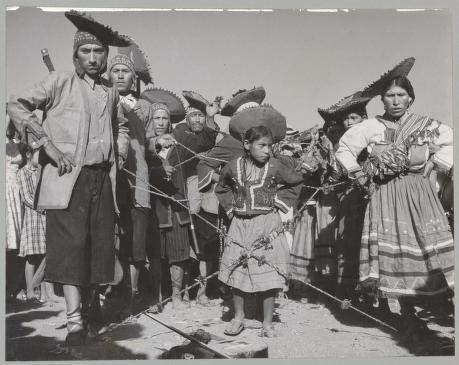
"Bury dance" Carnival, Peru.
Unknown artist
- Source:
- Library of Congress
- Rights:
- Public domain — free to use, share and adapt.
- Recorded as:
- Public Domain
This image documents a Peruvian highland tradition that may have deep pre-Columbian roots or syncretic colonial origins, preserved in a specific moment by a photographer. For historians and ethnographers of Andean culture, it is a concrete record of costume, community structure, and ritual practice at a precise date. For dancers and choreographers interested in indigenous and diaspora traditions, it shows how dance functioned within community life rather than as a separate art form.
What you are looking at
A large group gathering in bright daylight, shot in black and white. The composition centers on a small child in a patterned dress, surrounded by standing adults and older children wearing traditional Andean dress: long skirts, woven textiles, hats. The setting appears to be a street or open ground, with figures arranged loosely rather than in formal lines. The light is harsh and even, casting sharp shadows. Several adults hold long staffs or poles that angle upward across the frame—these are prominent visual elements. The overall mood is festive and communal, with multiple generations present. The dress and styling suggest a highland Andean community, and the title references a "bury dance," indicating this captures a specific ritual or carnival moment.
The dancing
The bodies are mostly upright and still, not caught mid-movement. The child at center appears to be standing relatively stationary, being regarded by the surrounding adults and children. The adults' posture is formal and observational rather than actively dancing. Several figures hold long wooden poles or staffs at various angles, which appear to be props or ritual objects rather than dance implements in active use. The gathering has the quality of a pause or moment of ceremony rather than active choreography in progress.
The dance depicted
This appears to document a Peruvian Andean carnival or ritual practice rather than a formal dance performance. The title "Bury dance" (likely a transliteration of a Quechua term) suggests a specific ceremonial or carnival tradition tied to death, burial, or symbolic transformation—common themes in Andean highland festivals. The presence of the child as a focal point, the staffs, and the communal gathering suggest ritual significance rather than secular entertainment. Without specialist knowledge of this particular Peruvian practice, the specific choreography cannot be confidently identified, but the image documents a living tradition of folk ceremony that likely has pre-Columbian or syncretic roots.
How it was made
A black-and-white photograph, likely documentary in purpose. The straight angle, even exposure, and lack of artistic composition suggest this was captured by a photographer documenting ethnographic or cultural practices rather than an art photographer. The sharpness and grain indicate mid-20th-century photographic stock. As a documentary photograph from 1962, this is a primary source record of a specific moment and place, with the authority and limitations of all documentary photography: it shows what was present in front of the camera but frames it according to the photographer's position and intent.
About this work
This is a documentary photograph of a Peruvian Andean carnival or ritual ceremony, likely from a highland community, capturing a moment identified as a "bury dance." The image records a communal gathering centered on a child, with adults and older children in traditional dress holding long staffs, arranged in what appears to be a ceremonial rather than choreographed formation. It belongs in a gallery of dance in art as evidence of living folk tradition and ritual practice—not as a representation of dance by an artist, but as a historical document of how dance and ceremony functioned within community life. The photograph is valuable precisely because it captures a specific moment without interpretation or aestheticization.
How to look at it
Focus on the staffs or poles held by multiple figures—they are a key element of whatever ritual is unfolding, yet the photograph captures a moment of relative stillness rather than active dance. Notice the careful positioning of the child at center and the way the surrounding figures regard or frame that child; this suggests the child may be the focus of a ceremony or blessing. The traditional dress—the hats, woven textiles, long skirts—is consistent across the group, indicating a shared cultural identity and possibly a formal occasion or season.
The period
In 1962, documentary photography was becoming a recognized tool for ethnographic and anthropological work. This photograph sits within mid-century traditions of cultural documentation—work that recorded indigenous and folk practices before assumed modernization could erase them. In Peru, the early 1960s were a period of significant social change; highland communities were experiencing increasing contact with coastal and urban culture. Carnival and traditional ceremonies remained vital to Andean community identity and were often the subject of anthropological and journalistic photography.
Where it lives
The image is held by the Library of Congress. It is identified as source material, likely part of a larger documentary collection. The bare catalogue record suggests it may have been acquired as part of a broader collection of Latin American photography or anthropological documentation.
Dance in this work
Questions about this work
What is a 'bury dance'?
The title likely refers to a specific Andean ceremony or carnival ritual, though the exact translation and practice would require specialist knowledge of Quechua terminology and highland Peruvian traditions. Andean carnival and ritual practices often involve symbolic themes of death, renewal, and transformation, which the term 'bury' may reference. This photograph alone cannot fully explain the practice; comparison with other documentation or ethnographic sources would be needed.
Why is there a child at the center?
In many ritual and ceremonial contexts, children can hold symbolic significance—they may be participants, focuses of blessing, or representatives of future generations. Without additional context, the photograph does not fully explain the child's role, but their central positioning and the surrounding adults' attention suggest deliberate ceremonial placement rather than accidental framing.
What are the staffs or poles for?
In Andean ritual and carnival practices, long staffs or poles often serve ceremonial or symbolic purposes—they may be dance implements, markers of status, offerings, or ritual objects tied to specific mythological or seasonal meanings. The photograph shows them present but does not capture active use or movement that would clarify their function.
More dance artwork





