31 works in this view — arrow keys or swipe to move between them.
Dance in Art · 1914
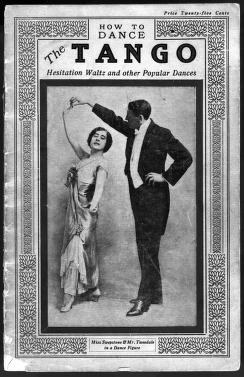
The tango, as standardized and taught by the representative dancing masters of the North American continent; tango two-step, hesitation waltz, Boston glide, one-step,
Unknown artist
- Source:
- Library of Congress
- Rights:
- Public domain — free to use, share and adapt.
- Recorded as:
- Public Domain
The tango arrived in North America from Argentina around 1912–13 and caused moral panic among conservative authorities who saw it as sexually provocative and unsuitable for respectable society. This instructional page is evidence of how the dance was domesticated: teachers and publishers removed the tango's improvisational, intimate character and reframed it as a standardized, teachable technique for the middle-class ballroom. For historians of dance and of American social life, this image documents the moment when a working-class import was being transformed into a respectable leisure activity through the apparatus of professional instruction and print media.
What you are looking at
This is a printed instructional page from 1914 showing two dancers in a formal ballroom pose against a plain background. The man, on the right, wears a dark suit and stands in an upright, formal posture. The woman, on the left, wears a light-colored dress with a fitted bodice and a skirt that falls to mid-calf, typical of 1910s fashion. They stand close together in a closed dance frame, with the woman's body angled toward the man and her weight appearing to be forward on her feet. The page is bordered with decorative typographic rules, and text at the top reads "HOW TO DANCE" and "TANGO," with a subtitle below identifying this as instruction in "Hesitation Waltz and other Popular Dances." The photograph is rendered in black and white halftone, the standard process for reproducing photographs in print at this period.
The dancing
The pair occupies a formal ballroom closed position: the man's right arm is around the woman's waist, his left arm extended at shoulder height holding her raised right hand. The woman's left arm rests on the man's shoulder or upper arm. Both dancers face the camera with their bodies in profile or three-quarter view, their posture upright and dignified. The woman's weight appears centered or slightly forward, the man's stance grounded and stable. There is no visible footwork or mid-movement action—this is a posed, stationary demonstration of frame and position rather than a captured moment of movement.
The dance depicted
This is instructional material for social ballroom dancing, specifically the tango as taught in North America in 1914. The page title explicitly states it shows "The tango, as standardized and taught by the representative dancing masters of the North American continent" alongside other dances including the "tango two-step, hesitation waltz, Boston glide, one-step." The image demonstrates the basic closed position and posture that professional dance teachers used to standardize the tango for American ballroom dancers. The formal, static presentation is typical of instructional dance photography of the period, designed to show correct frame and alignment rather than the momentum or character of the dance itself.
How it was made
This is a halftone photographic reproduction, the dominant process for printing photographs in newspapers, magazines, and instructional books from the 1890s through the mid-twentieth century. The fine dot pattern visible under magnification is characteristic of halftone screening. The image appears to have been professionally photographed in a studio with even lighting and a neutral backdrop, then screened and printed as part of a larger publication. Halftone reproduction was economical and allowed wide circulation of instructional imagery, making this the ideal medium for reaching the urban middle and working classes who were taking up ballroom dancing as a leisure activity.
About this work
This is an American dance instruction page from 1914, showing the fundamental closed position for the tango as taught by ballroom masters to the North American public. The tango had recently arrived from Argentina and was still being adapted and standardized for polite American ballroom society; this page represents that process of codification. The image is a straightforward documentary record: two dancers in correct position, photographed and printed for mass instruction. It belongs in a gallery of dance art because it captures a specific moment in the history of how dance knowledge was transmitted, validated, and commercialized in the early twentieth century. The formality of the pose and the earnestness of the instructional apparatus reveal the anxieties and ambitions of the era around "proper" dance technique and class respectability.
How to look at it
The photograph is deliberately static and frontal, freezing the dancers in the fundamental closed position rather than showing the tango's characteristic movement or character. A viewer should notice the formal uprightness of the pose, the geometric clarity of the frame (man's arm at shoulder height, woman's raised hand), and the neutral, expressionless faces—this is posture and position, not emotion or dynamism. The choice to show the dancers at rest and in profile/three-quarter view follows the conventions of 1910s instructional photography: the goal is clarity of anatomical position, not the capture of movement or artistry. Compare this to any photograph of tango dancers from Argentina or Paris in the same period, and you will see how much this American version has emphasized discipline and decorum over sensuality or improvisation.
The period
The tango craze in North America peaked between 1912 and 1915. The dance had originated in the working-class neighborhoods of Buenos Aires and was danced in cabarets and dance halls; by 1910 it had reached Paris, where it was adopted by fashionable society. American enthusiasm followed, but so did fierce resistance from religious leaders, newspapers, and etiquette authorities who condemned the tango as immoral and lascivious. Dance teachers capitalized on the craze by offering instruction in a 'sanitized' version of the dance, marketed as respectable and teachable. This page is part of that commercial and cultural project. Simultaneously, the 1910s saw the rise of ballroom dancing as organized leisure for the American middle class, with the emergence of professional dance teachers, standardized technique, and instructional media—books, magazines, and photographs—that had no precedent.
Where it lives
This page is held by the Library of Congress. It is a printed instructional publication, part of the mass of how-to-dance literature that emerged in America in the early twentieth century.
Dance in this work
Questions about this work
Why does the tango look so formal and stiff in this image?
This is not the Argentine tango as it was danced in its home country or in Paris cabarets. This is the North American ballroom version, standardized and 'refined' by professional teachers for middle-class consumption. The formal posture and static pose reflect the values of respectability and decorum that American dance teachers believed would make the tango acceptable to conservative society. The tango taught in this era was deliberately stripped of its improvisational character and working-class associations.
When did the tango arrive in North America?
The tango reached North America around 1912–13, arriving from Argentina via Paris. It caused immediate moral panic, with newspapers and religious leaders condemning it as indecent. By 1914, when this instruction page was published, the dance had become enormously popular despite—or because of—the controversy. Professional dance teachers seized the opportunity to profit by offering instruction in a 'respectable' version of the dance.
What other dances are mentioned on this page?
The page advertises instruction in the tango two-step, hesitation waltz, Boston glide, and one-step alongside the tango. These were all fashionable social ballroom dances in 1914. The one-step was one of the simplest and quickest of the era's dances; the hesitation waltz and Boston glide were variations on the waltz; the tango two-step was an Americanized simplification of the tango.
More dance artwork





