30 works in this view — arrow keys or swipe to move between them.
Dance in Art · 1919
Dancing shoes
Unknown artist
- Source:
- Library of Congress
- Rights:
- Public domain — free to use, share and adapt.
- Recorded as:
- Public Domain
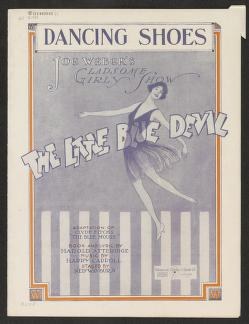
This image captures the moment when dance moved from theatrical practice into popular culture and consumer marketing. It shows us how early modern dance—with its promise of freedom and natural movement—was packaged and sold to women as a lifestyle choice, and it demonstrates the close alliance between dance innovation, fashion, and commercial art in the 1910s.
What you are looking at
This is a cover design for sheet music or a promotional poster from 1919 advertising dancing shoes. A stylized female figure dominates the composition, rendered in art deco or early modernist style with soft, ethereal linework. She is shown in profile, mid-movement, with her body angled dynamically. She wears a short, loose tunic or chemise dress typical of 1910s fashion, and her pose suggests the lightness and freedom of modern dance. The background is divided into vertical stripes in muted tones—ochre, gray, and cream—creating a rhythmic pattern that echoes the subject of the design. The title "Dancing Shoes" appears in large serif capitals at the top, with "De Veneto's" (or similar branding) above it, and a subtitle at the bottom that appears to read something like "The Living Rhythm" or similar. The overall design is clean, geometric, and promotional in intent, using the dancing figure as the central motif to sell footwear to a clientele interested in modern movement and fashion.
The dancing
The figure is a single dancer, shown in three-quarter view, with weight shifted to one leg in a pose suggesting forward motion or a suspended moment. The arm gesture is light and raised, with fingers extended, suggesting neither balletic precision nor heavy labor but rather the free, expressive movement of modern dance. The torso is elongated and slightly curved; the legs are not precisely rendered but suggested with flowing lines. The body demonstrates ease and freedom rather than technical control, and the overall impression is of buoyancy rather than strength.
The dance depicted
This is not a depiction of any specific named dance but rather an idealized image of modern, free movement marketed to consumers as fashionable and desirable. The 1919 date and the style of dress place this squarely in the era of early modern dance and the post-WWI cultural moment when dance and fashion were becoming closely linked as expressions of liberation and modernity. The figure suggests the influence of interpretive or barefoot dance rather than ballroom or classical ballet, but it is fundamentally a commercial image selling a lifestyle and product rather than documenting any particular dance practice.
How it was made
This is a lithograph or chromolithograph, a printing process that allowed for soft gradations of tone and a painterly effect while remaining reproducible for mass circulation. The technique is suited to commercial art and sheet music covers of the period. The color palette is restrained—ochres, grays, cream, and black—which was typical of 1910s commercial printing. The quality of line suggests the work was drawn directly onto stone or transferred from an original design, and the geometric background pattern is characteristic of art deco design emerging in this period.
About this work
This is a commercial design object from 1919—most likely a sheet music cover or promotional poster—that uses the figure of a dancing woman to market modern femininity and freedom. It sits at the intersection of dance, fashion, and consumer culture in the early 20th century, when interpretive and modern dance were becoming associated with women's liberation and contemporary lifestyle. The work is valuable not as a document of actual dance practice but as evidence of how dance was being commodified and sold as an image of modernity to the general public.
How to look at it
Attend to the contrast between the soft, organic lines of the figure and the hard geometric stripes of the background—this tension between natural movement and industrial modernity was central to 1910s design culture. Notice the figure's lightness and the suggestion of upward momentum, conveyed through the lifted arm and the curve of the body. The absence of grounding—no floor line, no weight—suggests that the dancing shoes promise to lift the wearer into a new kind of physical freedom.
The period
In 1919, modern dance in America was emerging from the pioneering work of Isadora Duncan and Ruth St. Denis, who had challenged classical ballet's formality with barefoot, expressive movement drawn from nature and non-Western sources. Simultaneously, women's fashion was liberating itself from corsets and heavy fabrics; the loose, short tunic dress shown here reflects that shift. The end of World War I brought a cultural appetite for novelty and modernity, and dance became a symbol of that change. Art deco design, with its clean lines and geometric patterning, was becoming the dominant commercial aesthetic, particularly for products aimed at young women.
Where it lives
This work is held by the Library of Congress and is catalogued as part of their general collections. It is a commercial printed object, likely a sheet music cover or promotional poster, designed for mass distribution and consumption.
Dance in this work
Questions about this work
Is this a portrait of a real dancer?
No. This is an idealized commercial design created to market shoes and embody a lifestyle. The figure represents a type—the modern, free, fashionable woman—rather than any specific person or performer.
What dance is this?
This is not a depiction of any particular named dance style. It is a stylized image of modern, interpretive movement that was fashionable among women in 1919. The loose tunic, barefoot aesthetic (implied), and free arm gesture suggest influence from early modern dance pioneers like Isadora Duncan, but the image is designed for commercial appeal rather than documentary accuracy.
Why are the shoes the subject if the figure appears to be barefoot?
The shoes are the product being sold; the barefoot appearance suggests the freedom and lightness they promise, rather than showing the product itself. This is typical of consumer advertising, which sells an idea or lifestyle rather than simply displaying the object.
What does the art deco style tell us?
Art deco was the cutting-edge modern design movement of the 1920s, and its use here signals that dancing shoes are a fashionable, contemporary product for consumers interested in modernity. The geometric background and clean lines associated the product with progress and innovation.
More dance artwork





