29 works in this view — arrow keys or swipe to move between them.
Dance in Art · 1913
Ich tanz so gern den Tango
Unknown artist
- Source:
- Library of Congress
- Rights:
- Public domain — free to use, share and adapt.
- Recorded as:
- Public Domain
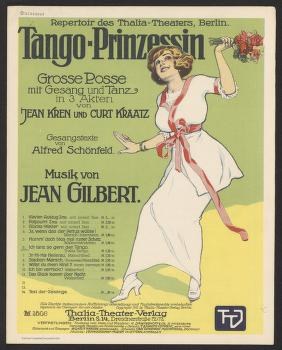
This poster documents the moment when tango crossed from ballroom into operetta and mass theater, showing how a specific dance style was adapted, simplified, and repackaged as spectacle for non-dancing audiences. It also illustrates how women's bodies were marketed through dance imagery in early 20th-century commercial design, using tango's association with sensuality and the exotic to sell tickets to middle-class theatergoers.
What you are looking at
A theatrical poster for a tango operetta, rendered in the commercial art style of 1910s Berlin. A woman in a white empire-waist gown dominates the composition, posed mid-movement with her body twisted, right leg extended, and left arm raised in a gestural flourish. Her pose conveys dramatic momentum—the kind of arrested motion typical of performance advertising. The woman wears a red sash or ribbon at her waist and holds a rose in her raised hand, establishing both the sensuality and the theatrical artifice of the scene. The background is a soft yellow-gold, allowing the figure to read clearly. At top left, the Berlin Repertoire Theatre's name appears, anchoring this as advertisement for a specific theatrical production. Typography in the Jugendstil manner announces the title "Tango-Prinzessin," the composer Jean Gilbert, and credits for the director Alfred Schönfeld and performers Jean Kiren and Curt Knaatz.
The dancing
A single female figure, posed in a moment of dynamic extension rather than in an actual dance hold or frame. Her right leg is fully extended behind or to the side; her torso twists to face the viewer while her left arm rises with elbow bent, hand open. The pose reads as a stylized theatrical gesture—expressive rather than technically precise—conveying exuberance and femininity. There is no partner visible, no closed or open dance hold, and no footwork detail. The posture is closer to theatrical pantomime or cabaret styling than to the ballroom frame of social tango.
The dance depicted
This is an operetta—a form of musical theater rather than dance proper—but tango is the subject and selling point. The operetta *Tango-Prinzessin* (Tango Princess), with music by the prolific composer Jean Gilbert, was a commercial theatrical product designed to capitalize on the international craze for tango that swept Europe and America in the 1910s. The image does not depict tango dancing in the technical sense; it advertises the *idea* of tango—exoticism, sensuality, and feminine allure—to theatergoing public. The tango that appeared on the stage in such operettas was typically a stylized theatrical version, often performed by soloists or pairs in elaborate costume, rather than a faithful representation of the ballroom dance.
How it was made
This is a lithographic poster, a medium perfectly suited to theatrical advertising. Lithography allowed for bold color areas, legible typography, and economical production and distribution. The artist has employed a limited palette—predominantly yellow-gold, white, red, and flesh tones—with black outlines defining the figure clearly. The technique's flatness and bold graphic quality are characteristic of Jugendstil (Art Nouveau) design practice in Berlin during this period. Such posters were produced for display in theaters, print shops, and public spaces, making them works of mass audience communication rather than unique artworks.
About this work
This is a lithographic theater poster advertising a Jean Gilbert operetta titled *Tango-Prinzessin*, issued by Berlin's Repertoire Theater around 1913. It captures a moment when tango—the Argentine ballroom dance—had become a sensation across European cities and was being rapidly absorbed into commercial popular entertainment, particularly operetta and revue. The poster does not document actual tango technique but rather the commercial aesthetics and fantasies surrounding tango: the emphasis on a single, elaborately dressed woman in an attitude of dramatic sensuality, the rose as a prop of romantic theater, and the theatrical gesture rather than the precise footwork of the dance itself. The work exemplifies how a global dance phenomenon was domesticated and transformed for metropolitan theatrical consumption.
How to look at it
Notice the pose: it is not a position that would appear in actual ballroom tango, where partners maintain a closed embrace and move in a coordinated frame across the floor. Instead, the artist has chosen an attitude—a moment of theatrical display—that emphasizes the woman's individual body and costume. The rose, the sash, the empire waist, the elaborately styled hair all signal that this is *costume* and *character*, not the actual practice of dance. The extended leg and raised arm are gestures of theatrical enthusiasm, the language of operetta and cabaret rather than of ballroom technique. This tells us that early 20th-century audiences understood tango not as a precise technical practice but as a visual and emotional spectacle—a vehicle for fantasy about modernity, exoticism, and female sexuality.
The artist
The artist is not recorded in the catalog. The work is signed neither on the image itself (visibly) nor in the catalog. The design is consistent with Berlin Jugendstil commercial design practice of the early 1910s—bold, flattened forms, clear typography, integrated use of color—but without attribution it is impossible to credit the designer. The poster was produced by the Berlin Theater Verlag (Berlin Theater Publishing House), a firm specializing in theatrical promotion.
The period
Between 1912 and 1914, tango became a craze in European cities. The dance had arrived from Argentina, passed through Paris, and reached Berlin, Vienna, and other imperial and metropolitan centers. Operetta was the dominant form of popular musical theater, and composers like Jean Gilbert (who wrote over 25 operettas) quickly seized on tango as subject matter and musical material. At the same time, tango dancing was controversial—it was condemned by conservative clergy and social commentators for its close partnering, hip motion, and associations with working-class and immigrant cultures in Buenos Aires. Operetta offered a way to commodify and domesticate the dance, placing it on stage in an aesthetic frame that made it acceptable to bourgeois audiences. This poster thus sits at the intersection of dance craze, theatrical entertainment, commercial design, and the social anxieties surrounding a new, sexy, and foreign form of movement.
Where it lives
This is a theatrical poster held by the Library of Congress. It was produced by the Berlin Theater Publishing House and distributed to advertise a production at the Berlin Repertoire Theater. Such posters are documents of theatrical history and commercial design rather than fine art objects, though they are now recognized as significant works of graphic design and visual culture.
Dance in this work
Questions about this work
Is this actually a tango dance, or is it something else?
It is an operetta—a form of musical theater with songs and plot. Tango is the *subject matter*, not the actual dance being shown. The operetta *Tango-Prinzessin* used tango music and the idea of tango as selling points, but the stage performance would have been theatrical and choreographed, not social ballroom tango. This poster advertises the operetta, not a tango competition or ballroom dancing.
Who was Jean Gilbert?
Jean Gilbert (1879–1942) was a German composer of operettas and popular music. He was one of the most prolific operetta composers of his era, writing over 25 stage works. He capitalized on contemporary musical fashions, including the tango craze, and his works were widely performed across Germany and Austria. Many of his operettas were translated and performed internationally.
When and where was this tango craze happening?
Tango arrived in Europe around 1910–1912, spreading from Paris to Berlin, Vienna, and other major cities. By 1912–1914, it was a major cultural phenomenon—danced in ballrooms, cafés, and on stages, written about in newspapers, and condemned by moralists. The 1910s were the peak of tango's European vogue before World War I. This poster dates to roughly that moment of maximum enthusiasm.
Why is the artist not credited?
Commercial posters of this era were often not signed by their designers, especially in Berlin. The poster advertises the *production*, not the artwork. The designer's name might have appeared on the stone or in the printer's records, but such information was not always preserved. This is typical of applied and commercial graphic design practice.
More dance artwork





