28 works in this view — arrow keys or swipe to move between them.
Dance in Art · 1882
Court minuet
Unknown artist
- Source:
- Library of Congress
- Rights:
- Public domain — free to use, share and adapt.
- Recorded as:
- Public Domain
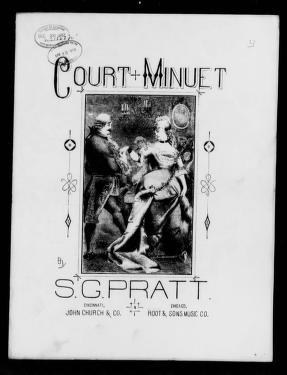
This image is crucial evidence for how the minuet was visualized and transmitted in the 19th century, when the dance itself had become historical. For dancers and historians, it shows the iconic pose—the bow and curtsy in counterbalance—that defined minuet decorum, and it demonstrates how print culture kept the minuet alive in collective memory long after it vanished from ballrooms. The engraving also reveals the gendered and spatial conventions of court dance: the woman's passivity, the man's initiation, the strict separation of bodies, and the precision of gesture.
What you are looking at
This is a black-and-white engraving depicting an intimate court dance scene from the 18th century. A elegantly dressed couple occupies the center of the composition: the man, in a coat with ornate buttons and breeches, bends forward in a courtly posture toward his partner, while the woman, in a wide pannièred gown with elaborate detail, leans back gracefully. The woman's skirts dominate the lower half of the image, their volume emphasized by the engraver's careful rendering of folds and texture. The setting is sparse—a few decorative elements suggest an interior space—but the focus is entirely on the couple and their interaction. The engraving employs fine parallel lines and cross-hatching to create shadow and volume, typical of 18th-century reproductive printmaking. The title "Court Minuet" and artist credit to S. G. Spratt appear as text at the bottom of the print.
The dancing
The male dancer initiates a deep, forward bow—a hallmark of minuet courtesy—while the female dancer responds with a corresponding lean or curtsy, her torso angled backward in counterbalance. Neither dancer touches the other; space and decorum are preserved between them. The woman's arms appear to be held at her sides or slightly extended, consistent with minuet arm carriage of the period. The man's posture is exaggerated and theatrical, emphasizing the formality and precision required of the dance. The composition captures the moment of salutation or reversal, when couples would exchange bows and curtsies as part of the minuet's prescribed sequence.
The dance depicted
This is unambiguously a minuet, the most prestigious and codified social dance of the 18th century. The title announces it; the court dress, the spatial separation, the balanced bow-and-curtsy, and the theatrical formality of the poses all confirm it. The minuet was danced by aristocratic couples in strict, geometric patterns, with prescribed arm and leg positions derived from ballet technique. It required years of instruction and was a marker of social rank and refinement. The engraving documents not a moment of improvisation but a formulaic moment within a formal sequence—the kind of instant a dancing master would recognize and a student would study.
How it was made
This is a wood or steel engraving, a reproductive print technique that allowed wide circulation of dance imagery in the 19th century. The fine parallel lines (hatching) and precise cross-hatching create tone and volume without color. The technique required a skilled engraver working from a design or painting; the credit to S. G. Spratt suggests Spratt was either the engraver or the designer. Wood and steel engravings were relatively inexpensive to produce and distribute compared to paintings or hand-colored prints, making them ideal for popular dance instruction, theatrical imagery, and courtship narratives. The print's survival and Library of Congress holding suggest it had some circulation as a commercial or educational image.
About this work
This engraving documents the minuet at a moment when it was becoming more historical than contemporary. Dated 1882, it depicts an 18th-century court dance through 19th-century print technology—a retrospective image produced for audiences who no longer danced minuets but valued them as emblems of refined manners and aristocratic tradition. The minuet had ceased to be a living social practice decades earlier, yet it retained symbolic power in visual culture as the epitome of courtly grace and geometric precision. By the date of this print, the minuet existed primarily in memory, in dance manuals, and in images like this one. The engraving serves as both documentation and nostalgia, preserving not the reality of minuet practice but its romantic afterimage—a couple suspended in formality, separated by space and etiquette, performing the elaborate courtesy that once defined elite society.
How to look at it
Notice the precise geometry of the pose: the man bends forward from the waist while the woman leans back, creating a visual counterbalance that was essential to minuet aesthetics. Observe the distance between the bodies—they never touch, a rule that governed every moment of the minuet. Look at the woman's skirts; their enormous volume (achieved with panniers, the structured underpinnings of the period) took up space and required the male dancer to navigate carefully around them. The engraver has frozen the moment of salutation, one of the few fully prescribed positions in the minuet sequence. The theatrical exaggeration of the bows suggests the artist understood the minuet as a highly formalized, almost balletic form rather than a naturalistic social interaction.
The artist
S. G. Spratt is credited on the print but remains obscure; no comprehensive record of Spratt's practice appears in standard art historical sources. The credit may refer to the engraver, the designer, or both. By 1882, reproductive wood and steel engravings were produced by commercial workshops and printing houses; individual engravers were often not well-documented. If Spratt designed the composition, they were working in a well-established tradition of minuet imagery dating back to 18th-century dance manuals and theatrical prints. The lack of biographical information reflects the anonymous or semi-anonymous status of much 19th-century commercial reproductive printmaking.
The period
By 1882, the minuet was dead as a social practice. It had dominated aristocratic ballrooms from the early 18th century until its decline in the 1790s, when Enlightenment culture and revolutionary upheaval destabilized the court hierarchy that had sustained it. The 19th century saw a wave of nostalgia for courtly manners, fueled by Romantic literature, historical novels, and the rise of historical costume and deportment instruction. Prints like this one were part of a broader market for historical dance imagery—visual reminders of a lost world of refinement. At the same time, competitive ballroom dancing (Waltz, Polka) had become the dominant couple dance form, and the minuet survived only as a historical curiosity, performed at fancy-dress balls or taught in deportment classes for young aristocrats. The engraving's date (1882) places it in the Victorian era's peak interest in historical propriety and courtly manners.
Where it lives
This engraving is held by the Library of Congress and appears to be a commercial print from the late 19th century. It was likely published as a standalone sheet or as part of a collection of historical dance imagery, deportment instruction, or theatrical costuming references. The absence of a publisher's name on the visible portion of the print makes definitive attribution of the publisher difficult.
Dance in this work
Questions about this work
What is the minuet and why was it important?
The minuet was the most prestigious social dance of the 18th-century European aristocracy. It required years of training, precise geometry, and strict adherence to codified steps and arm positions. It was a marker of social rank, refinement, and elite status. By the 19th century, it had fallen out of practice but remained a symbol of courtly grace and historical elegance.
Why don't the dancers touch?
Touching was strictly regulated in court dance. The minuet required spatial separation as a matter of decorum and formal choreography. The couple would move in parallel and facing patterns, with moments of approach and retreat, but without hand contact except in certain prescribed figures. This restraint was part of what made the minuet an expression of refined manners.
What are the woman's enormous skirts?
Those are panniers—wide, structured frameworks that extended the sides of the skirt horizontally. They were a defining fashion of the 18th century and made minuet dancing physically demanding; the male dancer had to navigate around the woman's skirts carefully, and the woman had to be aware of their volume at all times. The skirts took on dramatic visual importance in dance imagery of the period.
Is this a document of how the minuet was actually danced, or an idealized image?
It is both. The pose shown—the bow and curtsy in counterbalance—was indeed a prescribed, recurring moment in the minuet. However, this engraving was made in 1882, long after the minuet had stopped being danced. It is a 19th-century image of an 18th-century dance, filtered through memory, nostalgia, and historical imagination. It shows what the minuet was remembered to look like rather than a direct record of lived practice.
More dance artwork





