49 works in this view — arrow keys or swipe to move between them.
Dance in Art
French: La Danse d'une nymphe et d'un satyre The Dance of a Nymph and a Satyr.label QS:Lfr,"La Danse d'une Nymphe et d'un Satyre."label QS:Len,"The Dance of a Nymph and a Satyr."label QS:Lpl,"Taniec nimfy i satyra."
Alexandre Ubeleski
- Source:
- Wikimedia Commons
- Rights:
- Public domain — free to use, share and adapt.
- Recorded as:
- public_domain
This image preserves the Baroque court's most idealizing vision of what dancing meant: not steps or technique, but the body in a state of weightless, joyful elevation, orchestrated by divine music and blessed by putti. It shows us that 17th-century patrons valued the *idea* of dance as much as its execution—the fantasy of movement rather than its instruction. For anyone studying the cultural history of dance, especially the rise of ballet and its debt to courtly aesthetics, this work offers a window into the mythological and moral language in which dancing was celebrated.
What you are looking at
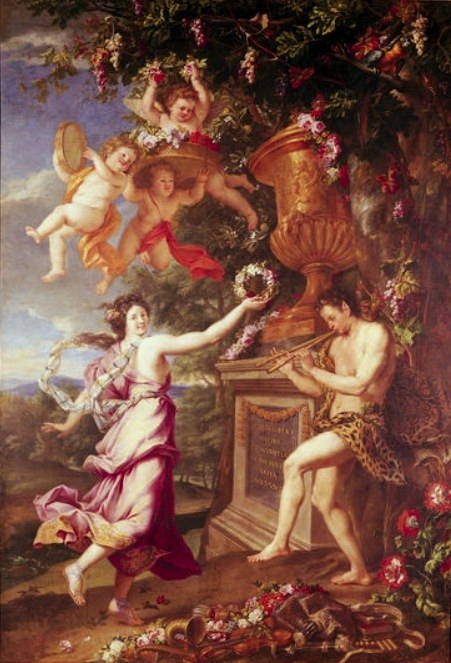
A lush mythological garden scene densely framed by flowering vines and roses, with a marble urn as the central monument. A nymph in flowing rose-pink drapery dances with graceful, elevated movement at the left of the composition, one arm raised in a gesture of joy or invocation. A satyr in earthy tones and classical drapery responds at the right, his body leaning toward her in animated engagement. Above them, hovering in the clouds, three putti (cherub figures) play musical instruments—a lyre and pipes—while two additional putti hold garlands of flowers, all blessing or orchestrating the scene below. The lighting is soft and golden, typical of Baroque painting, with warm tones dominating the foliage and flesh. The entire scene is framed by an architectural surround suggesting a tapestry or decorative panel, with the natural garden of vines and blooms cascading over the edges.
The dancing
The nymph's pose suggests upward, weightless movement: her torso tilts back slightly, her nearer leg extends behind her as if in a leap or suspension, and her raised arm gestures skyward with a sense of ecstatic elevation. The satyr's posture is more grounded and forward-leaning, his body angled toward her in pursuit or partnership, one arm reaching in her direction. Both figures occupy a shared space but do not clasp hands; the distance between them suggests a moment of reciprocal attraction frozen mid-motion. The satyr's muscular classical frame contrasts with the nymph's ethereal, elongated silhouette—a formal visual echo of masculine and feminine ideals in Baroque court art.
The dance depicted
This is not a representation of a codified dance form but rather a mythological fantasy of movement—a literary and artistic trope in which classical figures enact an idealized courtship through gesture and spatial play. The nymph's lightness and the satyr's earthiness evoke the Baroque court's fascination with contrast and the picturesque. The presence of musical putti and the ornamental garden setting align this with the pastorals and court ballets that entertained European nobility in the 17th century, where such mythological pairings featured. The image captures the Baroque ideal of *grazia* (grace) and sprezzatura—the appearance of effortless, elevated movement—rather than any specific Renaissance or Baroque court dance like the minuet or galliard.
How it was made
The work appears to be an oil painting on canvas, executed with the rich, luminous technique characteristic of Baroque decoration. The soft modeling of flesh, the jewel-like saturation of the drapery, and the fine detail in the surrounding botanical forms all point to panel or easel painting intended for a wealthy collector or aristocratic patron. The formal composition—a central scene framed by elaborate decorative surround—suggests this may be a study for or independent version of a larger decorative scheme, possibly for a palazzo or chateau. The cultivation of such mythological and pastoral imagery indicates a work created for an educated audience familiar with classical literature and courtly aesthetics.
About this work
This is a Baroque oil painting depicting an imagined dance between a nymph and satyr in a flower-laden garden, with musical putti presiding from the clouds. It belongs to a rich tradition of 17th-century courtly imagery in which classical mythology and idealized human movement served as vehicles for aristocratic taste and education. The work captures not a teachable dance technique but rather the Baroque vision of what dancing—as an expression of grace, desire, and cosmic harmony—ought to look like. For historians of court culture and dance spectacle, it documents how the dancing body was imagined and valued among European elites at a moment when ballet and court entertainments were becoming more formal and codified.
How to look at it
Attend first to the moment the artist has frozen: the nymph in upward flight, the satyr reaching toward her, the musical putti suspended above—all capture the *instant* of mutual attraction and graceful response, not a held pose or formal alignment. Notice how the bodies do not touch but communicate through space and gesture, a convention derived from court dance manners where partners maintained dignity through proximity rather than embrace. The abundance of flowers and architectural framing elevates this private moment into something cosmic and blessed; this is not naturalistic movement but movement transfigured by art and myth. Finally, observe how the satyr's weight and muscularity anchor the scene while the nymph's weightlessness seems to defy gravity—a visual metaphor for the Baroque ideal of feminine *grazia* and masculine strength in the dance.
The artist
Alexandre Ubeleski (also spelled Ubelesco) was a painter active in the late 17th century, whose name suggests Slavic or Eastern European origins, though little biographical detail survives in standard references. He worked in the Baroque manner, specializing in mythological and allegorical scenes for aristocratic patrons. The style, subject matter, and quality suggest he was trained within or influenced by the Baroque workshops of Southern Europe, possibly Italy or Flanders, where such mythological easel paintings were in high demand among collectors.
The period
This work dates to 1670, a pivotal moment in European dance history. Louis XIV had established the Académie Royale de Danse in 1661, formalizing and elevating ballet as a courtly art form; by 1670, the minuet and other codified dances were becoming dominant in court ritual. Simultaneously, painters across Europe were producing paintings and prints of mythological figures in idealized movement, often as decoration for aristocratic homes or as independent artworks celebrating courtly values. The pastoral and mythological imagery—nymphs, satyrs, Arcadian gardens—was a established Baroque trope, made famous by painters like Peter Paul Rubens and by the wealth of court ballet libretti that blended classical allusion with contemporary courtly spectacle. The presence of musical putti and flowering abundance links this to a broader Baroque celebration of sensory pleasure and divine harmony.
Where it lives
The work is recorded in Wikimedia Commons, suggesting it is in public holding or has been published in a digitized collection. The catalogue record does not specify a museum, archive, or private collection, nor does it confirm medium or current location.
Dance in this work
Questions about this work
Is this a real dance or a fantasy?
It is a mythological fantasy. Nymphs and satyrs do not exist, and this is not a depiction of a specific, teachable dance form. Rather, it captures the Baroque ideal of how the body should move when animated by grace, desire, and divine harmony. It belongs to the same world as the court ballets and pastoral operas of the 17th century, in which classical mythology was a stage for showing off courtly values and elegant movement.
What is the artist trying to show about dance?
That dancing is an expression of elevation, joy, and mutual attraction—and that it should look effortless and weightless. The nymph's upward leap and the satyr's responsive lean embody the Baroque principle of *grazia*: movement that appears natural but is actually highly cultivated. The musical putti and flowering garden signal that dance is a cosmic and divine act, not merely a social or courtly pastime.
Does this relate to ballet?
Indirectly. This painting was made in 1670, just nine years after Louis XIV formalized ballet training through the Académie Royale de Danse. While it does not depict ballet steps or technique, it embodies the aesthetic ideals—grace, elevation, ethereal beauty in women, strength in men—that ballet was systematizing. Court ballets of the period often featured mythological characters like nymphs and satyrs, so this imagery would have been familiar to aristocratic audiences who watched or participated in such spectacles.
Who is Ubeleski?
Little is known of Alexandre Ubeleski beyond his name and a few dated works. He was active in the late 17th century and worked in the Baroque manner, specializing in mythological scenes for wealthy patrons. His name suggests Eastern European origins, but his training and working context remain obscure. He is not among the most famous painters of the period, but his work reflects the widespread taste for such mythological imagery among European elites.
More dance artwork





