49 works in this view — arrow keys or swipe to move between them.
Dance in Art
Set model
Sonnabend, Yolanda
- Collection:
- Set model
- Source:
- Victoria and Albert Museum
- Rights:
- Rights vary by item — check the source record before reusing this image. Source record ↗
- Recorded as:
- V&A — check rights per item
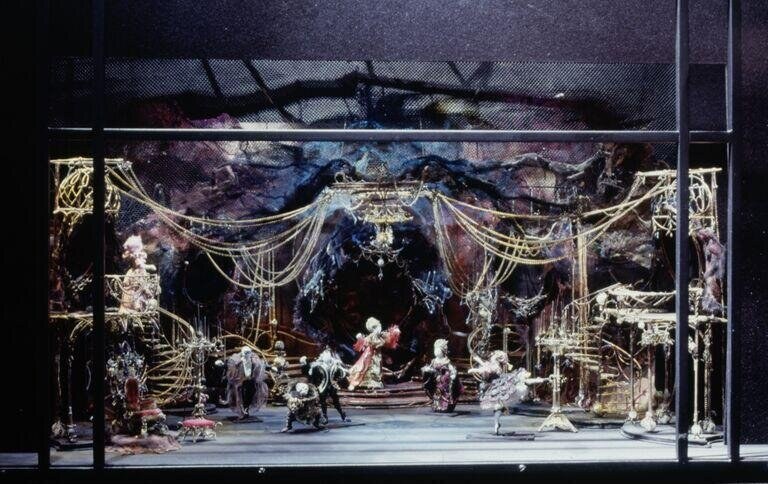
For dancers and choreographers, this model documents how theatrical design encodes movement: the architectural frame creates sightlines and spatial hierarchies that literally shape how bodies move and are seen. For historians, it is evidence of how late-20th-century theatrical professionals visualized and recreated 18th-century court culture—which is itself a historical act distinct from the original.
What you are looking at
A theatrical stage set rendered as a three-dimensional model displays an ornate interior, likely depicting a palace or aristocratic salon. The space is dominated by a sweeping architectural framework: elaborate gilt swags and garlands drape across the upper registers, while classical columns frame the composition. The floor is a pale, burnished surface suggesting marble or polished stone. Multiple figures in 18th-century dress—men in breeches and coats, women in full skirts and corseted bodies—are positioned throughout the space in attitudes of courtly interaction. Some stand in formal groupings; others appear mid-gesture. The background rises into a deep vista with further architectural detail and sky. The lighting is theatrical, with warm illumination highlighting the gilt elements and casting the figures into sharp relief. The overall effect is one of courtly spectacle and formal social exchange.
The dancing
The dancers and courtiers maintain upright, dignified carriage throughout. Several figures stand in pairs or small groups, their postures suggesting formal conversation or arrangement rather than active movement. The women's skirts—full and voluminous—dominate their silhouettes. At least one figure appears to be in motion or turning; another stands with arm extended in what may be a presentational or salutatory gesture. The spacing and positioning suggest choreographed formation rather than naturalistic grouping, which is characteristic of court dance spectacle where placement and geometry carry meaning.
The dance depicted
This appears to depict a scene from 18th-century court ballet or opera-ballet, most likely a moment of formal courtly assembly or a suite of entrées where dancers present themselves in character. The dress, the architectural setting, and the formality of the figures all point to historic-baroque court traditions. The lack of visible pointe work and the character of the dress suggests pre-Romantic ballet, possibly late Baroque or early Rococo court entertainment (1720s–1770s). The set design itself—with its emphasis on symmetry, gilt ornament, and architectural framing—was central to how court dance was experienced: the body existed within an elaborate theatrical frame that communicated status and order.
How it was made
This is a three-dimensional scale model, likely created for stage design purposes. The model appears to be constructed from wood, painted canvas, and applied gilt elements, with careful attention to perspective and lighting. Yolanda Sonnabend was known for elaborate theatrical design work, and set models like this served as blueprints for full-scale stage construction and allowed designers and directors to work out spatial composition, sightlines, and the relationship between costume, movement, and architecture before realizing the design in performance. The model's creation in 1987 suggests it was made for a contemporary production—likely a revival or new interpretation of a historical work.
About this work
This set model represents a moment in 20th-century theatrical practice when designers still worked with handcrafted three-dimensional models to design ballet and opera stages. The model itself captures an 18th-century courtly fantasy—a space of formal assembly and hierarchical beauty rendered through gilt, marble, and classical proportion. The work sits at the intersection of three things: the historical reality of court entertainment, the design traditions of theatrical modernism, and the choreographic imagination of late 20th-century artists staging historical repertory. The model is not a record of performance but a designed object in its own right—a blueprint and a visual argument about what court dance was and what it should look like when revived.
How to look at it
Observe how the set is organized: the symmetry, the central axis, the framing of bodies within an architectural order. This is not accidental but deliberate—court dance existed to display social hierarchy, and the stage design enforces that through geometry and perspective. Notice how the gilt elements draw the eye upward and outward, creating a sense of grandeur that individual bodies inhabit. The positioning of figures suggests choreographed moments rather than a single instant of movement; in court dance, stillness and formal arrangement were as important as motion. The model's scale allows you to understand how the dancer would experience this space: enclosed, framed, part of an ornate system.
The artist
Yolanda Sonnabend was a prominent figure in mid-to-late 20th-century theatrical design, particularly for ballet and opera. She worked as a set and costume designer on major productions, creating environments that balanced historical research with modernist aesthetic principles. Her design practice centered on the relationship between architecture, color, light, and the moving body, and she created numerous scale models as part of her design process. Sonnabend's work was influential in establishing how contemporary productions could engage historical material—not through literal recreation but through designed intervention.
The period
In 1987, when this model was created, there was intense activity around the revival and reinterpretation of historical ballet—particularly Baroque and Classical works. Major companies were reconstructing 18th-century choreography and commissioning new productions of historical works with contemporary design sensibilities. Simultaneously, postmodern and contemporary dance was questioning the very premises of classical ballet form. Sonnabend's work sits within this moment of historical consciousness and scenic experimentation. The elaborate, architecturally ambitious set design she employs here references the court spectacles that originally generated these dances, while the modernist language of the model itself signals a contemporary relationship to that history.
Where it lives
This model is catalogued as a set model in the collection. It was created as part of a theatrical design process, likely for a specific production. Sonnabend's models are held in various theatrical archives and collections; this example's current holding is documented in the source record as 'va'.
Dance in this work
Questions about this work
Is this an actual stage set or a model?
This is a scale model—a three-dimensional blueprint created by the designer to work out the spatial and visual design before the full set was built. Models like this allowed designers, directors, and choreographers to see how dancers would move within the space, how light would fall, and how the eye would travel through the composition. It is a working tool but also, increasingly, a collectible object in its own right.
What dance is this supposed to be?
The model does not depict a specific moment of choreography but rather a stage environment suitable for court ballet or opera-ballet. The architectural style, dress, and formal arrangement suggest an 18th-century setting. Without additional documentation about the production this was designed for, we cannot identify the specific work, but the aesthetic vocabulary is clearly Baroque court entertainment.
Why does the design look so elaborate and decorated?
In 18th-century court entertainment, the stage was as much a display of wealth, power, and artistic sophistication as the dancers themselves. The gilt, the marble columns, the architectural grandeur—all of these communicated status and beauty. When Sonnabend designed this model in 1987, she was engaging with that historical language. The model shows a designer thinking about how stage design shapes what dance means and how it is seen.
More dance artwork





