49 works in this view — arrow keys or swipe to move between them.
Dance in Art
Polovtsian Dances
Choumoff, Pierre
- Collection:
- Photograph
- Source:
- Victoria and Albert Museum
- Rights:
- Rights vary by item — check the source record before reusing this image. Source record ↗
- Recorded as:
- V&A — check rights per item
The Polovtsian Dances represent a pivotal moment in ballet history when Russian classical training was exported westward and when male dancers were trained to perform spectacular jumps and athletic feats as markers of both technical mastery and theatrical masculinity. This photograph documents that exact tradition in action—a moment when ballet was at the height of its cultural prestige and when the representation of 'exotic' or 'primitive' male warriors was central to European audiences' appetite for Russian dance.
What you are looking at
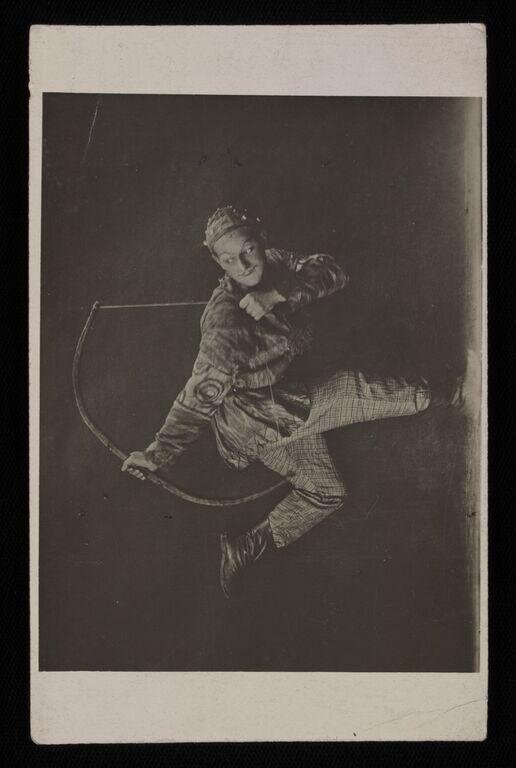
A solo male dancer leaps diagonally across a dark stage, captured mid-air in a moment of explosive energy. His body twists dynamically, legs splayed in a wide split-leap, torso angled forward, one arm extended while the other is drawn back. He wears patterned trousers (appearing to be checkered or geometrically printed) and a richly decorated tunic or coat with ornamental embroidery, suggesting Central Asian or Russian folk costume. His head is crowned with a tall, elaborate headdress, possibly a papakha or similar traditional headpiece. The photograph is taken from a low angle, which amplifies the sense of height and power. The dark background throws the figure into sharp relief, emphasizing the balletic suspension of the jump and the precision of the pose.
The dancing
A single male dancer performs an expansive aerial leap with the body held in a classically trained frame—the torso controlled and upright despite the split extension, the head lifted and dignified. The legs are spread wide in a near-horizontal split, demonstrating extreme flexibility and control. The arm gesture is reaching and open, suggesting either a celebratory or narrative pose within the choreography. The photograph captures a moment of weightlessness that reveals a dancer trained in ballet technique adapting it to folk material.
The dance depicted
The Polovtsian Dances are a famous orchestral interlude from Borodin's opera *Prince Igor* (1890), depicting the wild revelry of the Polovtsian (Cumanian) warriors. The dance is traditionally performed by male warriors in a style that blends Russian imperial ballet training with the warrior vocabulary of Central Asian folk movement—explosive jumps, aggressive floor patterns, and displays of masculine athletic prowess. This photograph documents a male soloist performing one of the signature high jumps that define the Polovtsian male vocabulary: a moment of pure elevation that showcases training, power, and the exotic militarism the Edwardian and early-twentieth-century European audiences expected from this orientalist work.
How it was made
This is a photograph, most likely a gelatin silver print or similar early photographic process from around 1925. The high contrast, the grain, and the sharp definition of edges are consistent with theatrical photography of the 1920s era. The dark background and dramatic single-figure composition suggest this may be either a studio portrait or a frame captured during a live performance and subsequently printed. Early theatrical photography often required significant lighting and exposure control, which explains the clean separation of the dancer from the black ground and the crisp detail of the ornamental costume.
About this work
This is a performance photograph of a male dancer executing a signature leap from the Polovtsian Dances, a cornerstone of the Russian Imperial Ballet repertory that entered European dance through Diaghilev's Ballets Russes in the early twentieth century. The work belongs to the genealogy of early modern theatrical photography as a document of dance performance before film became the primary medium. The photograph captures a precise moment in a specific choreographic tradition—one that fused classical ballet technique with orientalist fantasy and warrior aesthetics. It stands as evidence of how early-twentieth-century ballet dancers trained classically while performing culturally coded roles within a narrative framework.
How to look at it
Notice the moment the photographer chose: not the takeoff or the landing, but the precise apex of the leap, where the body seems to defy gravity. Observe how the dancer's training is visible in the control of the torso and the elegant line of the extended arm even as the legs perform a maximally wide split. The ornamental costume—the headdress, the embroidered tunic, the patterned trousers—reads as 'oriental' or 'exotic' in the visual language of 1920s European taste, yet the body's execution is unquestionably that of a ballet-trained performer. This tension between classical technique and orientalist fantasy is the central content of the work.
The artist
Pierre Choumoff was a Russian-American photographer active in the early twentieth century, known for theatrical and portrait photography. He worked during the era when Diaghilev's Ballets Russes were reshaping European perceptions of dance, and his practice focused on capturing theatrical performance and dance figures. Choumoff's photographs are part of the documentary record of early-twentieth-century dance as it was experienced in performance.
The period
The 1920s saw the full flowering of the Ballets Russes' influence on European culture. The Polovtsian Dances, choreographed by Mikhail Fokine in 1909 for the Ballets Russes premiere of *Prince Igor*, had become one of the most famous and frequently performed sequences in the ballet canon. By 1925, when this photograph was taken, the work was being performed by companies throughout Europe and North America. The aesthetic of the photograph—the emphasis on the male body in flight, the exotic costume, the dramatic lighting—reflects the values of theatrical modernism and the particular cultural fascination with Russian ballet as a marker of cosmopolitan sophistication.
Where it lives
The photograph is held in the Virginia Commonwealth University collection (source: va). It is catalogued under the title *Polovtsian Dances* and attributed to Pierre Choumoff, dated 1925. The work appears to be a theatrical photograph, likely either commissioned as a promotional or archival image or captured during a performance.
Dance in this work
Questions about this work
What are the Polovtsian Dances?
They are a famous orchestral sequence from Borodin's opera *Prince Igor*, choreographed by Mikhail Fokine in 1909 for the Ballets Russes. The dances depict the wild celebration of Polovtsian warriors and became one of the most iconic moments in early-twentieth-century ballet, celebrated for its spectacular male jumps and its exoticist staging of Central Asian 'otherness' for European audiences.
Why is this photograph historically significant?
It documents the moment when Russian imperial ballet technique was being exported to the West and when male ballet dancers were increasingly expected to perform feats of extreme athleticism and elevation. The photograph also preserves a specific moment in the history of orientalism in dance—when European and American audiences were fascinated by the representation of 'exotic' warrior cultures performed by classically trained dancers.
What does the costume tell us?
The ornamental tunic, the patterned trousers, and the tall headdress are designed to code the dancer's body as 'Polovtsian' or generically Central Asian/Russian folk in the visual vocabulary of early-twentieth-century European theatre. The costume is a fantasy rather than a historically accurate reconstruction, but it was central to the work's appeal and to the audience's experience of exoticism.
More dance artwork





