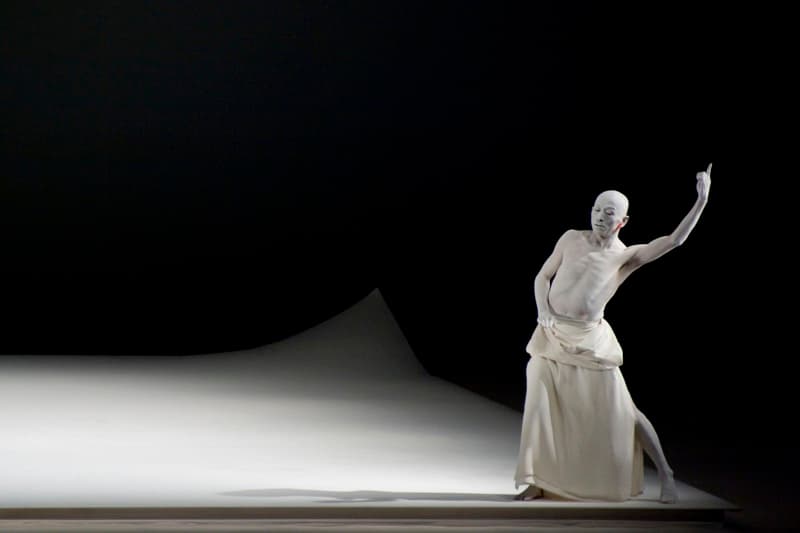
Ushio Amagatsu
Legend of Dance
Why They Matter
Amagatsu made Sankai Juku one of the most durable international institutions to emerge from butoh. His contribution was not simply to export a Japanese genre; it was to develop a precise ensemble language and production ecology in which bodies, stage matter, light, sound, and time carry equal dramat
Watch
Sankai Juku Official Kagemi Scene 5
Sankai Juku / ODORE
Direct company evidence of Amagatsu's stage language
Sankai Juku Official Meguri Digest
Sankai Juku / ODORE
Shows a mature work and its fossil-like visual world
Sankai Juku Official Utsushi
Sankai Juku / ODORE
Documents Amagatsu's reworking of earlier repertory
Meguri — ImPulsTanz
ImPulsTanz
Institutional presenter context for international touring
Cal Performances: Sankai Juku Meguri
Cal Performances
Connects work analysis to an institutional presenter
Sankai Juku Workshop Behind the Scenes
University Musical Society
Offers evidence of company pedagogy beyond performance
Biography
Born in Yokosuka in 1949, Ushio Amagatsu studied theater as well as classical and modern dance before entering Japan's emerging butoh world. In the early 1970s, he worked with Akaji Maro's Dairakudakan, part of the generation following butoh's founders Tatsumi Hijikata and Kazuo Ohno. Amagatsu respected those pioneers but explicitly described the need to confront his own experience and make "his own butoh."
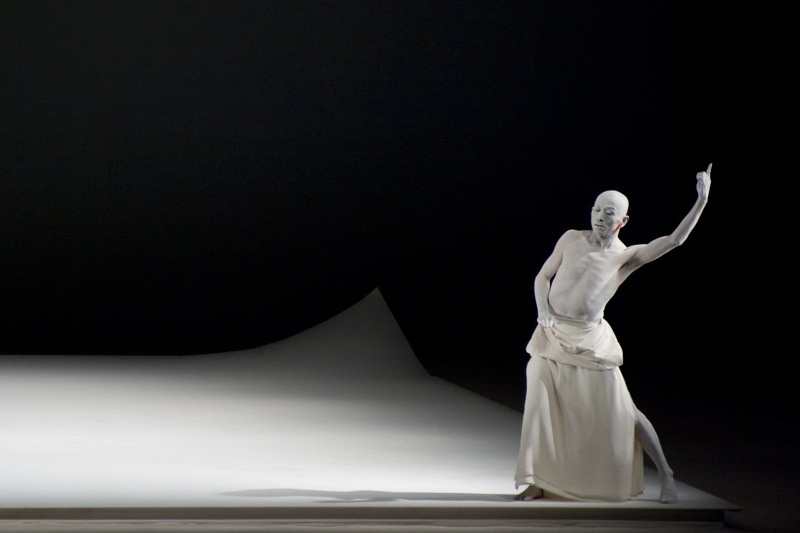
In 1975 he founded Sankai Juku. Early works including *Amagatsu Sho*, *Kinkan Shonen*, and *Sholiba* established an all-male ensemble whose shaved heads, white-powdered bodies, extreme temporal control, and transformed stage environments differed from both Western concert dance and the public image often attached to early butoh. Sankai Juku's first overseas tour reached France in 1980, and Paris became central to Amagatsu's production ecology: from the early 1980s, Théâtre de la Ville regularly co-produced and premiered his works, allowing the company to create at scale while remaining aesthetically coherent.
Amagatsu's theater repeatedly placed human figures against elemental or geological imagery. Water, sand, ash, suspended objects, lotus forms, fossil-like reliefs, and sharply controlled light made the stage feel less like a location than a changing cosmology. His choreography often treats stillness, falling, recoil, and measured walking as negotiations with gravity itself.
His practice extended beyond Sankai Juku. He created independent commissions, worked with artists including Ismael Ivo and composer Philip Glass, and directed opera, including Péter Eötvös's *Three Sisters*. Sankai Juku's *Hibiki* received the 2002 Laurence Olivier Award for Best New Dance Production, confirming the company's international influence.
After serious illness in the late 2010s, Amagatsu continued choreographing even when he no longer performed with the ensemble. *Arc* premiered in 2019, and *Totem* followed in 2023. He died on March 25, 2024, in Yugawara, Kanagawa Prefecture. Sankai Juku continues as both a repertory institution and a living company shaped by his philosophy.
Career Highlights
Joined the founding generation of Dairakudakan led by Akaji Maro.
Founded Sankai Juku after leaving Dairakudakan.
Presented Amagatsu Sho with the early four-man company.
Created Kinkan Shonen (The Kumquat Seed).
Led Sankai Juku’s first overseas performances in France.
Created Bakki for the Festival d’Avignon.
Created Fushi with music by Philip Glass.
Was named a Chevalier of France’s Ordre des Arts et des Lettres.
Directed the world premiere of Péter Eötvös’s opera Three Sisters in Lyon.
Hibiki won the Laurence Olivier Award for Best New Dance Production.
Created Arc, the first Sankai Juku work in which illness kept him from performing onstage.
Created Totem, his final work.
Legacy & Impact
Amagatsu made Sankai Juku one of the most durable international institutions to emerge from butoh. His contribution was not simply to export a Japanese genre; it was to develop a precise ensemble language and production ecology in which bodies, stage matter, light, sound, and time carry equal dramaturgical weight. His work broadened global understanding of butoh while remaining distinct from its founders and from later practitioners, establishing a model of artistic coherence that continues to influence dancers and companies worldwide.


Explore More Legends
Discover the dancers, teachers, choreographers, and cultural icons who shaped how the world moves.
Keep the thread going
Dance history, technique, and the occasional rabbit hole — in your inbox. Thoughtful, infrequent, unsubscribe anytime.
Free. No spam. One click to leave.